Could a 70-year-old walk out of a clinic with the body of a 35-year-old?
Harvard Medical School geneticist David Sinclair got exactly that question during a recent onstage interview in India.
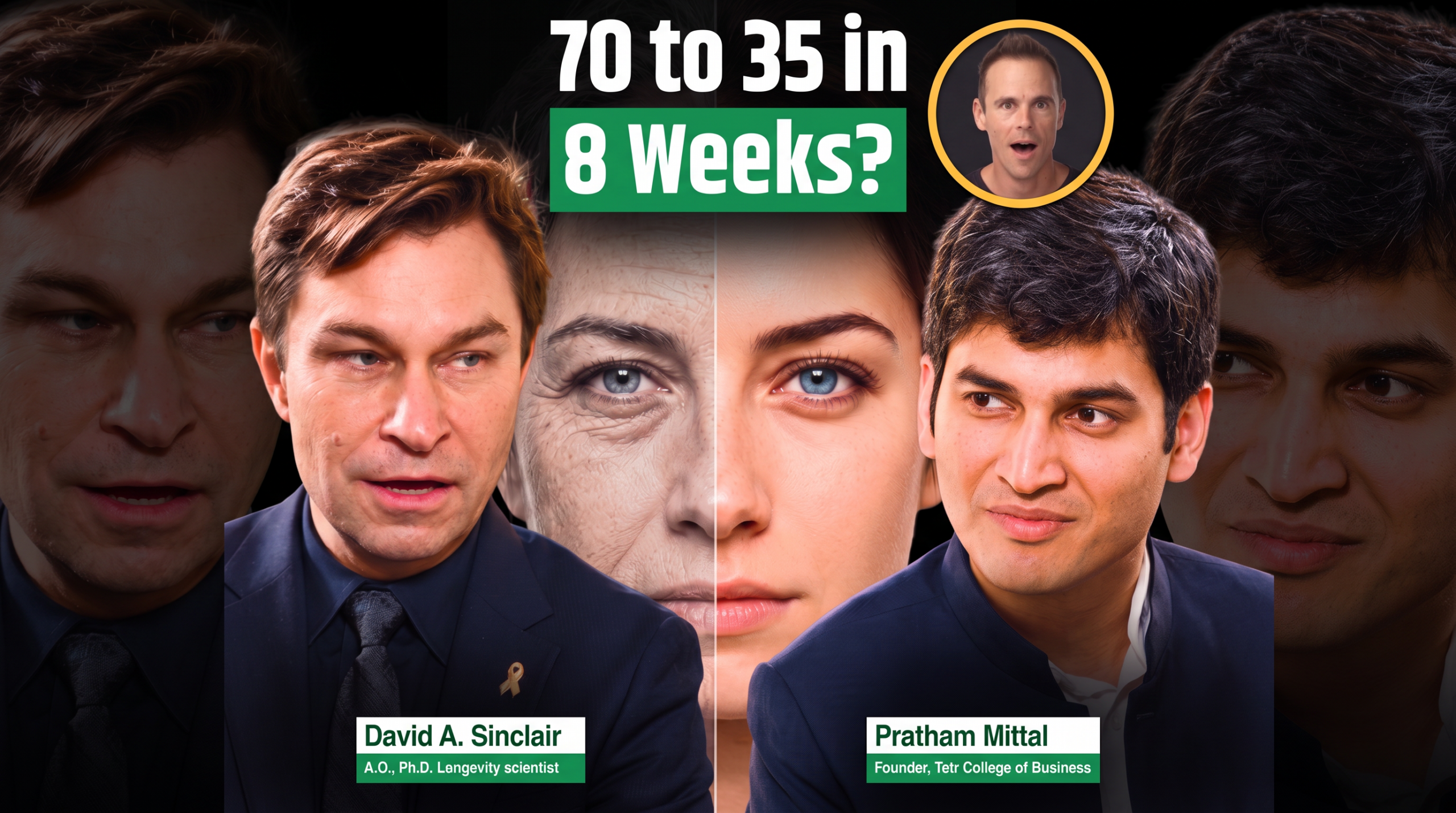
His answer began with mice, and the details are stranger than most people expect.
Human trials are already running, and the first patient has been dosed.
Here is what Sinclair says is coming, where the hype needs a reality check, and which habits he follows today.
Jump to:
So, Does a 70-Year-Old Become 35?
Not yet, and not in humans. Sinclair’s clearest evidence comes from rodents.

If you want something simple that actually works, this is one of the most effective tools I’ve used to build strength, conditioning, and endurance without needing a full gym setup.
- Full-body training with one weight using swings, squats, and presses
- Solid cast iron build that feels stable and lasts for years
- Comfortable grip that makes high-rep workouts easier to handle
His lab can age mice to the equivalent of 90 or 100 years within months. Then the animals receive a cocktail, delivered as a simple drink rather than a virus.
Within 4 weeks, they are alive, happy, running around. I’ve seen the videos.
Measurements reportedly show the animals are biologically younger, not merely perkier.
It’s not covering up the consequences, the symptoms of aging. It’s actually reversing aging, and then the body gets rid of the symptoms.
Sinclair stops short of promising immortality for people.
I don’t think we’re ready to live forever. That part is for futurists. But I live in reality.
Mouse results do not always carry over to people. The 70-to-35 question stays open.
Human Trials Start With the Eye
Sinclair describes a therapy called ER100, now being tested in people with glaucoma and NAION, a kind of stroke in the eye.
- Delivery: a one-second injection into the eye, which Sinclair says patients do not feel
- On-switch: six weeks of doxycycline pills, the drug that activates the engineered genes
- Vehicle: a virus-like particle called AAV, built to reach nerve cells at the back of the eye
What we’re doing now is a phase one study, which is to look at safety and tolerability.
Each patient serves as their own control, with vision tracked for five years. No human results were shared in the conversation.
If you want something simple that actually works, this is one of the most effective tools I’ve used to build strength, conditioning, and endurance without needing a full gym setup.
- Full-body training with one weight using swings, squats, and presses
- Solid cast iron build that feels stable and lasts for years
- Comfortable grip that makes high-rep workouts easier to handle
You can congratulate me if the trials are successful.
Sinclair says the approach cured blindness in monkeys. Monkey eyes resemble human eyes, so he calls any human failure “probably just an engineering problem” involving dose or delivery.
The Scratched CD Theory of Aging
Sinclair’s core idea, the information theory of aging, treats DNA like music on a compact disc.
The information to be young is still there, but the cell doesn’t read it correctly.
Therapy uses three of the four Yamanaka factors, leaving out the one tied to cancer. Cells rewind only about 50%, sometimes 75%, never all the way back.
Sinclair says animals treated for over a year showed no cancer. He also admits big gaps remain.
We still don’t understand actually where the backup copy is in the cell.
Critics, including longevity researcher Matt Kaeberlein, push back on “age reversal” language. Sinclair concedes the field has been overhyped and says he is often misquoted, so he now says reverse epigenetic aging.
What Could Come Next
- Liver: in animals, Sinclair claims better results against fatty liver disease than any drug now sold
- Joints: regrowing cartilage and bone, work he says a group in China has also shown
- Brain: mice looked healthier within weeks when treated by mouth
- Ear: tough to reach, a surprise setback
Imagine a soccer player being able to play for another 10 years.
A pill is in animal testing, in mice and pigs, with no negative effects so far. Gene therapy now costs hundreds of thousands of dollars, so Sinclair’s team is aiming for a few thousand, then a few hundred.
If you want something simple that actually works, this is one of the most effective tools I’ve used to build strength, conditioning, and endurance without needing a full gym setup.
- Full-body training with one weight using swings, squats, and presses
- Solid cast iron build that feels stable and lasts for years
- Comfortable grip that makes high-rep workouts easier to handle
The Risks Sinclair Admits
Asked whether a 90-year-old has nothing to lose by trying the cocktail, Sinclair was blunt.
Well, there is a downside. You could die.
He says some people offshore are already experimenting.
I do know of people who are not waiting for us to publish the final cocktail.
His advice: a healthy 90-year-old should keep being a healthy 90-year-old until safety is shown.
What to Do While the Science Catches Up
Move, Even Briefly
Exercise is the obvious answer to everything.
His floor: 10 minutes, three times a week. Can’t run? Row, play pickleball, just move.
Rethink Meals
Sinclair skips breakfast, eats one main meal and avoids snacking. He calls breakfast hype “Kellogg’s marketing.”
He leans mostly plant-based for polyphenols and lower branched-chain amino acids, and has cut dairy and nearly all alcohol. He also warns against growth hormone peptides and BCAA drinks, which he says may build muscle at longevity’s expense.
If you want something simple that actually works, this is one of the most effective tools I’ve used to build strength, conditioning, and endurance without needing a full gym setup.
- Full-body training with one weight using swings, squats, and presses
- Solid cast iron build that feels stable and lasts for years
- Comfortable grip that makes high-rep workouts easier to handle
His Supplement Stack
- Resveratrol: about a teaspoon daily, mixed into yogurt or olive oil because it dissolves poorly
- Metformin: 1 gram, sometimes swapped for berberine; mice lived roughly 8 to 9% longer
- NMN: 1 gram daily, though he warns some products contain none or are contaminated, so ask for lab analytics
Sinclair says his views are not Harvard’s and that he is not anyone’s physician. He calls his father’s results “end of one, not a clinical trial,” so check with a doctor before copying any of it.
One more takeaway: he cites a reanalysis of Danish twin data suggesting genes account for about half of lifespan, not 20%. His verdict: DNA is not destiny.