A 14-year-old boy lay dying in 1922, weighing just 65 pounds as his organs began shutting down.
Doctors told his family to say their final goodbyes.
Then researchers injected him with something extracted from an animal pancreas in a Toronto laboratory, and within weeks, his blood sugar normalized and his body started repairing itself.
That life-saving molecule was insulin—a peptide that proved these tiny chains of amino acids could pull someone back from death’s door.
In a recent detailed breakdown, Dr. Will Haas, a physician specializing in peptide therapy for 15 years, explained how thousands of peptides are now sold online with promises to rebuild bodies at the cellular level—but some are unregulated research chemicals that could quietly damage vital organs.
Understanding which peptides actually work for your specific biology could mean the difference between transformation and harm.
Jump to:
- What Peptides Actually Are (And What They’re Not)
- The Critical Mistake Everyone Makes
- Level One: The Cellular Foundation Where Aging Actually Begins
- Level Two: The Tissue Layer Where Injuries Get Stuck
- Level Three: System-Wide Signaling (Where Big Results and Big Mistakes Happen)
- The Trap That Wastes Money and Damages Health
What Peptides Actually Are (And What They’re Not)
Peptides aren’t exotic new drugs or mystical supplements. They’re short chains of amino acids—the same building blocks that form proteins throughout the body.
But here’s what most people miss: peptides aren’t structural materials sitting passively in tissues. They’re messengers carrying instructions from one part of the body to another.
Insulin doesn’t force glucose into cells—it knocks on cellular doors and tells them to open up. Oxytocin, another peptide, tells the brain who to trust and bond with.
These are not exotic new drugs. These are signals your body has been sending your whole life.
Scientists have learned to create synthetic versions that either copy signals the body already produces or send messages the body already knows how to interpret.
GLP-1, for example, is a natural signal released by the gut after eating. When someone injects semaglutide, they’re mimicking that GLP-1 message—and the body already knows exactly what to do with it.
The Critical Mistake Everyone Makes
Just because the body recognizes a signal doesn’t mean that signal is right for every person’s problem.
Dr. Haas explains that every peptide sends its message to one specific level of biology. Pick the wrong level, and even the most powerful, popular peptide becomes completely useless—or worse, harmful.
He breaks down peptide function into three distinct levels, like floors in a building. Understanding these levels changes everything about how to approach peptide therapy.
Level One: The Cellular Foundation Where Aging Actually Begins
The first level is where energy is actually manufactured. Every organ, tissue, and cell needs energy to function—hearts need it to pump, brains need it to think, cells need it to repair damage.
That energy comes from mitochondria, tiny structures inside cells that act as power plants, converting food into ATP—the fuel cells run on.
When young, these power plants run efficiently. With age, stress, toxins, and time damage them. When mitochondria slow down, everything they power slows down too.
Mitochondria have their own DNA, completely separate from the rest of cellular DNA. That’s how distinct and critical they are.
Three Peptides That Work at the Foundation
Epitalon is based on a natural compound made by the pineal gland. It activates telomerase, the enzyme protecting chromosome caps that shorten with each cell division. Animal studies show it can activate telomerase and extend lifespan, making it one of the most researched longevity peptides available.
MOTS-c breaks conventional rules—it’s written directly into mitochondrial DNA itself. Every other peptide is made outside cells and sent in, but MOTS-c has a unique relationship with energy machinery. Animal studies show it improves insulin sensitivity and produces exercise-like effects without actual exercise.
SS-31 targets the exact membrane inside mitochondria where energy production occurs. As this membrane ages and leaks, energy production drops. SS-31 protects it and is currently in human clinical trials for heart failure and mitochondrial diseases.
This is the foundation. It’s for people focused on long-term aging, deep energy, and longevity. It won’t give you the fastest visible results.
Level Two: The Tissue Layer Where Injuries Get Stuck
Why does a paper cut heal in three days while a torn tendon hurts for three years? Same body, wildly different outcomes.
The answer is blood supply. Tendons and ligaments receive minimal blood flow, so they heal painfully slowly—sometimes never fully recovering on their own.
Level two addresses organized tissue structures: tendons, ligaments, gut lining, skin, and nerve tissue. This level tackles problems the body hasn’t been able to fix independently.
Three Peptides With the Strongest Tissue Repair Evidence
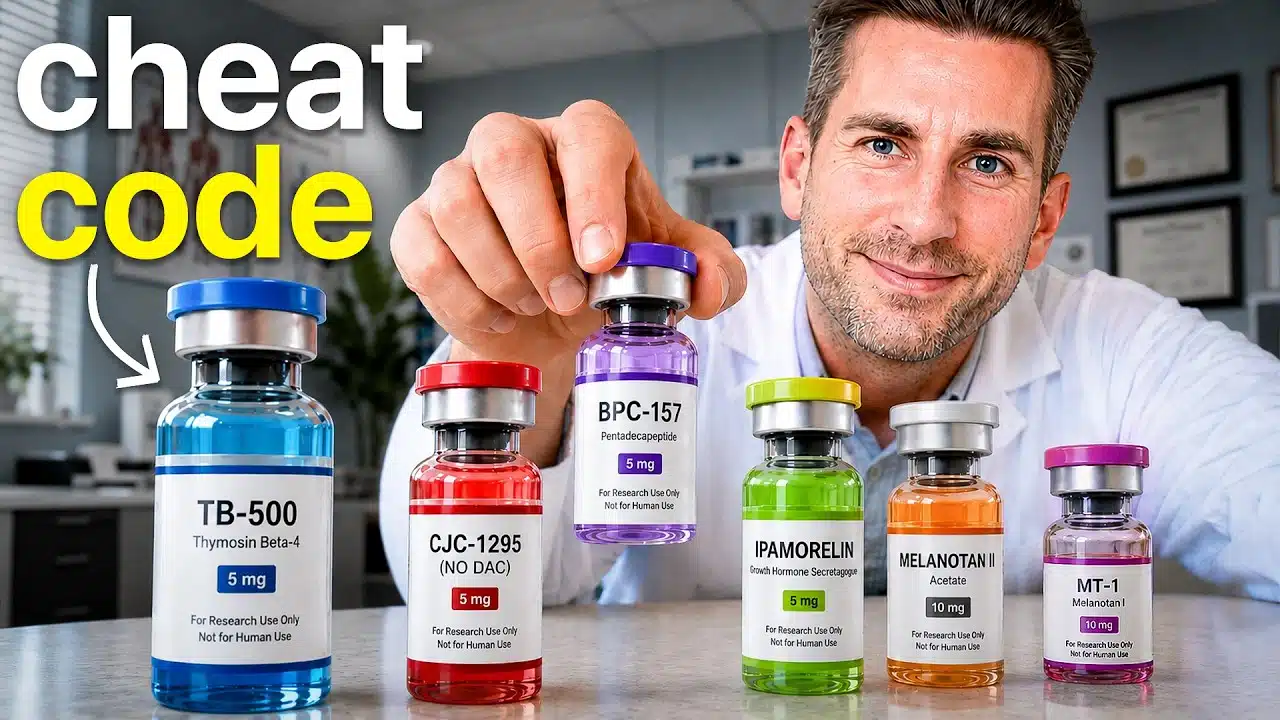
BPC-157 was originally identified from a protein in human stomach acid. Its data is among the strongest in peptide literature, especially for gut lining repair, tendon and ligament healing, and nerve tissue recovery. It doesn’t just calm inflammation—it actively helps rebuild damaged structure.
TB-500 (thymosin beta-4 fragment) works through actin, a protein controlling how cells move and tissues rebuild after injury. When tissue is damaged, repair speed depends on how well cells can organize and reconstruct. TB-500 supports this directly, proving especially useful in muscle, cardiovascular tissue, and wound healing.
GHK-Copper changes the activity of genes involved in repair, antioxidant defense, and inflammation management. It bridges tissue repair and broader body-wide effects simultaneously, making it one of the most versatile peptides available.
These peptides work locally in spaces around cells—areas where tissue has been damaged or won’t recover independently.
Level Three: System-Wide Signaling (Where Big Results and Big Mistakes Happen)
When dysfunction runs through entire systems—hormones, metabolism, nervous system—tissue peptides aren’t enough. This top floor produces the biggest visible results and the most dangerous errors.
It splits into three systems, and understanding them requires knowing about a venomous lizard.
The Endocrine System: Growth Hormone Signaling
These peptides communicate with the pituitary gland to release more natural growth hormone in its normal rhythm—rather than flooding the body with synthetic hormones from outside sources.
Growth hormone shapes body composition, sleep quality, recovery speed, metabolism, and aging rate more than almost any other hormone. It declines steadily with age.
- Sermorelin: One of the first developed, well-studied for aging and recovery, nudges pituitary to release growth hormone naturally
- Ipamorelin: More selective, triggers growth hormone without spiking cortisol—one of the cleaner options
- CJC-1295: Often stacked with Ipamorelin to extend release window for longer effects
- Tesamorelin: The only FDA-approved growth hormone releasing peptide, specifically for reducing visceral fat in certain patients
The Metabolic System: From Gila Monster Venom to Weight Loss Revolution
The very first GLP-1 medication came from Gila monster venom—a venomous desert lizard. That discovery created this entire category.
These peptides activate receptors controlling metabolic signaling. The number of receptors determines how many metabolic conversations happen simultaneously.
Semaglutide activates one receptor (GLP-1), produces around 15% body weight reduction, and carries the strongest cardiovascular safety data in its class.
Tirzepatide activates two receptors (GLP-1 and GIP). In head-to-head trials against semaglutide, it produced 22.5% body weight loss with better muscle preservation. Two receptors mean two simultaneous metabolic conversations.
Retatrutide activates three receptors (GLP-1, GIP, and glucagon). Phase two trials showed about 24% body weight reduction over 48 weeks. Adding glucagon increases fat burning—the body isn’t just eating less, it’s burning more. Not yet FDA-approved, but it shows where this category is headed.
The Nervous System: The Real Frontier
Most psychiatric drugs push neurotransmitters around—more serotonin, calmer pathways. But they don’t address nervous system health itself.
These peptides work on neurotrophic pathways—signals deciding whether the nervous system stays healthy, forms new connections, and keeps functioning over time.
The most important signal is BDNF (brain-derived neurotrophic factor). When BDNF is low, thinking gets foggy, mood drops, and the brain ages faster. When high, the brain keeps adapting, learning, and repairing.
- Semax: Derived from natural hormone fragment, raises BDNF, shows effects on focus, processing speed, and stress resilience—used clinically in Russia for stroke recovery for decades
- Selank: Works on anxiety-stress response through GABA system (same target as anti-anxiety drugs) but without dependence or sedation
- Dihexa: One of the most potent neurotrophic peptides studied, research suggests it’s far more effective than BDNF itself at building new neural connections (synaptogenesis)—being studied for Alzheimer’s and cognitive decline
- Cerebrolysin: Neuropeptide complex with long history in Europe and Asia for stroke, brain injury, and neurodegenerative disease—carries several neurotrophic factors supporting neuronal survival and repair
The Trap That Wastes Money and Damages Health
Everyone hears about level three—the weight loss, brain peptides, visible results. So they jump straight to the top floor and start injecting without examining the floors underneath.
If the foundation is cracked, renovating the penthouse first accomplishes nothing. Money gets spent, results don’t appear, and people blame the peptide.
Dr. Haas sees this constantly: a 42-year-old appears to be a textbook weight loss candidate with low energy and stalled metabolism. The obvious fix looks like a level three peptide, but blood work tells a different story.
The real problem is two floors down, the cellular level. And until that foundation is handled, nothing upstairs performs the way it should.
The floor getting the most attention isn’t always the floor the body needs first. The only way to know which level to start with is examining actual biology—not guessing based on desired results.
Before prescribing any peptide, comprehensive assessment should include full blood work, complete hormonal evaluation, and inflammatory markers. These numbers reveal which biological level is under the most stress—and it looks different in every person.
The goal isn’t putting someone on the most advanced compound. It’s finding the right floor for their specific biology, then watching data and adjusting as the body changes.
Peptides carry extraordinary potential—insulin proved that a century ago when it pulled a dying teenager back to life. But that same power requires precision, not popularity, to guide which peptide enters which body at which time.