Seventy-five percent of growth hormone vanishes by age 55.
Most adults spend their nights in what researchers call “slow decay mode”—losing muscle, storing fat, skipping repairs that used to happen automatically.
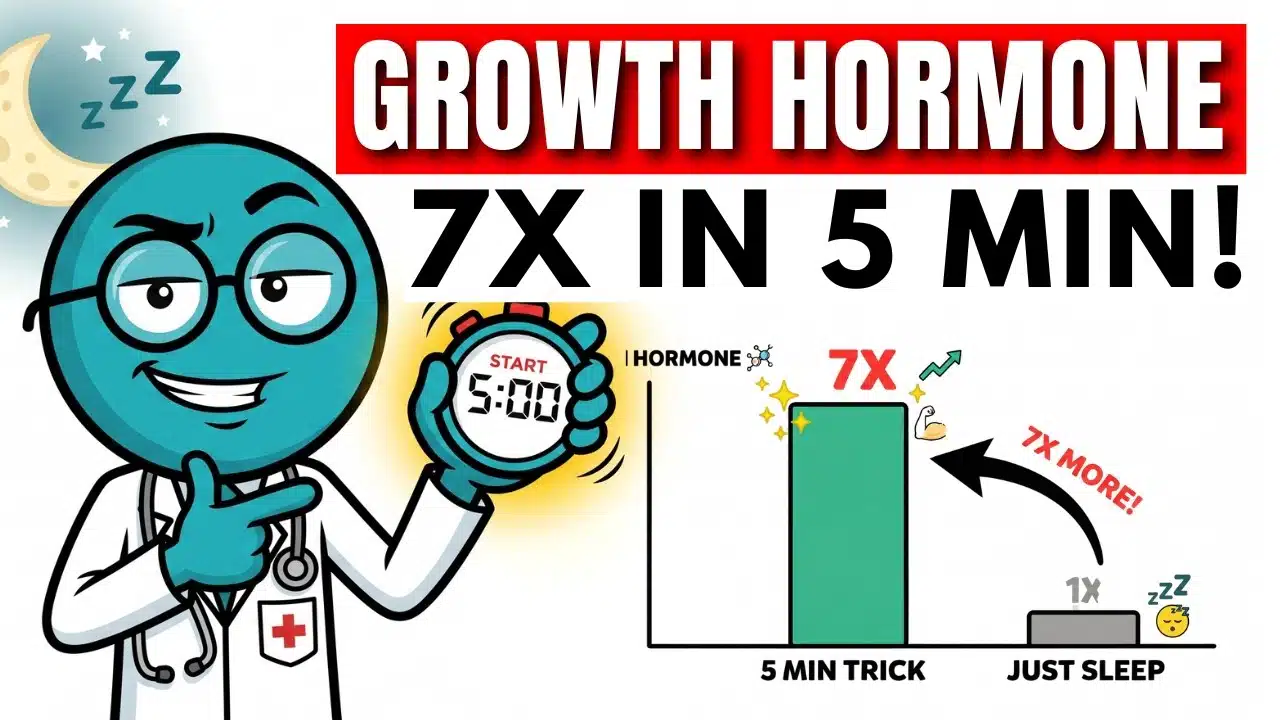
A 2019 clinical trial found that a specific five-minute bedtime sequence increased overnight growth hormone production by 700% in adults over 50.
The protocol costs nothing, requires no equipment, and works in pajamas.
Jump to:
- What Growth Hormone Actually Does (And Why You Need It)
- The First 90 Minutes Control Everything
- The Five-Minute Protocol That Changes Everything
- Why Nobody Told You About This
- Cortisol Is the Lid on Your Growth Hormone
- What Happened When Someone Actually Tried This
- Stacking With Intermittent Fasting Multiplies Results
- Four Mistakes That Kill Results
- What to Track and When Changes Appear
- The Protocol Must Run Five Nights Minimum Per Week
- The Vagus Nerve Gets Weaker With Age
- Why This Works When Sleep Alone Doesn’t
- The Uncomfortable Truth About Your Remaining Nights
What Growth Hormone Actually Does (And Why You Need It)
Growth hormone is the master overnight repair hormone that tells fat cells to release stored energy and muscle cells to preserve lean tissue.
It runs most cellular maintenance that keeps organs functioning properly. Released in pulses during the deepest stage of sleep—slow-wave sleep—this hormone determines whether your body spends the night in repair mode or decay mode.

If you want something simple that actually works, this is one of the most effective tools I’ve used to build strength, conditioning, and endurance without needing a full gym setup.
- Full-body training with one weight using swings, squats, and presses
- Solid cast iron build that feels stable and lasts for years
- Comfortable grip that makes high-rep workouts easier to handle
After 50, most adults spend dramatically less time in slow-wave sleep. That means dramatically less growth hormone.
The First 90 Minutes Control Everything
Research shows that the first 90 minutes of sleep produce roughly 60% of total nightly growth hormone.
Everything after that—all subsequent sleep cycles combined—produces less than half. If the first pulse arrives smaller or not at all, the rest of the night cannot compensate.
Most people over 50 spend the first 30 to 60 minutes of bedtime scrolling phones or replaying the day mentally. This delays slow-wave sleep onset and cripples that critical first hormonal pulse.
The Five-Minute Protocol That Changes Everything
The complete sequence takes five minutes, performed right before bed:
Component One: 90 Seconds of Slow Nasal Breathing
- Inhale through nose for 4 seconds
- Exhale through nose for 7 seconds
- Count silently without forcing
This 4-7 breathing ratio activates the vagus nerve faster than any other pattern tested in human research. Stanford studies have documented measurable nervous system shifts within 90 seconds.
If you want something simple that actually works, this is one of the most effective tools I’ve used to build strength, conditioning, and endurance without needing a full gym setup.
- Full-body training with one weight using swings, squats, and presses
- Solid cast iron build that feels stable and lasts for years
- Comfortable grip that makes high-rep workouts easier to handle
Component Two: 90 Seconds of Progressive Muscle Relaxation
Start at your feet. Tighten muscles for 2 seconds, then release for 4.
Move systematically upward: calves, thighs, hips, stomach, chest, shoulders, face. By the time you reach the top of your head, your sympathetic nervous system has dropped out of fight-or-flight mode.
Component Three: Two Minutes With Legs Up the Wall
Lie flat on your back with legs straight up against a wall, arms relaxed at your sides.
This position pulls blood out of your lower body, drops cortisol, and triggers the final parasympathetic shift that primes the first sleep cycle.
Why Nobody Told You About This
If a pharmaceutical company released a pill that boosted nighttime growth hormone by 700%, it would appear on every health podcast within a week.
The five-minute protocol does the same thing biologically. Almost no one over 50 has heard of it because effective interventions with no commercial owner rarely get promoted.
If you want something simple that actually works, this is one of the most effective tools I’ve used to build strength, conditioning, and endurance without needing a full gym setup.
- Full-body training with one weight using swings, squats, and presses
- Solid cast iron build that feels stable and lasts for years
- Comfortable grip that makes high-rep workouts easier to handle
Each component hits a different biological lever. Breathing activates the vagus nerve—your master switch between stress and repair modes. Muscle scanning drains sympathetic activation. Legs up the wall pulls cortisol out of the lower body where it accumulates throughout the day.
Cortisol Is the Lid on Your Growth Hormone
Cortisol and growth hormone are biological opposites.
When cortisol is elevated, growth hormone cannot fire—no matter how hard the pituitary tries. After 50, most adults have elevated evening cortisol from work stress, screen time, late caffeine, or daily demands.
The five-minute protocol isn’t generic relaxation. It’s opening the lid that’s been clamped down on your hormonal production for years.
What Happened When Someone Actually Tried This
One 54-year-old who implemented the protocol experienced dramatic changes within weeks.
After one month: lost one inch off waist, sleep tracker showed slow-wave durations not seen since 2018, morning energy returned to levels from a decade earlier.
If you want something simple that actually works, this is one of the most effective tools I’ve used to build strength, conditioning, and endurance without needing a full gym setup.
- Full-body training with one weight using swings, squats, and presses
- Solid cast iron build that feels stable and lasts for years
- Comfortable grip that makes high-rep workouts easier to handle
Then he stopped for a week to test whether changes would hold. Within three days, 3 a.m. wake-ups returned. After five days, morning bloat reappeared. Seven days in, waist measurements had increased by a quarter inch despite no other changes.
The body does not save your progress. The body responds to the last 48 hours of signals. Stop the signal, the response stops. There is no savings account.
Stacking With Intermittent Fasting Multiplies Results
Adults practicing intermittent fasting with 14-16 hour windows enter bedtime with elevated baseline growth hormone.
Research from Satchin Panda’s lab at the Salk Institute documents an additional 30-50% amplification when the bedtime protocol is added.
Optimal timing: finish dinner by 7 p.m., perform protocol at 9:30 p.m., asleep by 10 p.m., wake at 6 a.m., first meal at noon. That creates a 14-hour window where growth hormone runs uninterrupted with the first pulse maximized.
Four Mistakes That Kill Results
Mistake #1: Doing the Protocol Right After Dinner
Breathing doesn’t work on a full stomach because the diaphragm cannot move properly. Wait at least 90 minutes after eating.
Mistake #2: Keeping Bedroom Lights Bright
Bright light suppresses melatonin and shrinks slow-wave sleep regardless of how quickly you fall asleep. Use one soft lamp, no overhead lights, no phone screens.
If you want something simple that actually works, this is one of the most effective tools I’ve used to build strength, conditioning, and endurance without needing a full gym setup.
- Full-body training with one weight using swings, squats, and presses
- Solid cast iron build that feels stable and lasts for years
- Comfortable grip that makes high-rep workouts easier to handle
Mistake #3: Drinking Alcohol Within Four Hours of Bed
One drink within four hours of bed reduces growth hormone by 50-75% regardless of any protocol. The protocol still works, but you’re amplifying a fraction of what’s possible.
Mistake #4: Performing the Protocol on Your Bed
The bed is a sleep cue. Active components performed on the bed confuse the body about whether to wind down or stay alert. Do everything on the floor next to your bed.
What to Track and When Changes Appear
Measure waist circumference on day one, then every Sunday morning before eating. The waist tape is the only metric that doesn’t lie in the first three weeks.
Track morning resting heart rate daily—lower over time means it’s working. Rate subjective energy 1-10 each mid-morning; this number often moves within four or five days.
Expected timeline:
- Week 1: Deeper sleep, fewer middle-of-night wakeups, lower morning cortisol
- Week 2: First measurable waist drop (quarter to half inch)
- Week 3: Visible body composition changes, belt notches moving
- Week 4: Fasted morning glucose drops 5-15 mg/dL in most adults who track it
The Protocol Must Run Five Nights Minimum Per Week
Three nights isn’t enough. Skip more than two consecutive nights and the adaptation curve resets.
If you want something simple that actually works, this is one of the most effective tools I’ve used to build strength, conditioning, and endurance without needing a full gym setup.
- Full-body training with one weight using swings, squats, and presses
- Solid cast iron build that feels stable and lasts for years
- Comfortable grip that makes high-rep workouts easier to handle
This follows the same principle as any biological adaptation—the body invests only as long as demand continues. Consistency matters more than perfection.
The Vagus Nerve Gets Weaker With Age
The vagus nerve weakens with age the same way muscles do.
By 50, vagal tone has dropped significantly in most adults, partly from chronic stress and partly from sedentary living. Low vagal tone means your body stays in low-grade stress mode even when you’re asleep.
The 4-7 breathing pattern pulls the switch back down—not over weeks, but within 90 seconds. You’re not just relaxing; you’re exercising a nerve that’s been atrophying for two decades.
Why This Works When Sleep Alone Doesn’t
Mainstream advice says “get 7-9 hours and you’re fine.” That guidance was written for 30-year-olds with intact slow-wave sleep architecture.
After 50, sleep duration isn’t the variable—sleep depth is. You can lie in bed for nine hours and spend only 30 minutes in slow-wave sleep. The other eight and a half hours produce almost nothing.
If you want something simple that actually works, this is one of the most effective tools I’ve used to build strength, conditioning, and endurance without needing a full gym setup.
- Full-body training with one weight using swings, squats, and presses
- Solid cast iron build that feels stable and lasts for years
- Comfortable grip that makes high-rep workouts easier to handle
Sleep alone after 50 isn’t a passive solution. It’s a passive problem.
The Uncomfortable Truth About Your Remaining Nights
If you’re 54 today, you have roughly 11,000 nights left if you’re lucky.
You’ve already spent maybe 15,000 of them under-signaling the hormone that runs your body—15,000 nights of slow decay you cannot recover.
The next 11,000 are the only ones you have any control over. That choice sits on your nightstand right now and will be there again tomorrow night and the next.
Skip the protocol tonight and your body spends another eight hours in slow decay. Do the protocol tonight and the first pulse fires the way it used to in your forties.
The only question is how many more nights you give away before taking them back.
If you want something simple that actually works, this is one of the most effective tools I’ve used to build strength, conditioning, and endurance without needing a full gym setup.
- Full-body training with one weight using swings, squats, and presses
- Solid cast iron build that feels stable and lasts for years
- Comfortable grip that makes high-rep workouts easier to handle