A groundbreaking new study published in the Journal of Strength and Conditioning Research is challenging everything fitness enthusiasts thought they knew about building muscle.
Researchers from Ulster University and Manchester Metropolitan University discovered that moderate-intensity resistance training using partial range-of-motion at long muscle lengths produces the same muscle growth as traditional high-intensity, full range-of-motion training.
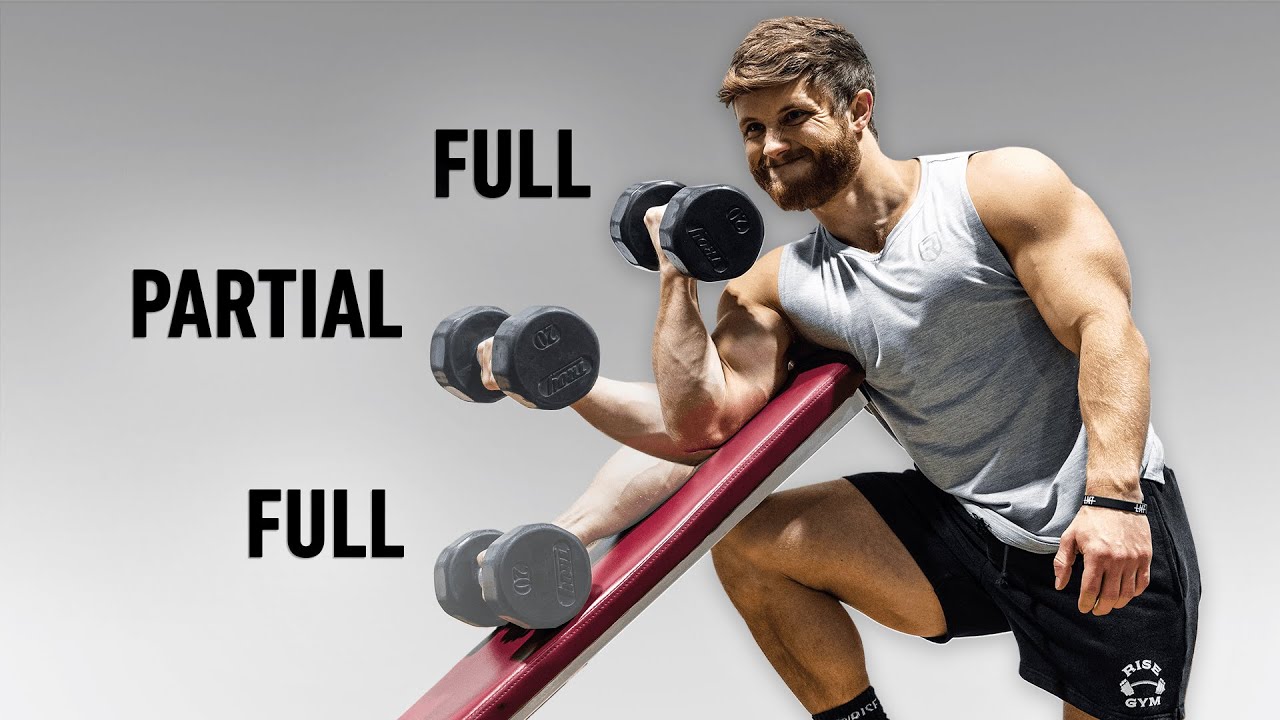
Even more surprising? The partial range approach at stretched positions actually created superior improvements in muscle architecture.
This could revolutionize how athletes, bodybuilders, and everyday gym-goers structure their training programs—especially those dealing with joint limitations or looking for safer alternatives to heavy loading.
Jump to:
The Study That’s Rewriting Training Rules
Lead researcher Gerard McMahon and his team recruited 45 participants and divided them into four distinct groups for an eight-week knee extension training protocol.
Each group followed a different approach:
- Shortened partial ROM (SP): Training from 0-50° knee flexion at 80% of one-rep max
- Lengthened partial ROM (LP): Training from 40-90° knee flexion at only 55% of one-rep max
- Full ROM (FROM): Training through complete 0-90° knee flexion at 80% of one-rep max
- Control group (CON): No resistance training
The researchers meticulously measured vastus lateralis muscle thickness, pennation angle, and fascicle length at three different locations along the thigh before and after the training period.
Muscle Growth: Partial Beats Shortened, Matches Full
The results were striking. Both the lengthened partial ROM and full ROM groups experienced significantly greater muscle thickness increases compared to the shortened partial ROM group at the lower portion of the thigh.
What’s remarkable is that the lengthened partial ROM group achieved these results using only 55% of their one-rep max—considerably lighter loads than the 80% used by the full ROM and shortened partial ROM groups.
At the mid-thigh region, full ROM training outperformed shortened partial ROM training. Meanwhile, lengthened partial ROM demonstrated superiority over shortened partial ROM at the upper thigh.
Perhaps most importantly: there were no significant differences in muscle thickness gains between lengthened partial ROM and full ROM training at any measurement location.
Fascicle Length: Where Lengthened Training Shines
Fascicle length—the length of individual muscle fiber bundles—is crucial for athletic performance and injury prevention. Longer fascicles can generate force through greater ranges of motion and may reduce injury risk.
Here’s where lengthened partial ROM training truly distinguished itself.
The lengthened partial ROM group experienced significantly greater fascicle length increases than the full ROM group at both the upper and lower portions of the thigh. They also outperformed the shortened partial ROM group at all three measurement sites.
Full ROM training still proved superior to shortened partial ROM training at the middle and lower thigh regions for fascicle length adaptations.
Interestingly, researchers discovered an inverse relationship between baseline fascicle length and the magnitude of change—those starting with shorter fascicles experienced greater lengthening adaptations across all training groups.
Why Training at Long Muscle Lengths Works
The mechanisms behind these findings relate to muscle mechanics and cellular signaling.
When muscles are trained at longer lengths—in stretched positions—they experience greater passive tension and mechanical stress. This unique stimulus appears to trigger specific adaptations that promote both muscle growth and structural changes like fascicle lengthening.
The process involves sarcomeregenesis—the addition of new sarcomeres (the basic contractile units of muscle) in series, which directly contributes to fascicle lengthening.
Traditional high-intensity training primarily creates adaptations through mechanical tension and metabolic stress. Lengthened partial ROM training appears to maximize the mechanical stretch component while requiring less absolute load.
Practical Applications for Your Training
This research offers several actionable strategies for optimizing resistance training programs.
For Maximum Muscle Growth
Incorporating exercises that emphasize the stretched position—even with partial range-of-motion—can produce comparable hypertrophy to traditional full ROM training while using lighter loads.
Think Romanian deadlifts stopping at mid-shin rather than the floor, or leg extensions focusing on the bottom half of the movement where quadriceps are lengthened.
For Injury Prevention and Rehabilitation
Athletes recovering from joint injuries or those with mobility limitations can maintain training stimulus without requiring full range-of-motion or maximal loads.
Training at long muscle lengths with moderate intensity provides a safer alternative that doesn’t sacrifice results.
For Athletic Performance
The superior fascicle length adaptations from lengthened training may enhance force production capabilities across greater joint angles and potentially reduce injury risk during high-speed movements.
Sports requiring explosive actions through large ranges of motion—sprinting, jumping, cutting—could particularly benefit from this approach.
Limitations and Future Directions
While groundbreaking, this study focused exclusively on knee extensor training. Different muscle groups may respond differently to varied range-of-motion strategies.
The eight-week duration, while sufficient to demonstrate meaningful adaptations, leaves questions about long-term outcomes. Would the differences between groups persist, expand, or diminish over months or years of training?
Additionally, the study didn’t measure functional outcomes like strength across different joint angles or athletic performance metrics.
Future research examining multiple muscle groups, longer training durations, and performance outcomes will help refine these recommendations further.
Rethinking Traditional Training Wisdom
For decades, fitness professionals have emphasized full range-of-motion and heavy loads as non-negotiable requirements for optimal muscle development.
This study challenges that dogma. Moderate-intensity resistance training using partial ROM at long muscle lengths produces equivalent hypertrophy and superior architectural adaptations compared to high-intensity full ROM training.
The implications extend beyond academic interest. This research provides evidence-based support for training methodologies that many lifters may have dismissed as suboptimal.
Whether you’re an athlete seeking performance advantages, someone managing joint issues, or simply looking to maximize training efficiency, prioritizing exercises that load muscles in lengthened positions—even through partial ranges—deserves serious consideration.
The key isn’t abandoning full range-of-motion training entirely, but rather understanding that strategic implementation of lengthened partial ROM work offers a legitimate, evidence-based alternative that may actually provide unique benefits traditional approaches cannot match.