Whether you’re an elite athlete, a weekend warrior, or somewhere in between, you’ve probably faced a stubborn muscle group that just refuses to grow.
Maybe it’s your glutes, maybe your calves, or possibly your hamstrings that lag behind the rest of your physique.
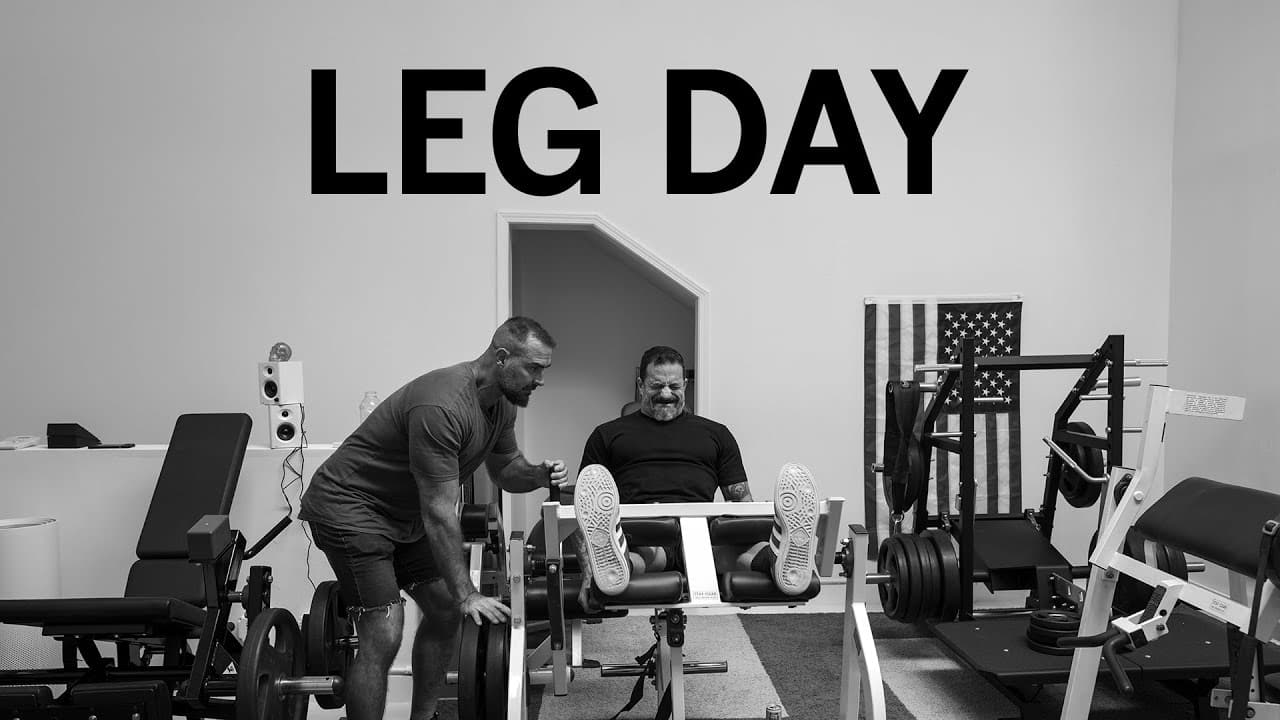
Fortunately, according to renowned strength coach and researcher Dr. Bret Contreras – widely known as “The Glute Guy” – there’s a science-backed way to correct these imbalances and strategically grow weak points.
In a recent hands-on session with neuroscientist Dr. Andrew Huberman, Contreras walked through a full lower-body session based on the principle of selective hypertrophy – or how to target specific muscles for size and strength adaptations.
If you’re interested in finally getting your glutes to grow, addressing muscle asymmetries, or just building a more balanced set of wheels, this workout framework gives you the tools and science to do it.
Jump to:
- What Is Selective Hypertrophy and Why It Matters
- Start at the Ankles: Tibialis Raises and Calf Work
- Hamstrings: Opt for the Stretch Bias
- Stiff-Leg Deadlifts for Hamstring Thickness
- Quadriceps: Balancing Vastus and Rectus Femoris Work
- Belt Squats: High Hypertrophy with Low Spinal Load
- Don’t Neglect the Adductors
- Glute Hypertrophy: Dual Targeting with Squats and Hip Thrusts
- Targeting the Forgotten Muscle: The Glute Medius
- Programming Advice for Weak Points
- Tying It All Together: Full Routine Summary
- Final Takeaway
What Is Selective Hypertrophy and Why It Matters
Selective hypertrophy focuses on developing specific muscles rather than just doing general leg or full-body training. This approach is especially helpful if certain muscles dominate others — like your quads taking over all your lower body work — or if you’re recovering from injury and need to rebuild lost tissue.
“Selective hypertrophy is the key for developing lagging body parts and achieving symmetry,” notes Contreras.
A perfect example: Huberman noted that years after breaking his foot, his left calf remains smaller and weaker, requiring more targeted work than the right side.
To address this, Contreras suggests doubling the training volume on weak muscles — for example, doing two sets on the weaker side for every one set on the stronger side.
Start at the Ankles: Tibialis Raises and Calf Work
Contreras emphasizes the importance of starting from the bottom — quite literally. Strengthening your tibialis anterior (the muscle in the front of your shin) helps prevent shin splints and improves ankle mobility and gait mechanics.
Tibialis Raise Tips:
- Use lighter weight to stimulate the area without overloading the joints.
- Perform 15–20 reps as a warm-up or accessory movement.
- Keep continuous tension throughout the set — no pausing at the bottom.
For calf growth, Contreras recommends not only standing calf raises but also seated variations and even stretch-based techniques.
The key? Train deep into the stretch, hold at the bottom for 5 seconds per rep, and use partials at the end of a full set to push closer to failure — especially in the lengthened position.
Hamstrings: Opt for the Stretch Bias
When it comes to hamstrings, recent research shows that lengthened overload is king. A study by Mao et al. suggests seated leg curls produce more hypertrophy than lying leg curls due to greater stretch at the hips.
Training Tips:
- Pull your hips into greater flexion to maximize stretch at the start of each rep.
- Keep your glutes in contact with the seat throughout the movement.
- Progressive overload is key — add reps week to week while maintaining form.
Stiff-Leg Deadlifts for Hamstring Thickness
The stiff-leg deadlift complements curls by adding a compound stretch to the hamstrings and glutes. Emphasize straight legs and a deep hip hinge to maximize tension.
If access to a barbell is limited, dumbbells offer a solid alternative and allow for natural range of motion.
Quadriceps: Balancing Vastus and Rectus Femoris Work
Compound lifts like squats and belt squats primarily hit the vastus muscles — the vastus medialis, lateralis, and intermedius.
But to effectively train the rectus femoris — the only quadriceps muscle that crosses the hip and knee — single-joint exercises like leg extensions are necessary.
Optimizing Leg Extensions:
- Lean back while performing to bias the rectus femoris.
- Use higher reps (10–20 range) to minimize joint stress.
- Try techniques like two-leg up, one-leg down eccentrics for added intensity.
Belt Squats: High Hypertrophy with Low Spinal Load
Belt squats mimic back squats without placing stress on the spine. This makes them ideal for people who want to increase quad size without compromising recovery capacity.
They also add what Contreras calls “penalty-free volume” — extra work that won’t beat up your joints.
To bias the quads, keep a narrow stance, remain upright, and drive the knees forward through each rep.
Don’t Neglect the Adductors
Most lifters forget about the adductors — the inner thigh muscles responsible for hip stability, groin health, and visual thickness.
Contreras urges athletes to intentionally train them since squats — especially variations like belt squats — do not sufficiently target this area.
If you don’t have a hip adduction machine, bodyweight Cossack squats and Copenhagen planks provide excellent alternatives and can be surprisingly intense.
“If someone hasn’t done adduction in a while, they’ll wake up incredibly sore the next day,” says Contreras.
Glute Hypertrophy: Dual Targeting with Squats and Hip Thrusts
The myth that squats are the best glute-builder has been challenged by recent studies. In fact, Plotkin 2023 found that squats and hip thrusts produce equal glute gains — but target them differently.
While squats also bring major quad and adductor development, hip thrusts are superior for boosting sprint performance and functional glute strength due to their horizontal loading profile.
Hip Thrust Guidelines:
- Begin with bodyweight to learn proper pelvic tilt and avoid hyperextension.
- Use a full lockout at the top without overly arching the lower back.
- Perform sets of 8–12 reps with controlled eccentric tempo and short rest.
Targeting the Forgotten Muscle: The Glute Medius
This side glute muscle contributes to hip stability, balance, and the visual “shelf” in the upper glutes — especially a focus for aesthetics in women and athleticism in both sexes.
Squats and thrusts don’t adequately train it.
Contreras recommends lateral movement exercises like band walks and Copenhagen hip shifts, focusing on shifting into a deep stretch and contracting outward to “pop” the glute medius.
Programming Advice for Weak Points
Trying to build everything at once leads to stagnation. Contreras recommends focusing on 1–2 target muscles per month while maintaining other lifts at lower volume.
For example:
- Month 1: Quads + Chest
- Month 2: Hamstrings + Back
- Month 3: Glutes + Adductors
“If something goes up, something else has to give,” Contreras explains. This rotation avoids overtraining while still making noticeable progress in lagging areas.
Tying It All Together: Full Routine Summary
Lower Body Weak Point Routine:
- Tibialis Raises – 2–3 sets of 15–20 reps
- Seated Calf Raises – 3 sets of 10–15 with a 5 sec stretch
- Seated Leg Curl – 3–4 sets of 10–15 (focus on stretch)
- Stiff-Leg Deadlift – 3 sets of 8–10
- Leg Extensions – 3 sets of 12–20 leaning back
- Belt Squat – 3 sets of 10–12 (vary stance each week)
- Bodyweight Adduction or Cossack Squats – 1–2 moderate sets
- Hip Thrusts – 3–4 sets of 8–12
- Glute Med Shift Walks – 2–3 sets of 10 reps per side
Final Takeaway
Building a strong, balanced lower body takes more than just squats and deadlifts. What separates great programming from average is the inclusion of key missing pieces: the tibialis, adductors, rectus femoris, and glute medius.
By applying selective hypertrophy principles and altering your monthly focus, you can finally unlock the growth in those nagging weak body parts — while dramatically improving symmetry, performance, and posture.
“It’s not just about lifting heavy,” says Contreras. “It’s about getting your muscles to work how they’re supposed to work.”