Popular physical therapist and fitness expert Jeff Cavaliere recently shared a crucial insight: there are seven primitive movement patterns essential for human function, and most people lose the ability to perform them as they age.
The reason? We simply stop doing activities that challenge these fundamental movements.
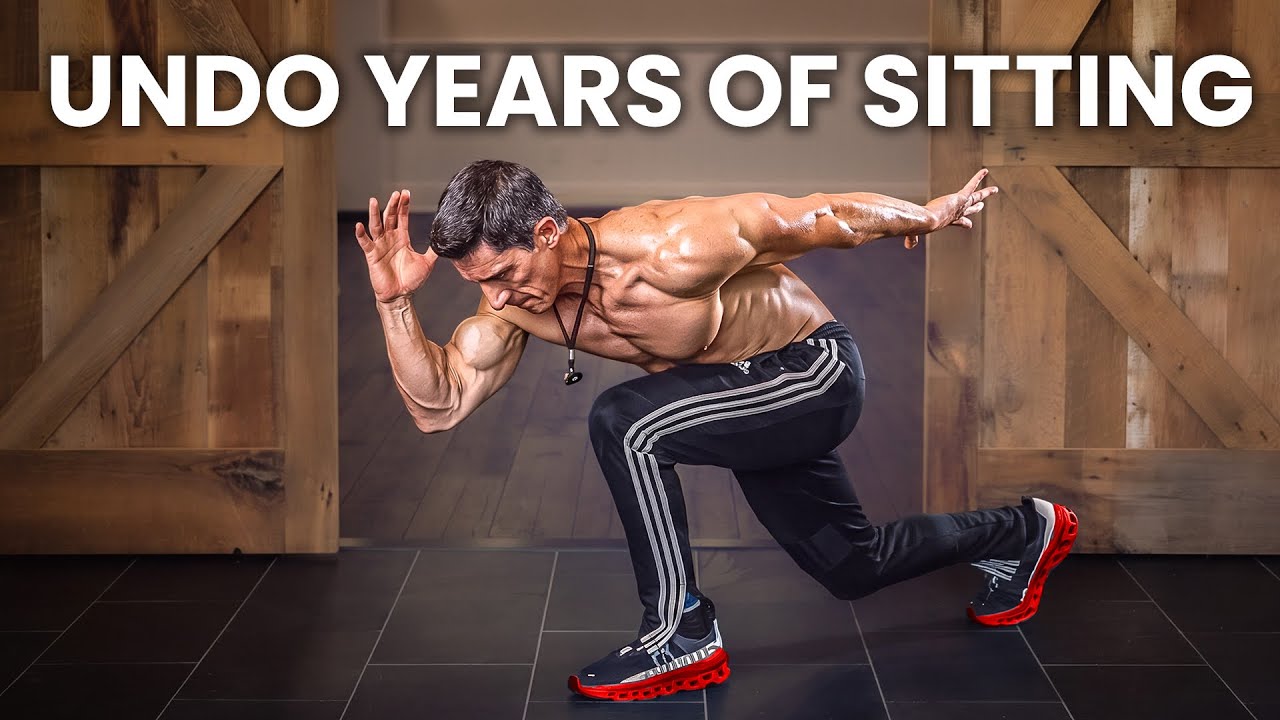
In a recent video, Cavaliere demonstrated seven floor-based exercises that train each movement pattern, requiring minimal space while delivering maximum functional benefit.
These movements aren’t just about fitness—they’re about maintaining independence and quality of life for decades to come.
Jump to:
- The Chimp Squat: Reclaiming Deep Squat Mobility
- Floor Sweep: Mastering The Hip Hinge
- The Relay: Reinforcing Natural Gait Mechanics
- Solar Twist: The Fall-Prevention Movement
- Sweeping Lunge: Ground-Based Lateral Mobility
- Tracker Push-Up: Integrated Pushing With Mobility
- Clark Tent: Pulling Strength Meets Rotator Cuff Function
- The Functional Fitness Blueprint
The Chimp Squat: Reclaiming Deep Squat Mobility
The first primitive pattern addresses squatting, which Cavaliere trains through the chimp squat. This movement combines sumo squat mechanics with dynamic weight shifting to restore hip and ankle mobility.
Starting with feet wider than shoulder-width, practitioners perform a deep sumo squat, then shift laterally while placing hands on the ground and leaning into the lead foot.
Cavaliere challenges a common fitness myth during this exercise.
A lot of people talk about not wanting the shin to go past the toe or in the direction of the toe. That’s actually incorrect. Biomechanically, in order to get a deep squat, you need to have the tibia move forward.
He emphasizes that ankle dorsiflexion—allowing the shin to travel forward—is essential for proper squat mechanics. When this mobility disappears, functional problems begin.
The prescription: five repetitions to each side, progressively working deeper into the position with each rep.
Floor Sweep: Mastering The Hip Hinge
Pattern number two focuses on hip hinging—arguably the most commonly lost movement pattern. Cavaliere’s floor sweep exercise forces proper hinging mechanics through strategic foot positioning.
Taking an extra-wide stance limits lower body mobility, which paradoxically forces correct movement at the hips. With narrow stance hinges, most people simply bend at the waist rather than hinging from the hip joint.
The movement involves sweeping hands along the floor as far as possible, then rising with arms reaching overhead while squeezing the glutes forcefully.
A critical technical point: maintaining spinal curvature throughout the movement.
When we get to the bottom, ideally you don’t want to be folding and allowing this to just sort of cave in. Instead, you want to be able to keep the little arch in your back so that the hinge is actually reinforced.
This positioning ensures hamstrings and adductors receive proper stretching while reinforcing safe movement patterns. Ten total repetitions complete the exercise.
The Relay: Reinforcing Natural Gait Mechanics
Walking requires coordinated contralateral movement—opposite arm and leg working together. The relay exercise trains this pattern while challenging hip stability and core control.
Starting with weight shifted to one side and hand positioned near the cheek, practitioners perform a controlled reverse lunge while driving the opposite arm upward.
The key differentiator? Extreme control and exaggerated range of motion.
Cavaliere instructs practitioners to reach arms out maximally to challenge core stability while maintaining proper knee tracking over the toe. Knee valgus—inward collapse—signals hip weakness that this exercise addresses.
The idea is, can you do this slow with stability? Get deep. Maintain good biomechanics. Feel the loading of the hip. If you can do all those things, you can maintain that function well into old age.
Five repetitions per side complete the pattern.
Solar Twist: The Fall-Prevention Movement
Torso rigidity and lost rotational ability contribute to more falls than perhaps any other mobility deficit. The solar twist specifically targets spinal rotation while dissociating upper and lower body movement.
The exercise involves pivoting off the back foot while sweeping one hand past the knee and reaching the opposite hand toward the floor behind the body. Arms then open overhead with maximal rotation before repeating.
This dynamic movement pattern challenges three-dimensional stability that static exercises cannot replicate. The constant rotation reinforces the neuromuscular patterns necessary for reactive balance—exactly what prevents falls during unexpected situations.
Ten repetitions build the rotational capacity that keeps people safe and functional.
Sweeping Lunge: Ground-Based Lateral Mobility
Lunging represents another essential pattern, addressed through Cavaliere’s sweeping lunge. This floor-based variation provides stability while challenging mobility.
Starting in a modified lunge position with hands on the ground, practitioners sweep the trailing leg across while following with the hand, transitioning into a deep lunge on the opposite side.
The hands-on-ground approach offers crucial benefits for those with limited mobility or balance concerns—it provides safety while still demanding significant hip flexion and adductor flexibility.
If they can only get from here to here, that’s fine. Again, having the hands in contact with the ground gives you the stability to be able to work on that and still have the safety built into the exercise.
This scalability makes the movement accessible regardless of current ability level.
Tracker Push-Up: Integrated Pushing With Mobility
Upper body pushing movements engage chest, shoulders, and triceps simultaneously—exactly how these muscles function in real-world activities. The tracker push-up variation adds lower body mobility while reinforcing proper push-up depth.
The movement involves lowering into a push-up until the cheek contacts the ground while simultaneously driving one knee forward. This bottom position provides a brief rest while reinforcing shoulder mobility.
From this grounded position, practitioners slide the knee back while pushing up to complete the repetition.
Those unable to perform standard push-ups simply drop to the knees—the pattern remains identical, maintaining the mobility requirements regardless of strength level.
Five repetitions to each side ensure balanced development.
Clark Tent: Pulling Strength Meets Rotator Cuff Function
Pulling movements balance pushing patterns while strengthening chronically weak upper back muscles. The Clark tent combines pulling mechanics with rotator cuff activation in a single floor-based movement.
Starting with elbows on the ground and hands crossed over the chest, practitioners lift the spine off the floor by “opening the shirt like Superman.” Only the tailbone and head remain in contact with the ground.
From this lifted position, hands rotate outward, engaging external shoulder rotation until palms contact the floor.
It should feel amazing. Literally feel amazing. At the same time, it should feel challenging because you’re challenging muscles that are often times very weak.
This dual sensation—relief combined with muscular challenge—indicates the exercise addresses commonly neglected movement patterns.
Ten repetitions restore coordinated pulling function that degrades without specific training.
The Functional Fitness Blueprint
These seven movements represent a complete functional maintenance program requiring only floor space. Together they address:
- Squatting: Chimp squat for deep hip and ankle mobility
- Hinging: Floor sweep for proper hip mechanics
- Gait: Relay for contralateral coordination
- Rotation: Solar twist for fall prevention
- Lunging: Sweeping lunge for lateral stability
- Pushing: Tracker push-up for integrated upper body strength
- Pulling: Clark tent for posterior chain and rotator cuff function
Cavaliere’s approach prioritizes movement quality over exercise intensity, recognizing that maintaining these primitive patterns preserves independence and prevents age-related functional decline.
The minimal space requirement eliminates barriers to consistent practice. No equipment, no gym membership, no excuses—just fundamental human movement patterns performed regularly on the floor.
For those seeking structured programming built around functional longevity, Cavaliere designs his programs specifically with movement maintenance in mind. His physical therapy background informs exercise selection that prioritizes joint health and sustainable strength development alongside aesthetic goals.
These seven exercises provide a practical framework for anyone concerned about maintaining physical capability throughout aging. The patterns feel deceptively simple, yet address exactly the movements that disappear first when untrained—and cause the most significant functional limitations when lost.