Arnold Schwarzenegger didn’t become a legend by accident.
In a powerful blueprint series, the seven-time Mr. Olympia champion breaks down exactly how he built one of the most iconic physiques in bodybuilding history.
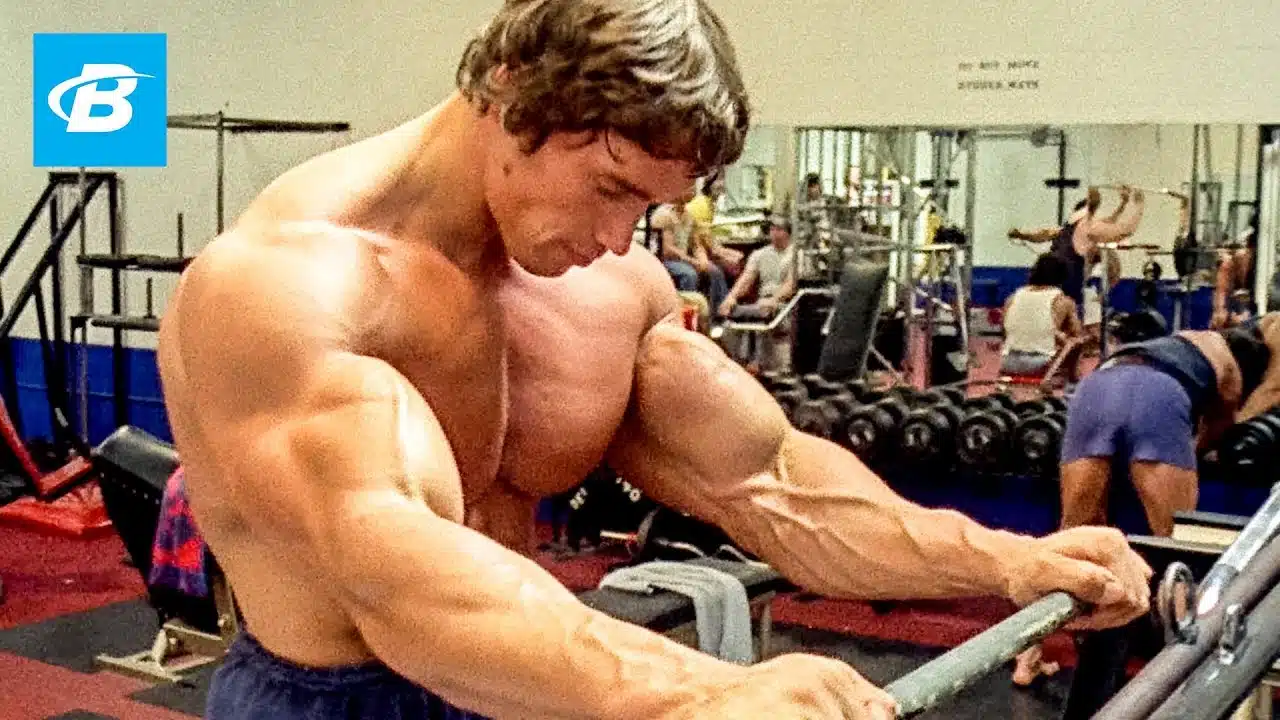
His approach wasn’t complicated, but it was relentless.
And according to Arnold, the same principles that took him to the top can work for anyone willing to put in the work.
Jump to:
- The Foundation: Basic Movements Build Champions
- Shocking the Muscle: Breaking Through Plateaus
- Chest Training: Three Exercises, Maximum Stretch
- Back Development: Width and Thickness
- Arm Training: Creating Peak and Thickness
- Shoulder Training: The Arnold Press Origin
- Leg Development: Squats Remain King
- Core Work: The 500-Rep Standard
- Nutrition: The 250-Gram Protein Protocol
- Pre-Competition: Where Legends Are Chiseled
- The Universal Blueprint
The Foundation: Basic Movements Build Champions
Arnold’s training philosophy centers on mastering fundamental exercises. Squats, bench press, barbell curls, bent-over rows—these weren’t just warm-ups.
They were the entire foundation.
The important thing for people to recognize is that not everyone wants to be a champion. But they can apply the same principles.
He criticizes modern bodybuilding for abandoning these core movements. Arnold witnessed fewer people performing cleans, presses, and upward rows—exercises critical for developing traps and lower back strength.
His message is clear: basics aren’t boring. They’re essential, especially in the crucial three months before competition.
Shocking the Muscle: Breaking Through Plateaus
Arnold introduced a concept he calls “shocking the muscle.” The body adapts quickly, memorizing workout patterns and becoming efficient.
Too efficient, actually.
The body is saying, look, I know all your tricks, I know you’re gonna start first with bench press, and then I know you’re gonna walk over to the chin-up bar and do chin-ups. I know that routine. I know exactly everything you do and I am prepared for that.
His solution? Constant variation. Instead of starting with 135 pounds and working up predictably, he’d shock his chest by beginning with 315 pounds for 20 reps.
Then strip the plates immediately and continue with 225 for another 10 reps. Then down to 135 for 15-20 more reps without rest.
The Result of Muscle Confusion
Arnold describes his pectoral muscles shaking, cramping, and experiencing pain they weren’t prepared for. This forced adaptation and growth.
The principle applies across all muscle groups, not just chest.
Chest Training: Three Exercises, Maximum Stretch
Throughout his entire career, Arnold relied on three primary chest movements:
- Bench press for overall mass
- Incline press at various angles (low, medium, high)
- Dumbbell flyes for complete pectoral development
The flyes were particularly important. Arnold emphasized going as low as possible, almost touching the floor, creating maximum stretch.
To me the flys was an exercise that gave me the full pectoral muscle development, because I went all the way out and almost hitting the ground and I was a big believer in expanding the chest as much as possible and giving that stretch.
At the top, he’d touch the dumbbells together and flex hard, mimicking a most-muscular pose. Then back down for another stretch.
No machine could replicate this movement, according to Arnold.
Back Development: Width and Thickness
Arnold approached back training with surgical precision, targeting both width and thickness across multiple regions.
Bent-over barbell rows and T-bar rows built thickness. He performed bent-over rows balancing on a bench with up to 315 pounds—no chest support.
This forced his lower back to stabilize, developing strength and striation that many bodybuilders lack.
Targeting Every Back Region
Arnold didn’t just train “back.” He trained:
- Lower back thickness (stiff-legged deadlifts)
- Upper back thickness (heavy rows)
- Outer back (various rowing angles)
- Center back (targeted isolation)
- Width (chin-ups and pull-downs)
Each area required specific exercises and attention.
Arm Training: Creating Peak and Thickness
For biceps, Arnold used three essential movements: barbell curls for thickness, incline dumbbell curls for stretch, and concentration curls for peak development.
He worked up to 275 pounds on barbell curls. Sometimes he’d start heavy with just one rep, then strip weight and do two reps, then three, then four—never putting the bar down.
This is how I would go up until, without ever putting the bar down, to really let the bicep know, you don’t know what’s coming, you’re not gonna get used to my training method. I’m gonna have all kinds of tricks up my sleeve.
Concentration curls weren’t performed with light weights for definition. Arnold used heavy weights while maintaining strict isolation.
Tricep Development
Close-grip bench press formed the foundation. Arnold added overhead extensions with one and two arms, plus a unique variation where his head went under the bar while pressing out using body weight.
Shoulder Training: The Arnold Press Origin
What’s now called the “Arnold Press” came from a specific technique designed to maximize front deltoid stretch.
Starting with dumbbells down and elbows low—not just partially down, but all the way—Arnold would rotate outward while pressing up for full flexion.
He also performed bent-over lateral raises on a 45-degree bench with a face cutout (learned at Vince Gironda’s gym), turning wrists outward for exceptional rear deltoid development.
Shocking Shoulders Into Submission
One day weekly, Arnold would start with 110-pound dumbbells for six reps of presses. Then immediately grab 100s for six more. Then 90s, 80s, continuing down to 40-pound dumbbells.
By the end, even the 40s felt impossible. His deltoids would be “screaming” in pain—evidence of successful muscle shock.
Leg Development: Squats Remain King
Arnold considers squats the most important exercise for building massive thighs. Period.
He incorporated back squats, front squats, leg extensions, lunges, stiff-legged deadlifts, good mornings, and leg curls.
To shock legs, he’d occasionally swap squats for heavy leg press, loading the machine and pushing volume.
Core Work: The 500-Rep Standard
Arnold’s abdominal routine wasn’t complicated, but it was brutal in volume.
- Leg raises (straight and bent knee)
- Sit-ups
- Roman chair sit-ups
- Crunches
Total daily reps? Around 500. This wasn’t optional—Arnold and his training partners all believed in this volume for complete abdominal development.
Nutrition: The 250-Gram Protein Protocol
Arnold followed a simple formula: one gram of protein per pound of body weight.
At 240 pounds, that meant 240-250 grams daily. The challenge wasn’t knowing how much—it was getting his body to absorb it all.
Five Meals for Maximum Absorption
Arnold discovered five meals worked better than three. He wasn’t a huge eater—a 10-ounce steak with vegetables satisfied him.
Three scrambled eggs with bacon or sausage, tomatoes, and onions made a perfect breakfast. But two hours later, he’d be hungry again.
I would pull out of my bag a little plastic container that had a cup on it that you usually use at the bar to mix things. And I would have my milk in there and I would have my protein powder in there.
While sitting in class at Santa Monica City College or working construction, Arnold would shake up his protein drink. Everyone would stare as he performed bartender-like tricks with his shaker.
This gave him an additional 30 grams of protein mid-morning. Two hours after lunch, he’d have another shake. Two daily protein drinks helped him hit his 250-gram target.
Supplements Fill the Gaps
Arnold emphasizes that even perfect eating can’t provide all necessary nutrients. That’s precisely why supplements exist—they supplement what food cannot fully provide.
Vitamins, minerals, and protein powders aren’t shortcuts. They’re necessities for serious muscle growth.
Pre-Competition: Where Legends Are Chiseled
Arnold calls the pre-competition period “the most exciting period” because that’s when mass transforms into detailed, contest-ready muscle.
Diet tightens. Repetitions increase. Exercise variety expands. Set volume goes up.
Daily mirror assessments become brutally honest. Weak points get exposed and attacked.
That motivates you then. That’s what makes you train harder. So you’ve got to expose those weak points.
This honesty drove harder training. Setting the course, training daily, eating right—these actions moved him toward his goals.
The Universal Blueprint
Arnold’s final message transcends bodybuilding competition. Training principles, nutritional requirements, protein needs, vitamins, minerals, supplements—all remain constant whether competing or training for personal health.
He retired from competition after winning his seventh Mr. Olympia, but he never stopped bodybuilding.
Bodybuilding has been a beautiful experience for me, and I will continue it for the rest of my life. I only stopped competing, but I am not stopping bodybuilding.
His blueprint proves that with consistent work, proper nutrition, and strategic training variation, extraordinary results become achievable.
Legends aren’t born. As Arnold demonstrated through decades of disciplined training, they’re systematically built—one shocking set at a time.