Some athletes run marathons in the pouring rain. Others push through scorching heat or brutal winds.
NASA astronaut Sunita Williams did something no human being had ever done before — she ran one from space.
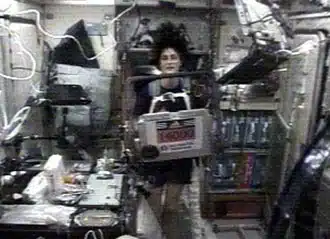
Strapped to a treadmill by bungee cords while orbiting Earth at 17,500 miles per hour, Williams crossed an orbital finish line that made history.
Here’s the full story of one of the most remarkable athletic feats ever attempted — and why it meant so much more than just finishing a race.
Jump to:
The Moment She Crossed the Finish Line
At approximately 2:24 p.m. EDT, Williams radioed Mission Control with the news everyone had been waiting for.
After four hours and 24 minutes of running, she had completed all 26.2 miles — making her the first person ever to run a marathon from orbit.
Hooyah, I’m done.
Those three words, radioed down from some 210 miles above Earth, said everything.
Bungee Cords, Harnesses, and a Treadmill Called TVIS
Running a marathon is grueling enough on solid ground. Doing it in microgravity is a challenge of an entirely different magnitude.
Because astronauts are weightless aboard the ISS, Williams had to be physically secured to the treadmill — known officially as the Treadmill Vibration Isolation System, or TVIS — using a bulky harness and bungee cords to keep her feet on the belt.
The setup can cause real discomfort. Williams had warned before race day that long sessions on the TVIS can become painful on the shoulders and hips — a very different kind of hurt than Heartbreak Hill.
The equipment also has a history of technical issues. But on marathon day, it didn’t skip a beat.
The thing held out like a champ, no problems, no faults, no nothing. It’s a great piece of gear.
Williams maintained a steady six-miles-per-hour pace throughout, running inside the station’s Russian-built Zvezda service module while the planet rolled by beneath her.
A Boston Girl Runs Boston — From 210 Miles Up
This race had a deeply personal dimension for Williams, who grew up in Needham, Massachusetts — right in the heart of Boston Marathon country.
She had run the course once before as a teenager. This time around, she qualified through the 2006 Houston Marathon with a time of three hours, 29 minutes, and 57 seconds.
The Boston Athletic Association assigned her bib number 14,000 — a nod to the ISS crew change between Expeditions 14 and 15. Williams taped it proudly to the front of her treadmill before the race began.
She started running at exactly 10:00 a.m. EDT, precisely when the starting gun fired in Boston. About 90 minutes in, she paused to share a mind-bending milestone.
It’s coming up on 9.5 miles and it looks like we’ve gone around the world. So that’s pretty cool. A nice statistic.
High, Dry, and Cheering on the Winners
Down in Boston, conditions were anything but ideal. Runners on the ground battled fierce winds and driving rain throughout the day.
Williams, orbiting above the weather entirely, was understandably impressed by those who powered through it. Kenya’s Robert Cheruiyot won the men’s division in two hours, 14 minutes, and 13 seconds. Russia’s Lidiya Grigoryeva took the women’s title in two hours, 29 minutes, and 18 seconds.
Incredible, congratulations to all those folks. Those were pretty horrific conditions and those are some great times.
Orange Slices, Drink Pouches, and Crewmates Who Showed Up
Even 210 miles above Earth, race day comes with support crew.
Most of Williams’ fellow ISS crewmembers were asleep during the run, but Expedition 14 commander Michael Lopez-Alegria and Expedition 15 flight engineer Oleg Kotov stayed up to prepare drink pouches and orange slices for her along the way.
Lopez-Alegria made no secret of how he felt when it was all over.
She has my undying respect.
Back on Earth, the support continued. Fellow NASA astronaut Karen Nyberg ran the Boston course herself, finishing in three hours, 32 minutes, and nine seconds. Williams’ sister Dina Pandya, flight surgeon Steve Hart, and longtime friend Ronnie Harris also took to the streets of Boston in her honor.
The Message Behind the Miles
For Williams, this was never just about the record. The real motivation was rooted in something far bigger than a finish line.
I think the idea came up because I’m a big proponent of physical fitness and I just wanted to make kids aware that it is a necessary part of your life. I think if I could do something up here to show kids that it’s fun and it’s important, then maybe somebody will get off the couch and start working out.
She ran over 26 miles, strapped to a machine, hurtling through space at nearly five miles per second — so that a kid somewhere might lace up their sneakers.
That might be the most impressive part of all.