Feeling sore for days after a workout might seem like a badge of honor, but it’s more often a sign that something’s off with your training program.
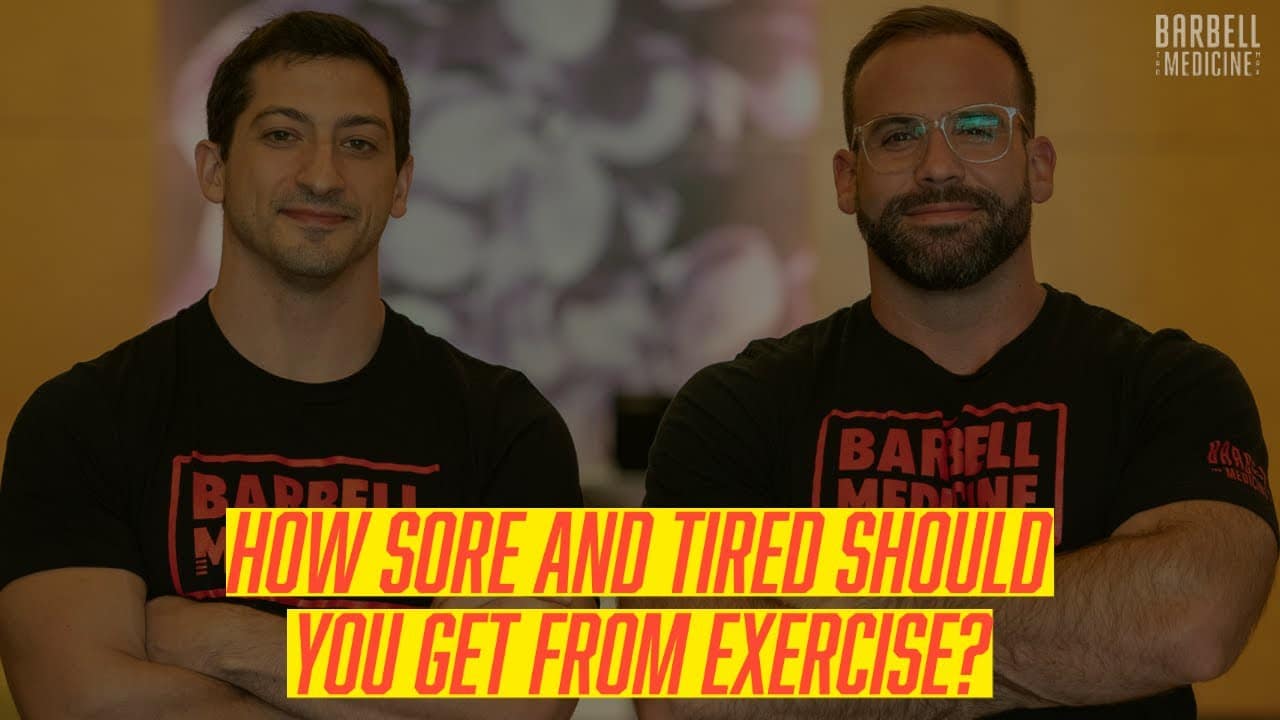
In a recent discussion, Dr. Austin Baraki and Dr. Jordan Feigenbaum—co-founders of Barbell Medicine—shared their thoughts on how to train hard without becoming functionally useless the next day. Their answer? Smart, individualized programming that prioritizes performance and recovery over pain and fatigue.
Whether you’re a novice lifter or a seasoned athlete, understanding how to balance intensity, volume, and recovery is essential for long-term gains. Here’s how to avoid digging yourself into a soreness hole that stalls progress.
Jump to:
Training Should Elevate, Not Debilitate
The core idea championed by Dr. Baraki and Dr. Feigenbaum is that your training shouldn’t leave you unable to function. Painfully sore legs. Skipping sessions. Losing productivity at work. If these outcomes are happening after a regular session, there’s one primary culprit: flawed programming.
“You should never feel that destroyed from your training,” says Dr. Feigenbaum. “It’s not a badge of honor, doesn’t make you better than anybody else, and is probably not the best way to go about your training if you want consistency and progress.”
Why You’re Wrecked After Training
There are two primary reasons people feel trashed after a workout:
- Training intensity is too high: You’re going closer to failure too often, pushing heavier weights than your current recovery capacity can support.
- Volume is excessive: Too many sets or reps, especially with minimal rest, can accumulate stress beyond what your body is ready to handle.
This often stems from chasing soreness or believing “more is better.” But according to Feigenbaum, that’s backward thinking. “If the training is set up appropriately,” he notes, “you’ll adapt and demonstrate that by increasing your loads in subsequent sessions—not by getting more sore.”
Auto-Regulation: The Cure for Crushing Fatigue
One of the key strategies both doctors employ is auto-regulation. This involves tailoring each workout to your performance potential on the day, instead of blindly following percentages or fixed goals.
“You have indicator weights for certain movements,” says Baraki. “You hit them and ask, ‘Did that move fast or slow?’ That tells you if you’re stronger than usual today or need to pull back.”
With time, this approach builds awareness—and safeguards recovery. The focus shifts from trying to beat your body into adaptation, to giving it the right dosage of stress so you can train again, sooner and stronger.
Practical Ways to Adjust Your Training
If you’re regularly feeling wiped out, consider these adjustments:
- Lower the RPE: Taking your sets down 1–2 notches in perceived exertion can dramatically reduce fatigue without compromising gains.
- Trim volume: Cut back on the number of working (especially back-off) sets if they no longer contribute to quality work.
- Avoid novelty overload: New exercises—especially eccentric-heavy ones—can spike soreness due to unfamiliar movement patterns. Introduce them gradually.
One lifter using a Barbell Medicine hypertrophy program reported extreme soreness. Instead of encouragement, Feigenbaum advised dialing the RPE down by two points—an acknowledgment that chasing DOMS is counterproductive when it hinders consistency and progression.
Real-World Example: Heavy Doesn’t Have to Hurt
Baraki shared a case from his own lifting. Recently, he pulled 660 lbs for a double—a load approaching his top range—without any residual soreness or fatigue. “Session RPE was like a 6. These were some of the heaviest weights I’ve lifted in a while, but everything moved fast. I felt strong… and completely fine afterward.”
This shows that even hard sessions don’t need to be punishing if programming and readiness are in sync. Progress doesn’t require pain—it requires planning.
Key Takeaways for Pain-Free Progress
- Match training to recovery capacity: Not how hard you can go, but how hard you should go, matters most.
- Use performance feedback daily: Don’t ignore how weights move or how you feel. Adjust accordingly.
- Soreness isn’t the goal: It’s a poor marker of adaptation and often reflects poor programming or excessive novelty.
- If you’re constantly crushed, change the program: Recovery and life function matter more than bragging rights.
Baraki summed it up clearly: “You can’t eat your way out of that, can’t sleep your way out of that. You can only program your way out of that.”
The Bottom Line
Effective training meets you where you are—not where you wish you were. It should leave you energized and progressing, not crawling into bed for a recovery nap that lasts two days.
Train smart. Adjust to your performance. And most importantly, don’t confuse soreness with success.