Pain in the gym isn’t a sign you’re doing something wrong—it’s often proof you’re pushing hard enough to matter.
But when discomfort crosses into injury territory, knowing how to fix it on the spot can mean the difference between progress and setbacks.
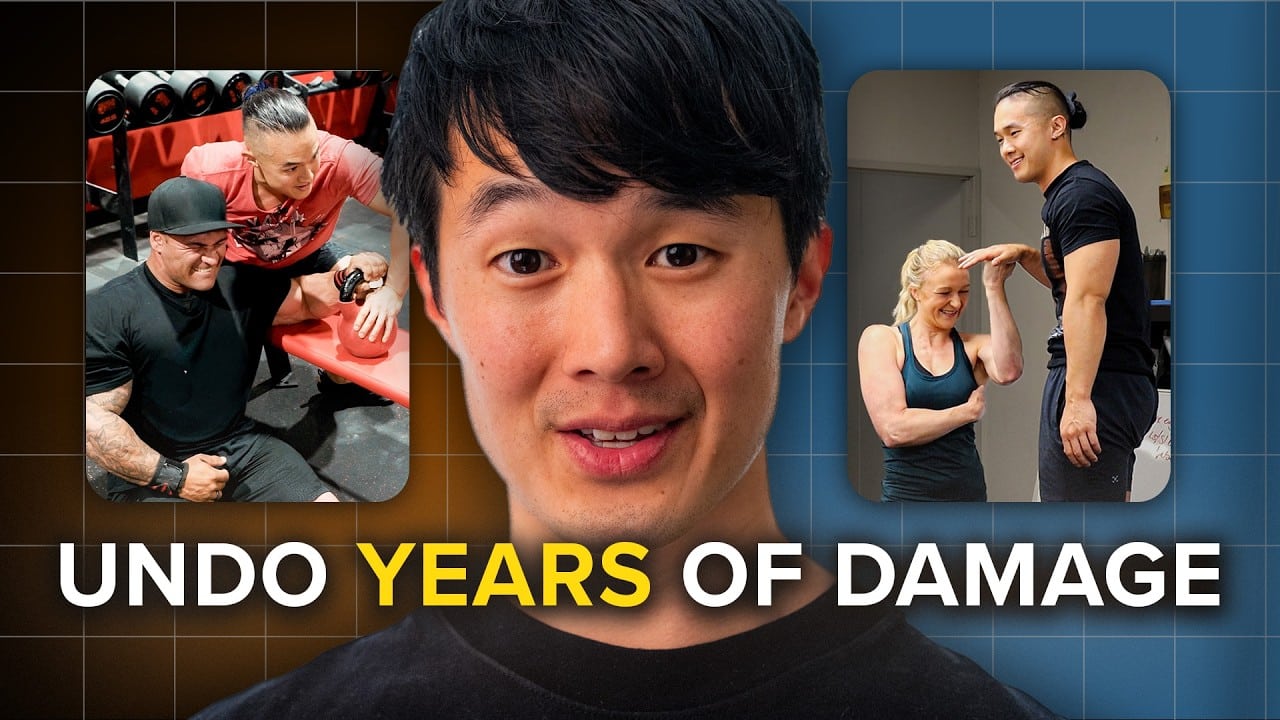
In a recent coaching demonstration, strength coach and rehabilitation specialist shared real-time solutions for three common gym injuries: shoulder pain during chest work, bench press impingement, and overhead pressing issues.
The insights reveal something surprising: most gym injuries aren’t caused by bad form, but by small imbalances that accumulate over months or years of otherwise solid training.
Jump to:
The Shoulder Pain That Stopped Chest Training Cold
When one lifter described debilitating shoulder pain that made even light pec deck work impossible, the coach immediately suspected rotator cuff dysfunction rather than structural damage.
I couldn’t fly the whole pec deck if I wanted. Half the stack was hurting a fair bit. Worse the day after. Just throbs all day.
The solution? Neurological activation of the rotator cuff through isometric holds.
The Kettlebell Rotation Fix
Using a light kettlebell positioned under the elbow, the coach had the lifter perform internal and external rotation holds—not movement, just static tension—for 15-20 seconds at a time.
The intensity stayed deliberately low at three or four out of ten. The chest, lat, and bicep remained completely relaxed.
The goal wasn’t to strengthen the rotator cuff through traditional resistance, but to wake up the nervous system’s connection to these stabilizing muscles.
Within minutes, the lifter went from unable to perform basic chest movements to completely pain-free.
It’s literally nothing. I keep trying it. Nothing at all.
The coach warned this wouldn’t be permanent immediately—cold sessions might still trigger symptoms—but repeated activation would eventually make the fix stick.
When Perfect Bench Press Form Still Causes Pain
Australia’s strongest man faced a frustrating problem: textbook bench press technique that still produced shoulder pain above 100 kilograms.
His form checked every box—proper arch, shoulder blades retracted and depressed, chest up, solid brace. Yet pain persisted.
He’s doing everything correct. His shoulder blade is back and down into his ass cheeks. His chest is up. He’s firmly braced. It’s like, shit, what are you meant to do?
The culprit? Pec minor length.
Why Textbook Form Can Backfire
The classic “chest up, shoulders back and down” bench press position creates maximum stretch across the pec minor. For lifters with naturally shorter pec minors, this optimal position becomes problematic under heavy loads.
The coach made three strategic adjustments:
- Bar path shifted higher: Instead of touching at the sternum, the bar came down closer to the clavicle
- Reduced depth initially: Half reps allowed adaptation to the new position
- Grip adjustment: Pointer fingers aimed toward the ceiling, creating slight internal rotation
These changes shortened the pec minor’s working length while slightly elevating the shoulder blades—technically “wrong” by conventional standards, but biomechanically appropriate for this athlete’s structure.
The Dramatic Result
After just minutes of practice with the modified technique, the lifter progressed from painful 60-kilogram reps to a completely pain-free 150-kilogram triple.
Was that painful? No, not at all.
The coach emphasized this isn’t always the first intervention—proper scapular positioning matters for most lifters—but for those already executing excellent technique who still experience pain, individual anatomy sometimes requires individual solutions.
Overhead Press Pain and the Serratus Blind Spot
Shoulder bursitis during overhead movements pointed to stabilization failure rather than structural damage. While most coaches focus on traps and rotator cuff for overhead stability, this case revealed the often-overlooked role of serratus anterior.
The diagnostic test was brutally simple: an uppercut position hold with the coach providing minimal resistance.
I’m not pushing on her at all, and she’s got Parkinson’s right now trying to drive up into me.
The Serratus Activation Protocol
The corrective exercise combined positioning, breathing, and isometric tension:
- Lunge stance with posterior pelvic tilt
- Uppercut position against fixed resistance
- Deep nasal inhale followed by forceful exhalation while driving upward
- Five deliberate breaths maintaining constant pressure
The shaking and instability during the drill revealed just how disconnected the serratus had become from overhead movements. When stabilizing muscles don’t activate properly, other structures compensate and eventually break down.
After the drill, overhead positioning immediately felt better—though the coach cautioned this represented acute improvement, not permanent adaptation.
Progressive Overload for Stability
The long-term solution involves the same principles applied to strength work: progressive volume, intensity, and frequency of serratus activation until the movement pattern becomes automatic.
Eventually, proper overhead pressing should provide sufficient serratus stimulus. But when neurological connections have degraded, isolated activation work becomes temporarily necessary.
The Common Thread Behind Gym Injuries
These three cases share a crucial insight: pain doesn’t always indicate poor technique or overtraining.
Smart, progressive training naturally pushes physiological limits. Small compensations and neurological gaps accumulate silently until suddenly they can’t be ignored.
The solution isn’t backing off from challenging training—it’s developing the diagnostic skills to identify which specific systems need targeted attention.
Rotator cuff activation, individualized bar paths, and serratus engagement represent precise interventions rather than generic mobility work or complete rest.
Practical Takeaways for Lifters
When pain emerges despite solid technique, consider these approaches:
- Test neurological activation of stabilizing muscles through low-intensity isometric holds
- Question whether “optimal” positioning matches individual anatomy—shorter or longer muscle bellies may require technique modifications
- Look beyond prime movers to smaller stabilizers like serratus anterior that often get neglected in training programs
- Expect acute improvements but understand lasting change requires consistent reinforcement through progressive overload principles
Pain isn’t failure—it’s feedback. The question is whether you know how to interpret and respond to what your body is telling you.