In a recent YouTube video, jiu-jitsu black belt and pro natural bodybuilder Ido Portnoy made a claim that sounds flat-out backwards.
Better conditioning, he argues, comes from breathing less, not more.
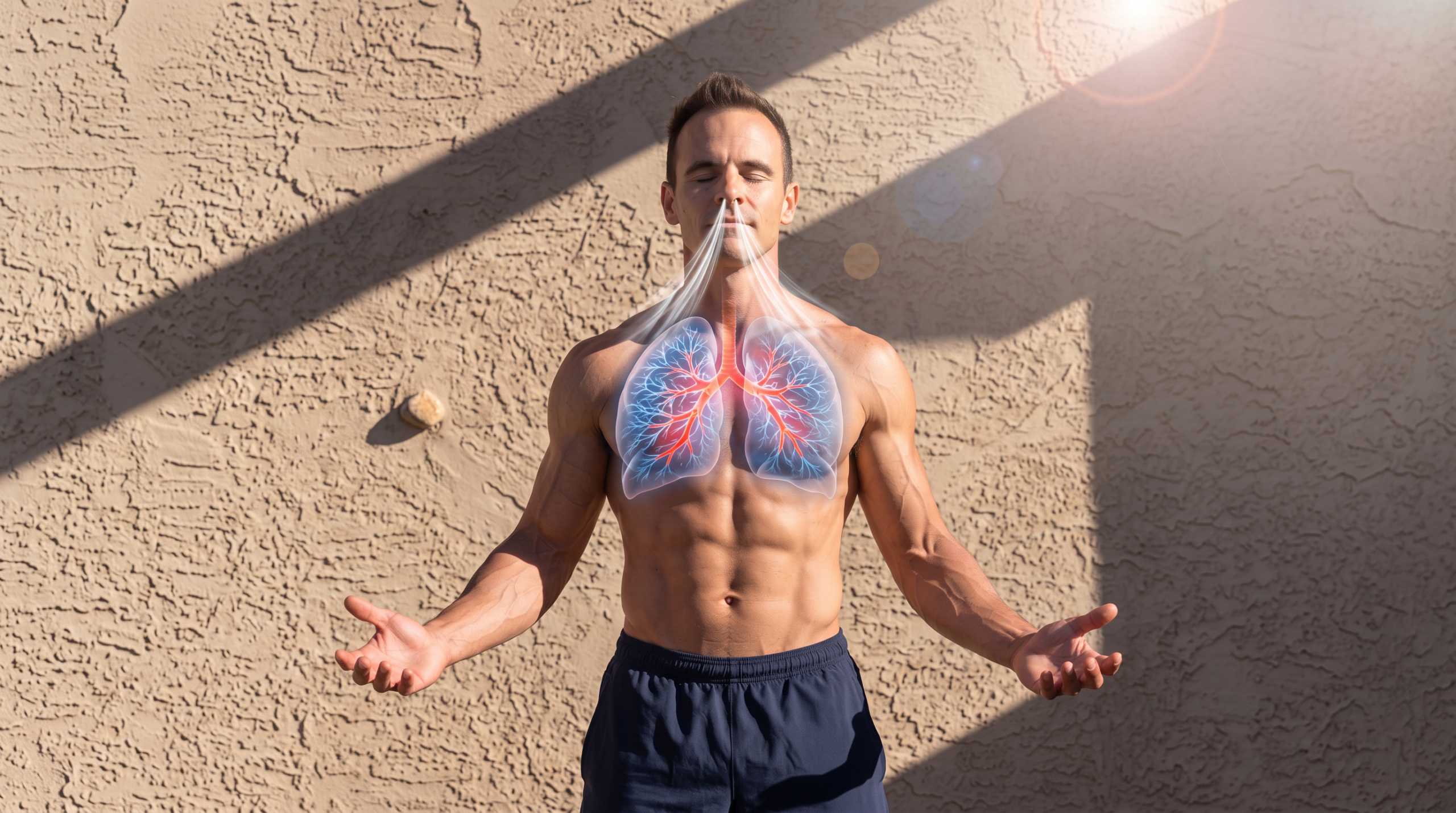
He points to a 2023 screening of nearly 2,000 competitive athletes, where over 90% reportedly showed dysfunctional breathing patterns.
Could that be why you gas out in the fourth quarter, snore at night, and crash at 3:00 p.m.?
Four pieces of “breathing machinery” hold the answer, and most coaches never teach them.
Jump to:
The Four-Part Breathing Machine
Portnoy first learned the idea from jiu-jitsu legend Rickson Gracie, whose memoir Breathe drives home one point.

If you want something simple that actually works, this is one of the most effective tools I’ve used to build strength, conditioning, and endurance without needing a full gym setup.
- Full-body training with one weight using swings, squats, and presses
- Solid cast iron build that feels stable and lasts for years
- Comfortable grip that makes high-rep workouts easier to handle
Not knowing how to breathe is like having a hand and not knowing how to use your fingers.
Portnoy breaks the system into four components:
- The engine: your diaphragm, the primary breathing muscle, which pulls down on inhale.
- The cage: your rib cage, which must expand out to the sides. Stiff ribs mean shallow, faster breaths.
- The gate: your mouth and tongue position, which shape your airway day and night.
- The filter: your nose, which slows airflow, warms and humidifies air, and releases nitric oxide.
The 10-Second Self-Test
Place one hand on your chest and one on your belly. Breathe normally.
If your chest moves first, the diaphragm is not leading. Portnoy says that pattern keeps neck and shoulder muscles overworked and nudges the nervous system toward fight-or-flight.
How Screens Quietly Hijack Your Breath
Researcher Linda Stone noticed her own breath stopping while she opened email. She coined the term “email apnea,” later broadened to “screen apnea.”
Her claim that 80% of people hold or shallow their breath at screens was observational, and Portnoy concedes the point. Still, he cites a 2016 review of mental-effort studies showing breathing got faster, not deeper, during focused tasks.
The 60-Second Reset
Set a phone reminder once or twice an hour. When it fires:
If you want something simple that actually works, this is one of the most effective tools I’ve used to build strength, conditioning, and endurance without needing a full gym setup.
- Full-body training with one weight using swings, squats, and presses
- Solid cast iron build that feels stable and lasts for years
- Comfortable grip that makes high-rep workouts easier to handle
- Notice. Where is your tongue? Is your mouth open? Is your breath high in the chest?
- Slow the exhale. Try 4 seconds in, 6 to 8 seconds out, through the nose.
- Repeat for about a minute. Then carry on.
Why Breathing Less Can Make You Perform More
Portnoy credits Patrick McKeown’s The Oxygen Advantage for flipping his thinking. Carbon dioxide, he explains, is no mere waste product.
Oxygen’s your body’s currency. Carbon dioxide is the key that releases it to your muscles.
That relationship is called the Bohr effect. Over-breathe, and you blow off carbon dioxide your blood needs to hand oxygen to working muscles.
Nasal breathing during hard training feels suffocating at first. Portnoy says that “can’t get enough air” feeling in healthy people reflects rising carbon dioxide, not an oxygen emergency.
- Few weeks: panic starts easing as chemoreceptors recalibrate.
- 6 to 8 weeks: ventilation tends to become more efficient at moderate efforts.
- Several months: nasal breathing near maximum intensity becomes realistic.
He cites George Dallam’s work on runners already nasal-trained for 6+ months. Their VO2 max matched nasal versus oral, while ventilation ran about 25% lower.
Composure: Federer, Haaland, and Musashi
Portnoy points to Roger Federer’s closed mouth and near-invisible breathing during long rallies. Yet he admits the evidence cannot say whether nasal training built that calm or decades of elite conditioning did.
Striker Erling Haaland reportedly tapes his mouth during altitude-room sprints. Kevin Garnett used opponents’ breathing against them.
If you want something simple that actually works, this is one of the most effective tools I’ve used to build strength, conditioning, and endurance without needing a full gym setup.
- Full-body training with one weight using swings, squats, and presses
- Solid cast iron build that feels stable and lasts for years
- Comfortable grip that makes high-rep workouts easier to handle
See, I can hear you breathing. I’ll say something.
Your breathing is a tell. Samurai Miyamoto Musashi wrote 400 years ago that victory is certain when an enemy is caught in a rhythm that confuses his spirit.
Force Without Breath-Holding
Portnoy deadlifted 755 pounds and squatted 645 before tweaking his back on a 150-pound sandbag. The culprit, he says, was a habitual Valsalva brace.
I was trying to be a steel beam when I needed to be more dynamic.
Strongman athletes breath-hold through heavy loads with healthy backs, so Portnoy does not call the Valsalva wrong. Use it for truly heavy lifts, but make rhythmic breathing your default elsewhere.
- Exhale on effort: inhale down into a squat, exhale as you drive up.
- Isometrics: hold a 2- or 3-second in, 2- or 3-second out rhythm against resistance.
- Falls: exhale on impact so force spreads through the body like a car’s crumple zone.
The Five Gears of Training
Researcher Stephen Seiler studied elite endurance athletes and found roughly 80% of training sits in an easy “green zone.” About 15 to 20% is truly hard, and almost none lands in the middle “yellow zone.”
Portnoy admits he lived in that yellow zone for years, calling it the “black hole.” Working with Rob Wilson and Brian Mackenzie’s framework, he sorts effort into five breathing gears:
- Gear 1: quiet nasal in, nasal out. Walking and recovery.
- Gear 2: forceful nasal breathing. Conditioning with a regulated system.
- Gear 3: nasal inhale, mouth exhale. The transition.
- Gear 4: easy mouth breathing. Fine in sport, risky as a default.
- Gear 5: mouth in, mouth out. Redline, used once or twice a week.
Gears 1 and 2 are the base. His payoff was faster recovery between rounds, and he now does most conditioning on the jump rope, assault bike, or sled with his mouth closed.
If you want something simple that actually works, this is one of the most effective tools I’ve used to build strength, conditioning, and endurance without needing a full gym setup.
- Full-body training with one weight using swings, squats, and presses
- Solid cast iron build that feels stable and lasts for years
- Comfortable grip that makes high-rep workouts easier to handle
For quick downshifts, he uses the physiological sigh: two quick nasal inhales, then a long mouth exhale. He credits Andrew Huberman’s Stanford lab with finding it effective for acute stress reduction.
Train the Pump and the Passage
Breathing muscles can use roughly 10 to 15% of your oxygen budget at peak effort, according to Portnoy. He splits training into the pump (diaphragm and intercostals) and the passage (tongue, soft palate, throat muscles).
For the pump, he uses a resistance breathing trainer, five minutes a day to start. For the passage, he cites research linking didgeridoo practice to fewer sleep apnea events and to less snoring.
Prefer something free? Try these:
- Tongue circles: trace the inside of your mouth for a minute each direction.
- Tongue to palate: press the whole tongue up, or slide the tip back to the soft palate.
- Humming: Portnoy cites a study showing a 15-fold nitric oxide increase versus quiet breathing.
- Balloons: inflate with deep diaphragmatic breaths, a Rickson Gracie teaching tool.
One caution: heavy snorers, people whose partners notice breathing pauses, and anyone waking exhausted should get a sleep study before trying mouth tape. Taping with a compromised airway can backfire.
The One Habit to Start Today
Portnoy’s ask is deliberately small. Keep your mouth shut when your nose can do the job.
If you want something simple that actually works, this is one of the most effective tools I’ve used to build strength, conditioning, and endurance without needing a full gym setup.
- Full-body training with one weight using swings, squats, and presses
- Solid cast iron build that feels stable and lasts for years
- Comfortable grip that makes high-rep workouts easier to handle
The mouth opens when it has to, not when it doesn’t.
His reward came during a jiu-jitsu session, when the breath stayed steady, the body relaxed, and everything simply flowed. Some of his claims rest on personal experience rather than controlled trials, so treat results as individual and adapt gradually.