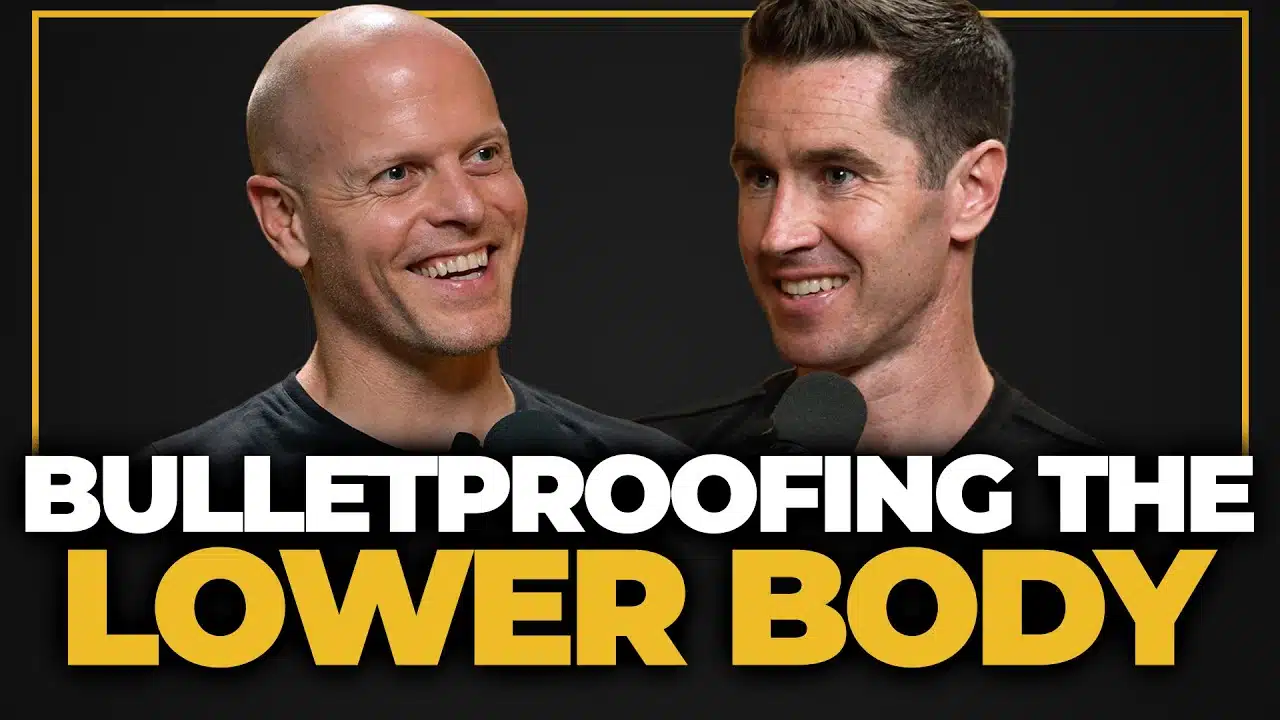
In a recent podcast conversation, fitness innovator Ben Patrick, better known as the Knees Over Toes Guy, sat down with Tim Ferriss to discuss his unconventional approach to knee health and athletic performance.
What makes Patrick’s story so compelling isn’t just the methods he’s developed.
It’s the journey from chronic pain and multiple surgeries to dunking basketballs at 34 without knee problems.
His mother, at 71, now sprints with the mobility of someone decades younger after following his protocols for eight years.
Jump to:
- From “Old Man” to Athletic Renaissance
- The Painkiller Problem Nobody Knew About
- Challenging Sacred Cows in Exercise Science
- The Backward Sled: An Unlikely Game-Changer
- Full Range of Motion: The Missing Link
- The ATG Split Squat: A Safer Starting Point
- The Power of Minimal Effective Dose
- Training From the Ground Up
- The Integrity Premium: Lessons Beyond Exercise
- Made in America: More Than Economics
- Practical Implementation: Starting Today
From “Old Man” to Athletic Renaissance
Patrick’s high school basketball coach gave him an unflattering nickname that would prove prophetic.
Had a high school basketball coach who started calling me old man. I was so stiff. It take me so long to warm up compared to other players.
The stiffness wasn’t just inconvenient—it was debilitating. By age 12, Patrick had developed chronic knee pain from excessive training without proper recovery or movement patterns.
His quest to “work his way” into basketball success backfired spectacularly.
So, I was just doing crazy workouts from the time I was maybe 9 years old. So, by 12, chronic knee pain.
By 18, Patrick underwent partial kneecap replacement, quad tendon reattachment, and meniscus transplant. Recovery took a year and a half, during which his right knee began hurting worse than his surgically repaired left knee ever had.
The Painkiller Problem Nobody Knew About
What Patrick revealed next adds a darker dimension to his story.
I had gotten from the surgeries and I had stayed on painkillers and my parents didn’t know. My girlfriend didn’t know. It was my wife now.
Facing the prospect of more surgeries and trapped in a cycle of pharmaceutical dependence, Patrick stumbled upon information from legendary strength coach Charles Poliquin that would change everything.
Challenging Sacred Cows in Exercise Science
The prevailing wisdom in fitness circles for decades had been crystal clear: never let your knees travel past your toes during exercise.
This guideline originated from 1970s exercise science research showing increased knee pressure when knees moved forward over toes during squatting movements.
Poliquin’s approach turned this conventional wisdom on its head.
He had various information that was very clear that it was like no no no what we’ve in the fitness world had all been taught don’t let your knee over your toes. He had stuff saying no this is actually the athletes he helps them prevent injury and rehab with training that position.
Patrick points out the logical flaw in avoiding knee-over-toe positions: every single time you walk down stairs, your knee goes over your toes while bearing load.
The Backward Sled: An Unlikely Game-Changer
The first intervention that allowed Patrick to stop taking painkillers was deceptively simple: dragging a sled backward.
This exercise came through Poliquin, who learned it from Louie Simmons at Westside Barbell, who invented it after studying Finnish powerlifters whose secret weapon was their day job dragging trees.
So every step I take, my knee is over my toes. It’s almost like if someone walked backward up a hill to rehab rather than going down the hill.
The safety profile of backward sled work is remarkable. Patrick coached over 100,000 sled sessions at his gym with zero injuries reported.
To demonstrate this safety, he had his 71-year-old mother attempt to drag a 1,000-pound sled backward—she couldn’t budge it, but she was completely fine.
How Backward Sled Work Functions
The mechanics make intuitive sense once explained:
- Circulation without pain: 100-200 yards of backward walking gets blood flowing to damaged tissues
- Controlled knee loading: Each step loads the knee over the toes in a way stairs demand but with adjustable resistance
- Progressive adaptation: Starting with bodyweight alone, then gradually adding resistance as tolerance improves
- Recovery-friendly: Low eccentric load means faster recovery between sessions
I remember after the first week of doing this, I then intentionally got off. That didn’t mean all my pain was gone, but it was like I wanted to experience this route and not try to shield the pain anymore.
Full Range of Motion: The Missing Link
Beyond backward sled work, Poliquin emphasized full range of motion squatting—another departure from mainstream basketball training.
Patrick estimates that 99% of basketball teams don’t squat with full range of motion, adhering to the “don’t go below 90 degrees” guideline.
Ferriss shared a relevant principle from Poliquin: “Strength is gained in the range it is trained.”
What appears to be inflexibility is often the body intelligently guarding against injury in ranges where it lacks strength.
Making Deep Squats Accessible
For people who can’t achieve pain-free deep squats, Patrick offers a simple progression:
- Elevate heels: Rolling up a towel or using a slant board improves mobility instantly
- Counterbalance with weight: Holding a plate or kettlebell out in front reduces knee pressure
- Progress gradually: Move weight closer to center of gravity as strength improves
- Scale the step height: Start with 2-3 inches if 6-inch stairs cause pain
Patrick’s baseline functional goal? Everyone should be able to hold a kettlebell and deep squat without pain—essential for parents picking up multiple children or anyone wanting long-term mobility.
The ATG Split Squat: A Safer Starting Point
The exercise Patrick has become most famous for is the front-foot-elevated split squat, sometimes called the ATG (ass-to-grass) split squat.
Ferriss emphasized why this exercise offers such an attractive risk-to-benefit ratio compared to traditional squatting.
With a barbell back squat, going into deep ranges with posterior pelvic tilt (the “butt wink”) can cause serious injury. The split squat makes such form breakdowns much harder to commit.
I had my front foot two steps up, holding on to a railing with one hand, and then just worked the way down. That’s how my mom has mostly done them. She’s 71. If you see her sprint, it’s like I’m going to need to see a birth certificate.
How to Perform the Movement
Place one foot on an elevated surface 6-8 inches high (a step, stacked plates, or slant board). Position the back leg as far back as comfortable.
Lower down while allowing the front knee to travel well past the toes. Use a handrail for support if needed.
The beauty lies in the scalability—adjusting step height and hand support makes this accessible for nearly anyone.
The Power of Minimal Effective Dose
Perhaps the most surprising aspect of Patrick’s system is the time commitment required: two 45-minute workouts per week.
Similarly, I work out only twice a week. Me and my mom, we do all the same exercises basically just at different levels.
Patrick’s mother dedicates just 10-15 minutes daily to her routine, which has reversed hip deterioration and restored sprint capability at 71.
Her Essential Four Exercises
When asked what three or four exercises his mother would choose if limited, Patrick identified:
- Sled work forward and backward: Foundation for circulation and conditioning
- Full range split squat: The exercise she credits with fixing her hip problems
- Back extension machine work: Critical for desk workers to balance anterior hip stretching with posterior chain strengthening
This minimalist approach reflects Patrick’s broader philosophy about training volume.
My starting system is one to two sets. And then I found for myself one to two sets I can maintain.
Training From the Ground Up
Patrick’s system follows three core principles that create balanced ability throughout the body.
First: Forward and backward resisted movement through sled work or resisted treadmill walking.
Second: Training from the ground up, starting with lower leg muscles before progressing to upper legs.
Third: Strength through mobility, ensuring strength exists throughout available ranges of motion.
The Neglected Tibialis Anterior
One particularly overlooked element is training the front shin muscle, the tibialis anterior.
Bodybuilder Bob Gaida, Mr. Universe before the steroid era exploded, invented the DARD (Dynamic Axial Resistance Device) specifically for this purpose.
Patrick modernized this concept with the “tib bar,” now available from multiple manufacturers.
Even without equipment, standing with your back against a wall, heels one to two feet out, and lifting toes while alternating between pinky-side and big-toe-side provides effective tibialis training.
This addresses lateral ankle stability issues that plague many former athletes.
The Integrity Premium: Lessons Beyond Exercise
The conversation took an unexpected turn when Patrick asked Ferriss about maintaining integrity while building massive reach.
Ferriss shared a pivotal moment after his most popular podcast episode on cryptocurrency with Balaji Srinivasan.
His team suggested four or five more crypto guests who would generate enormous downloads and revenue.
Whenever you find yourself on the side of the majority, it’s time to pause and reflect.
Ferriss realized that chasing that trend would train him to succumb to audience capture—becoming enslaved to whatever his audience wanted rather than following his own compass.
The Supplement Decision
Perhaps more remarkably, when launching The 4-Hour Body, Ferriss chose not to create a supplement brand despite his expertise in sports nutrition.
This decision likely cost him tens of millions of dollars.
His reasoning? If he sold supplements while recommending those exact supplements in his book, readers would rightly question his objectivity.
Once trust is questioned, it’s lost. And once lost, it’s nearly impossible to reclaim.
The long-term value of maintaining that trust—which enabled his angel investing career and returns that exceeded what any supplement business could have generated—proved the wisdom of that choice.
The Two Percent Rule
Ferriss offered a practical framework for evaluating decisions:
If you continue doing something with 2% more intensity each week or month, what does that look like three years from now?
This applies to YouTube titles, business practices, training intensity, or any habit formation.
Small compromises compound into major problems. Small improvements compound into remarkable results.
Made in America: More Than Economics
Patrick and his wife have committed to manufacturing their products in America despite higher costs and lower profit margins.
When Ferriss’s newsletter created a sales surge for Patrick’s wrist bar, the American manufacturing allowed them to fulfill orders through just-in-time production without risk of overordering inventory.
Patrick explained his philosophy simply: whether in America, Canada, or China, supporting local manufacturing matters.
The pride generated from this approach—radiating to his children and family—provides value that far exceeds any incremental profit from overseas manufacturing.
Practical Implementation: Starting Today
For someone inspired to begin applying Patrick’s principles, the entry point is remarkably accessible.
Start with backward walking. No equipment needed. Walk backward for 100-200 yards, focusing on pushing through the balls of your feet.
Add tibialis work. Stand against a wall and lift your toes for time. Alternate between pinky-side and big-toe-side emphasis.
Progress to split squats. Find a single step in your home. Place one foot on it, hold a railing for support, and lower down as far as comfortable without pain.
Scale the squat. Roll up a towel to elevate your heels. Hold a weight in front of you as a counterbalance. Start with a higher step if needed.
Remember Patrick’s key insight about volume: start with one to two sets. The program you stick with is the best program.
At 34, Patrick dunks on concrete without knee pain after a decade of following these principles. His 71-year-old mother sprints. His business thrives while maintaining integrity.
Sometimes the most revolutionary approach is simply having the patience to train consistently in the ranges that matter most—even when conventional wisdom says otherwise.