Creatine has long been dismissed as a supplement reserved for bodybuilders and athletes chasing muscle gains.
But emerging research suggests that adults over 50—especially women—might benefit most from daily creatine supplementation.
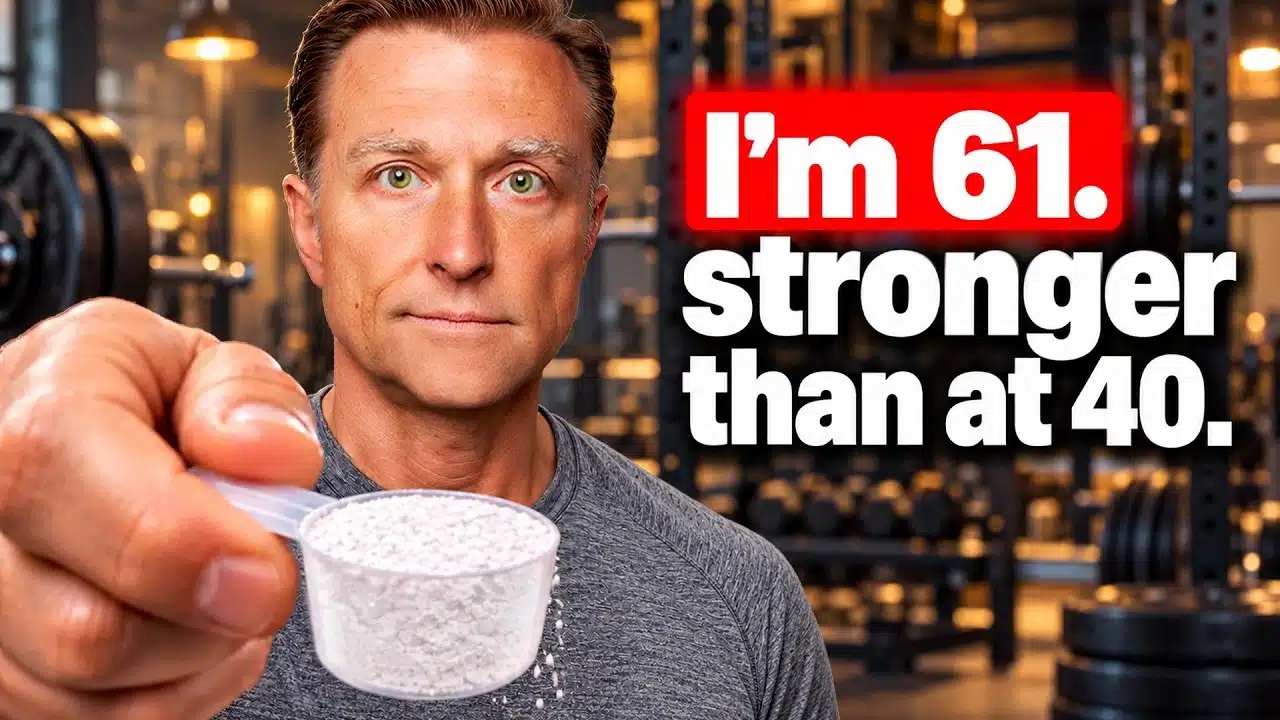
In a recent video, health educator Dr. Eric Berg explores what happens when someone over 50 takes creatine every day for 30 days, revealing benefits that extend far beyond the gym.
From sharper brain function to stronger bones, the timeline he describes might change how you think about this misunderstood compound.
Jump to:
- What Creatine Actually Does in Your Body
- Five Critical Functions of Creatine Beyond Muscle
- The 30-Day Timeline: What to Expect Each Week
- Addressing Common Concerns and Myths
- Food Sources: Getting Creatine Through Diet
- Why Women Over 50 Need Special Attention
- Creatine and Muscle Stem Cells
- Practical Supplementation Guidelines
- Who Benefits Most From Daily Creatine?
- The Bigger Picture: Creatine as Preventive Medicine
- Sources
What Creatine Actually Does in Your Body
Creatine isn’t just a powder you buy at supplement stores—your body produces it naturally, primarily in the liver, kidneys, and pancreas.
The problem? Production declines significantly with age, right when you need it most.
Berg explains that creatine plays a crucial role in cellular energy production. Inside cells, mitochondria generate ATP (adenosine triphosphate), the body’s primary energy currency.
ATP has three phosphates. So this energy in this ATP, which is like a charged battery, when you break off the phosphate, that’s when you actually can use the energy.
When ATP releases one phosphate to power cellular processes, it becomes ADP (adenosine diphosphate)—essentially a depleted battery. Creatine rapidly donates a phosphate group back to ADP, regenerating ATP and providing immediate bursts of energy lasting 5 to 10 seconds.
This phosphate recycling system is particularly important for explosive movements like sprinting up stairs, lifting heavy objects, or quickly standing from a chair—activities that become increasingly challenging after 50.
Five Critical Functions of Creatine Beyond Muscle
Berg outlines several lesser-known roles that creatine performs throughout the body, making it essential for healthy aging.
Brain and Cognitive Function
High-energy-demand tissues depend heavily on creatine, and brain tissue tops that list. Neurons require constant ATP regeneration to maintain cognitive function, memory formation, and mental clarity.
Research supports this connection. A 2023 review in Nutrients found that creatine supplementation improved memory performance in older adults, particularly those with lower baseline creatine levels from limited meat consumption.
Muscle Hydration and Size
Creatine draws water into muscle cells, improving hydration status and creating fuller, firmer muscles. This explains the typical 1-2 pound weight gain when starting supplementation—it’s fluid retention within muscle tissue, not fat accumulation.
Blood Sugar Regulation
Creatine enhances glucose uptake into muscles and improves glycogen storage capacity. This means better blood sugar control and more readily available energy for daily activities.
A 2020 study in Amino Acids demonstrated that creatine supplementation improved insulin sensitivity and glucose tolerance in middle-aged adults, suggesting potential benefits for metabolic health.
Methylation Support
Berg notes that creatine supports methylation processes critical for neurotransmitter production, DNA repair, and detoxification. By reducing the body’s need to synthesize creatine from scratch, supplementation frees up methyl groups for these other vital functions.
Bone and Connective Tissue Health
Perhaps most surprisingly for older adults, creatine supports skeletal health. Berg specifically highlights benefits for postmenopausal women facing increased osteoporosis risk.
However, the evidence here requires context. A 2020 review in Nutrition found that creatine supplementation combined with resistance training improved bone mineral density in postmenopausal women more than exercise alone—but the effect was modest and required consistent strength training to manifest.
Creatine doesn’t build bone on its own; rather, it appears to enhance the skeletal response to mechanical loading from exercise.
The 30-Day Timeline: What to Expect Each Week
Berg breaks down the progressive benefits as creatine saturates tissues over four weeks of daily supplementation.
Week One: Cognitive Enhancement
The first noticeable changes occur in brain function. According to Berg, improvements in focus, concentration, and memory emerge within days.
Also, let’s say you have a lot of stress in your life, your tolerance for stress will go up. You’ll handle things better.
Studies confirm rapid cognitive benefits. Research published in the Journal of the International Society of Sports Nutrition showed improved working memory and reduced mental fatigue after just one week of creatine supplementation in adults over 60.
Week Two: Strength and Recovery
As muscle creatine stores increase, physical performance improves noticeably.
- Increased strength: Lifting objects feels easier, climbing stairs requires less effort
- Faster recovery: Post-exercise soreness diminishes and resolution time shortens
- Enhanced endurance: Ability to complete additional repetitions during resistance exercises
- Better glycogen storage: More efficient carbohydrate storage in muscles and liver
Berg emphasizes that these aren’t subjective feelings—measurable performance improvements emerge consistently in research when older adults supplement with creatine during resistance training.
Week Three: Metabolic Improvements
By week three, systemic changes become apparent. Blood sugar regulation improves, making fasting periods more comfortable and reducing energy crashes between meals.
Muscle appearance changes subtly as hydration increases—firmer, fuller muscles without actual hypertrophy yet. Berg reassures viewers that any 1-2 pound weight gain represents intramuscular water, not adipose tissue.
Physical exertion during daily activities and structured exercise feels less demanding, potentially increasing spontaneous physical activity throughout the day.
Week Four: Complete Saturation
After four weeks of consistent supplementation, creatine fully saturates muscle and other tissues.
Berg notes that bone density improvements require longer timelines and objective measurement through DEXA scans, but subjective improvements in joint comfort and connective tissue resilience may emerge.
But, the biggest thing in week four is you’re going to feel like you want to work out, because your body can handle this extra effort.
This increased exercise motivation represents perhaps the most valuable benefit—creating a positive feedback loop where improved capacity drives increased activity, which further enhances fitness and metabolic health.
Addressing Common Concerns and Myths
Berg tackles several persistent misconceptions about creatine supplementation.
Does Creatine Damage Kidneys?
Despite outdated warnings, extensive research confirms that creatine supplementation does not harm healthy kidneys.
A comprehensive 2021 review in the Journal of the International Society of Sports Nutrition analyzed decades of safety data and concluded that creatine monohydrate poses no nephrotoxic risk in individuals with normal kidney function, even with long-term use.
People with pre-existing kidney disease should consult physicians before supplementation, but healthy older adults face no increased kidney risk.
Does Creatine Cause Hair Loss?
Berg acknowledges “one small study” suggesting a potential link but notes personal clinical experience reveals no pattern of creatine-related alopecia.
The study in question, published in 2009, showed increased DHT (dihydrotestosterone) levels in college rugby players—a hormone associated with male pattern baldness. However, no subsequent research has replicated this finding, and no studies have actually demonstrated increased hair loss from creatine use.
Current evidence suggests this concern is largely theoretical rather than practical.
Heat Stability
Creatine monohydrate remains stable when mixed with hot beverages like coffee, making supplementation convenient for morning routines. Heat does not degrade its effectiveness.
Food Sources: Getting Creatine Through Diet
While supplementation provides concentrated doses, certain foods naturally contain significant creatine.
Berg identifies the top dietary sources:
- Herring: Highest creatine content among common foods
- Pork: Particularly rich source
- Red meat: Beef and other mammalian muscle tissue
- Fish: Salmon, tuna, and other varieties
Plant-based foods contain virtually no creatine, which explains why vegetarians and vegans show lower muscle creatine stores and may experience more pronounced benefits from supplementation.
However, obtaining therapeutic doses through diet alone presents challenges. You’d need to consume roughly 2 pounds of raw meat daily to match the 5-gram supplementation dose commonly recommended—an impractical and potentially unhealthy approach.
Why Women Over 50 Need Special Attention
Berg emphasizes that postmenopausal women represent an especially important demographic for creatine supplementation.
A lot of women going into menopause have something called anabolic resistance. So, they’re not able to build their muscles effectively with the normal things that they do, with exercise and protein.
Anabolic resistance describes the reduced muscle protein synthesis response to exercise and dietary protein that accelerates after menopause. Women require higher protein doses and greater training stimuli to achieve muscle maintenance compared to younger counterparts.
Research published in Nutrients in 2021 confirmed that postmenopausal women need approximately 40 grams of protein per meal to maximally stimulate muscle protein synthesis, compared to 20-30 grams in younger women.
Berg advocates combining creatine with increased animal protein intake rich in leucine—the amino acid most potent for triggering muscle protein synthesis.
This is why they need more resistance training, more weight training, with even more animal protein that can then give them creatine, but also another amino acid called leucine.
This combined approach addresses anabolic resistance through multiple mechanisms: creatine enhances training capacity and recovery, while leucine-rich protein provides building blocks for muscle repair and growth.
Creatine and Muscle Stem Cells
Berg notes an emerging area of research: creatine’s effects on satellite cells, the stem cells responsible for muscle repair and regeneration.
Creatine also specifically helps increase the stem cells of muscle, which actually is going to help repair muscle.
Laboratory studies have demonstrated that creatine supplementation increases satellite cell activation and proliferation following muscle damage from exercise. A 2020 study in the Journal of Applied Physiology found that creatine enhanced satellite cell content in older adults performing resistance training.
This mechanism may partially explain creatine’s ability to enhance muscle mass gains when combined with strength training—it’s not just providing energy, but actually supporting the cellular machinery of muscle repair.
Practical Supplementation Guidelines
While Berg discusses his own creatine product containing additional ingredients like betaine, zinc, copper, and magnesium, standard creatine monohydrate remains the gold standard backed by most research.
Typical supplementation protocols include:
- Maintenance dose: 3-5 grams daily, which gradually saturates stores over 3-4 weeks
- Loading protocol: 20 grams daily (divided into 4 doses) for 5-7 days, followed by 3-5 grams maintenance—saturates tissues faster
- Timing: Can be taken any time of day, with or without food
- Mixing: Dissolves in water, juice, coffee, or protein shakes
The loading protocol accelerates saturation but isn’t necessary—both approaches reach the same endpoint, just at different speeds.
Who Benefits Most From Daily Creatine?
Evidence suggests certain populations gain disproportionate advantages from supplementation:
- Adults over 50: Compensates for declining natural production and supports age-related muscle loss (sarcopenia)
- Postmenopausal women: Addresses anabolic resistance and supports bone health when combined with resistance training
- Vegetarians and vegans: Lack dietary creatine sources and typically show lower baseline muscle stores
- Individuals with cognitive demands: Students, professionals, and anyone requiring sustained mental performance
- Those reducing meat consumption: Provides creatine otherwise obtained through animal protein
The safety profile and relatively low cost make creatine monohydrate one of the most accessible, evidence-based supplements for healthy aging.
The Bigger Picture: Creatine as Preventive Medicine
Berg’s 30-day timeline illustrates how this simple compound addresses multiple age-related declines simultaneously—cognitive function, muscle strength, metabolic health, and bone density.
Rather than viewing creatine as a performance enhancer for athletes, the evidence increasingly supports its role as a foundational supplement for healthy aging, particularly when combined with resistance training and adequate protein intake.
For adults over 50, especially women navigating the metabolic changes of menopause, those 30 days of consistent creatine supplementation may represent the beginning of measurable improvements in both physical capacity and quality of life.
The compound dismissed as merely a bodybuilding supplement may actually be one of the most valuable tools for maintaining independence, cognitive sharpness, and vitality throughout the aging process.
Sources
- Nutrients – Creatine Supplementation and Brain Health (2023 review) – https://www.mdpi.com/2072-6643/15/4/1051
- Amino Acids – Creatine supplementation and glucose metabolism study (2020) – https://link.springer.com/article/10.1007/s00726-020-02861-7
- Nutrition – Creatine and bone mineral density in postmenopausal women review (2020) – https://www.sciencedirect.com/science/article/abs/pii/S0899900720302574
- Journal of the International Society of Sports Nutrition – Creatine and working memory in older adults – https://jissn.biomedcentral.com/articles/10.1186/s12970-021-00471-4
- Journal of the International Society of Sports Nutrition – Creatine safety review (2021) – https://jissn.biomedcentral.com/articles/10.1186/s12970-021-00412-1
- Nutrients – Protein requirements in postmenopausal women (2021) – https://www.mdpi.com/2072-6643/13/8/2791
- Journal of Applied Physiology – Creatine and satellite cells in older adults (2020) – https://journals.physiology.org/doi/full/10.1152/japplphysiol.00685.2019