Six-time Mr. Olympia champion Dorian Yates recently put fitness creator Vana through one of his legendary back workouts, and the session revealed why the British bodybuilder earned his nickname “The Shadow.”
The intensity was relentless, the technique precise, and the philosophy behind every rep offered a masterclass in muscle building.
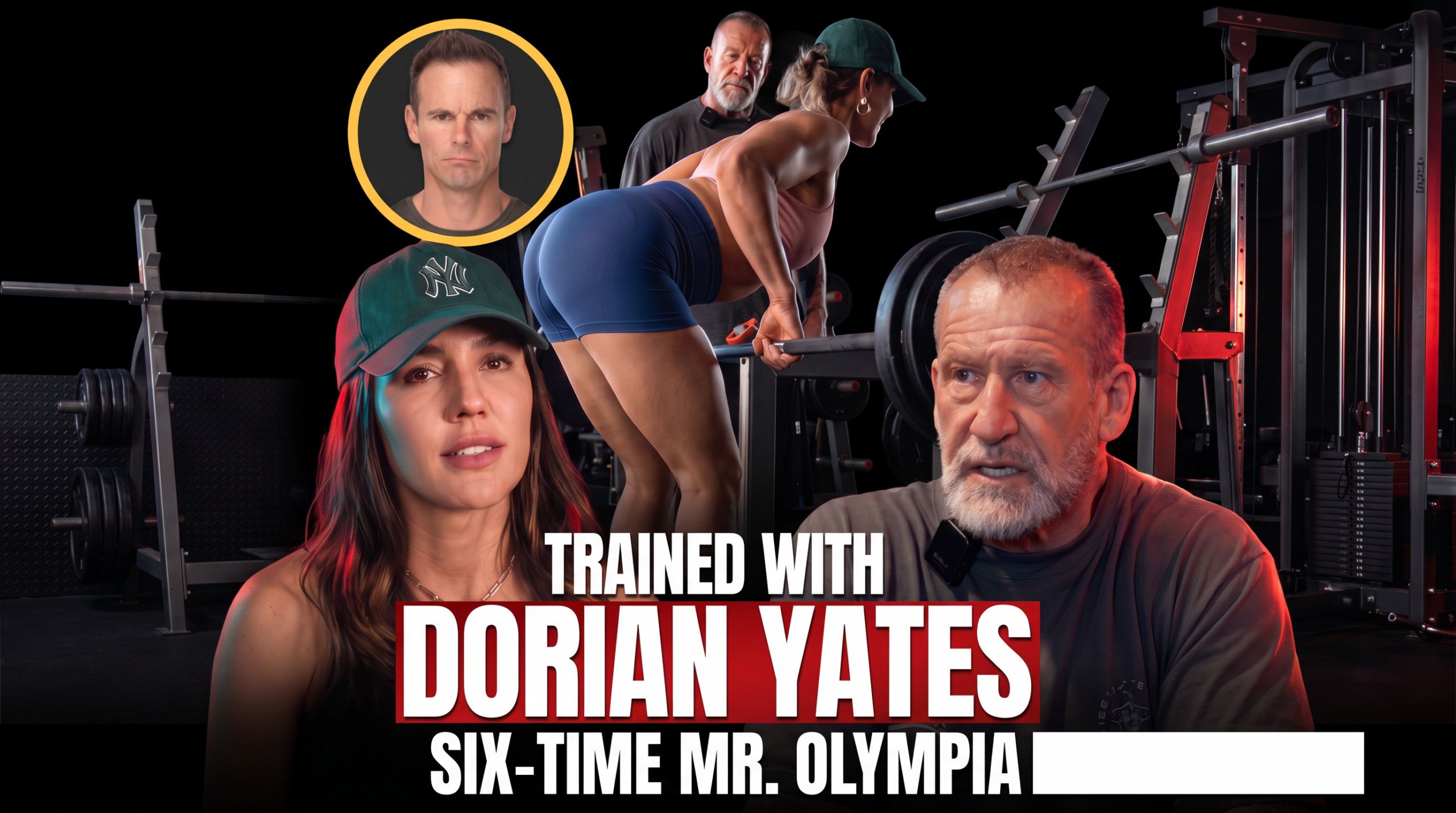
But beyond the grueling sets and forced negatives, Yates opened up about something rarely discussed: the psychological price of competitive bodybuilding and what happens when that identity disappears.
What emerged was a conversation about training extremes, mental health, and how one of bodybuilding’s most feared competitors learned to move beyond the sport that defined him.
Jump to:
- Understanding Muscle Function Before Moving Weight
- The Pre-Exhaustion Protocol: Isolate, Then Compound
- Three Phases of Every Rep: Positive, Static, Negative
- Training to True Failure and Beyond
- Form Over Ego: The Weight Doesn’t Matter
- Rep Ranges, Time Under Tension, and What Actually Matters
- Recovery: The Other Half of Bodybuilding
- The Dark Side: When Competitive Bodybuilding Isn’t Healthy
- Clinical Depression and Loss of Identity
- Dorian 2.0: Training for Mobility, Not Mass
- The Philosophy Behind the Intensity
- The Verdict: How Did Vana Perform?
- The Exchange: Mobility Meets Muscle
- Key Takeaways From a Legend’s Back Workout
- Sources
Understanding Muscle Function Before Moving Weight
Yates began the session with an anatomy lesson most gym-goers skip entirely. He mapped out exactly which muscles they’d be targeting and, more importantly, why.
“What we’re dealing with here, we got the lats which start here and go all the way down there,” Yates explained, pointing to the massive V-shaped muscles that made him a legend. “We got trapezius that start here, goes all the way up there. We got rear delts, we got rhomboids.”
He emphasized understanding the function of each muscle before attempting to train it. For the latissimus dorsi, that means pulling the upper arm down and back relative to the torso.
For the lats to contract properly, we need to be neutral spine or we can be a little bit arched. But if you’re rounded like this, you’re not getting the contraction.
This mind-muscle connection isn’t just bodybuilding mysticism. Research supports that internal focus on the working muscle can enhance muscle activation and potentially improve hypertrophy outcomes when combined with proper training variables.
The Pre-Exhaustion Protocol: Isolate, Then Compound
Yates employed a strategic technique called pre-exhaustion, starting with isolation movements before compound exercises.
The session began with a unique lat pulldown variation using elbow pads rather than a bar. This completely removed grip and bicep involvement, forcing the lats to work in pure isolation.
I’m effectively isolating my lats. They’re working just on their own. So we’re going to work on here, exhaust them in isolation and then go to the second exercise where we’re bringing in the gripping and the pulling.
After fatiguing the lats with the elbow-pad pulldowns, they moved to traditional reverse-grip pulldowns where grip strength and biceps entered the equation.
The theory: by pre-exhausting the target muscle, it becomes the limiting factor in compound movements, ensuring maximum stimulation even when smaller muscle groups might otherwise give out first. However, research on pre-exhaustion is mixed. Some studies show potential benefits for muscle activation, while others suggest it may actually reduce performance on subsequent compound exercises without clear advantages for growth.
Three Phases of Every Rep: Positive, Static, Negative
Yates broke down each repetition into three distinct phases, each with different strength potential.
So effectively on this exercise, there’s three parts in the movement: positive, static, negative, and in that order is the strength.
The eccentric (negative) phase is where muscles can handle the most load, which is why Yates constantly coached Vana to slow down the lowering portion of every rep.
“Let’s say you do these and you fail here, but you haven’t slowed down this negative,” he explained. “You’ve failed on the positive, but there’s energy left in the negative.”
This focus on eccentric training has solid scientific support. Research consistently shows that eccentric muscle actions can produce significant hypertrophy and may even be more effective than concentric-only training for building muscle mass.
When Vana reached failure on her bent-over rows, Yates didn’t end the set. He lifted the weight to the top position and had her perform additional negative-only reps.
Training to True Failure and Beyond
The intensity ramped up quickly. After warm-up sets to establish the movement pattern, Yates pushed Vana to absolute muscular failure on every working set.
“Pull. Contract. Keep the position. Keep pulling,” he commanded during a particularly brutal set of elbow-pad pulldowns. “Hold it there. Elbows back. Elbows back. One more.”
When concentric failure hit, the set wasn’t over. Yates implemented forced negatives, helping Vana lift the weight so she could lower it under control for additional eccentric repetitions.
I’m telling you to slow the negative down. And even when you get to the point of failure, there was some left because I took the weight to the top and you could lower it. So this is called extra negatives at the end.
This approach epitomized the “Blood and Guts” training philosophy that made Yates legendary. Every set was a battle. Every rep mattered. Nothing was left in reserve.
Research on training to failure shows nuanced results. While training close to or at failure can be effective for hypertrophy, going beyond failure with advanced techniques may provide additional stimulus but comes with increased fatigue and injury risk that must be managed carefully.
Form Over Ego: The Weight Doesn’t Matter
Despite his reputation for brutal intensity, Yates was meticulous about proper form and appropriate weight selection.
He constantly corrected Vana’s body position during bent-over barbell rows, preventing her from dropping too parallel to the floor.
“You’re going down here, which is okay. It’s not wrong. It’s just a way to do it,” he said. “But I want you to come up a bit more. It’s going to give you more power. You’re going to be able to handle a bit more weight.”
When discussing common mistakes, he identified ego lifting as the primary problem among young male lifters.
Men or young men normally they try to use too much weight and they’re not doing the exercise properly. That’s the thing.
He also addressed the partial rep trap—when lifters use momentum or body english to complete a range of motion they can’t actually handle.
“What they do is like to get it up, but you’re not contracting further,” Yates explained. “So if you can’t get all the way up, just lock the position and you go three-quarters.”
Rep Ranges, Time Under Tension, and What Actually Matters
When asked about optimal rep ranges, Yates provided practical guidelines rather than rigid rules.
Upper body anywhere between six and 12. It depends how fast you do the reps as well. You could do six in that time or you could do twelve. It’s really time under tension is more technical.
This aligns well with current research showing that muscle growth can occur across a spectrum of rep ranges (roughly 6-30 reps per set) as long as sets are taken close to failure. The key variable is achieving sufficient mechanical tension and metabolic stress.
Yates emphasized that bodybuilding differs fundamentally from other training modalities in its singular focus.
“It’s different from other training because we’re not practicing a skill here,” he said. “We’re not trying to increase our VO2 max or anything like that. We’re trying to stimulate muscle growth.”
That stimulus comes from short, intense sessions followed by proper recovery—not volume for volume’s sake.
Recovery: The Other Half of Bodybuilding
Yates made clear that muscle growth doesn’t happen in the gym. The workout is merely the stimulus; adaptation occurs during recovery.
Recovery is the big thing with bodybuilding. Like other sports, maybe you’re in the gym, but outside you can chill a bit. Bodybuilding, you’re in the gym to train, but then afterwards it’s like eating enough food, getting enough rest, getting enough nutrients and getting them at the right time.
This 24/7 commitment to the recovery process—nutrition timing, caloric surplus, sleep optimization, stress management—separated champions from recreational lifters.
The bodybuilding lifestyle required total dedication that extended far beyond the hour spent training.
The Dark Side: When Competitive Bodybuilding Isn’t Healthy
When Vana asked whether bodybuilding was unhealthy, Yates provided a nuanced answer that distinguished recreational training from elite competition.
Well, we have to define when we say bodybuilding because a lot of people bodybuild, but you’re asking about competitive bodybuilding. That’s a whole different thing. Most competitive sports are not naturally healthy. They are competitive and it’s only about winning.
He compared bodybuilding extremes to football players destroying their knees or any athlete pushing their body beyond natural limits for competitive advantage.
Elite sport, by definition, isn’t optimized for health—it’s optimized for performance and victory.
However, Yates was emphatic about the health benefits of non-competitive resistance training, especially for aging populations.
“Bodybuilding as in lifting weights, resistance training, whatever you want to call it, to build muscle mass, especially as you get older, amazing for your health,” he stated. “Probably number one thing you can do as you get older is maintain your muscle mass or build back your muscle mass.”
This is strongly supported by research. Studies consistently show that resistance training and maintaining muscle mass are associated with improved metabolic health, bone density, functional capacity, and longevity in older adults.
Clinical Depression and Loss of Identity
Perhaps the most revealing part of the session came when Yates discussed what happened after his career ended due to injury.
It’s absolute clinical depression time. Maybe we don’t know it, but we’re looking for that high that you got from that mission and the training and the sacrifice. It’s almost like a high in a way. And now it’s gone.
For someone who built their entire identity around being Mr. Olympia, retirement wasn’t just a career change—it was an existential crisis.
When asked what helped him overcome that loss, Yates’ answer was simple: “Time. Just time. Time and perspective.”
That perspective shift involved reframing what he’d sacrificed during his competitive years—the social isolation, the inability to travel, the single-minded focus that excluded everything else.
“All that time that you were doing that sport, you shut yourself off and you didn’t socialize, you didn’t travel because it might interfere with the training,” he reflected.
Depression following athletic career termination is well-documented in sports psychology research, particularly among elite athletes who strongly identify with their sport. The transition can trigger genuine mental health challenges that require time, support, and often professional help.
Dorian 2.0: Training for Mobility, Not Mass
Today, Yates trains very differently than during his competitive years.
I wouldn’t say I train that hard in the gym, but I train hard on things that I’m not good at. Like I train hard on mobility and I’m doing the functional work for fascia and other stuff that’s more relevant for what I’m doing now.
His goal shifted from building maximum muscle to maintaining what he has while addressing the physical imbalances that decades of single-plane movement created.
“All the training you do in bodybuilding is all in this plane,” he explained, moving his arms forward and back. “We never do something like turning with power. So all those things I’m working on now.”
He’s incorporated hanging for shoulder health, mobility work to counteract the classic bodybuilder posture (rounded, internally rotated shoulders), and functional patterns his sport never developed.
The wisdom gained: elite performance in one domain often creates deficits in others that need addressing for long-term health.
The Philosophy Behind the Intensity
Throughout the session, Yates revealed the mental framework that made his training legendary.
Bodybuilding has taught you focus, imagination, mind power, whatever you want to call it. If you don’t believe in something, if you don’t visualize it, if you don’t believe it’s going to happen, then it’s not going to happen.
But he was quick to add that visualization alone accomplishes nothing.
“You can’t sit in your chair and dream it’s going to happen. We live in a physical reality. You’ve got to do physical actions as well.”
The combination of mental focus and physical action created what he called “discipline”—a quality that transferred to every area of life.
When discussing his troubled youth and time in detention as a teenager, Yates was frank about bodybuilding’s role in his life.
I was never destined to work for somebody. I was never destined to do a job. I was never destined to be normal. I always knew that. So I was going to find an outlet somewhere and bodybuilding was the positive outlet.
For Yates, the sport wasn’t just about physiques or trophies—it was about earning freedom through self-directed achievement.
The Verdict: How Did Vana Perform?
After the final set of rear delt work, Yates gave his assessment of Vana’s performance.
Very good. Very good. I mean, you’re an athlete. Some people you tell them ten times the same thing and it’s difficult. They don’t click. But somebody that’s an athlete that has some experience is much easier because I can tell them, ‘Yeah, do this,’ and I show you once and your brain gets it.
He noted that her athletic background gave her body awareness and the ability to execute coaching cues immediately—something that separates trained athletes from beginners.
“If it was not, I would be brutally honest,” he added with characteristic directness.
The Exchange: Mobility Meets Muscle
The session was part of a trade. Yates taught Vana his blood-and-guts bodybuilding approach; she would teach him to get up from the floor without using his hands.
Their discussion about flexibility revealed an important distinction that Vana emphasized.
I don’t consider myself flexible. I consider myself strong in my end ranges, which is different. A flexible person is malleable. There’s a lot of Chinese gymnasts that they get folded in. This is not healthy for the body. That’s not control.
She compared her mobility work to Yates’ bodybuilding: “It’s just like bodybuilding but through an extended range of motion.”
Both acknowledged that extreme flexibility without strength and control can create joint instability and long-term problems—just as extreme muscle mass without mobility creates its own limitations.
The collaboration represented something bigger: champions from different disciplines learning from each other to address the gaps their specialization created.
Key Takeaways From a Legend’s Back Workout
Dorian Yates’ training session with Vana offered far more than exercise technique. It provided insight into the mindset, methodology, and personal journey of one of bodybuilding’s most intense competitors.
The practical lessons:
- Understand muscle function before attempting to train it
- Control the eccentric (negative) phase of every rep—it’s where growth happens
- Pre-exhaust target muscles with isolation before compound movements
- Train to true failure, but only when form remains perfect
- Recovery matters as much as training intensity
- Resistance training builds health; competitive bodybuilding pushes beyond healthy limits
- Every sport creates imbalances that need addressing for longevity
The deeper truth: Elite achievement often requires sacrifice that seems worth it in the moment but demands rebalancing later. Yates built an empire on intensity, suffered when that identity disappeared, then rebuilt himself by addressing what he’d neglected.
His current philosophy captures hard-earned wisdom: “I worked so hard when I was young that I feel I earned this. I can do what I want. That’s freedom in the end.”
Freedom through discipline. Balance through extremes. Growth through breaking down and building back up—whether that’s muscle tissue or identity itself.
That’s the real lesson from training with a six-time Mr. Olympia.
Sources
- Schoenfeld, B. J., & Contreras, B. (2016). Attentional focus for maximizing muscle development. Strength and Conditioning Journal. https://journals.lww.com/nsca-scj/
- Roig, M., et al. (2009). The effects of eccentric versus concentric resistance training on muscle strength and mass. British Journal of Sports Medicine. https://bjsm.bmj.com/
- Schoenfeld, B. J., et al. (2017). Strength and hypertrophy adaptations between low- vs. high-load resistance training. Journal of Strength and Conditioning Research. https://journals.lww.com/nsca-jscr/
- Westcott, W. L. (2012). Resistance training is medicine. Current Sports Medicine Reports. https://journals.lww.com/acsm-csmr/
- Park, S., et al. (2013). Athletes’ career transition out of sport. Sport Psychologist. https://journals.humankinetics.com/view/journals/tsp/