Alyssa McKenna just shattered expectations in the Hyrox world by completing 350 wall balls completely unbroken in just 11 minutes and 18 seconds.
That’s roughly 31 wall balls per minute for more than 11 straight minutes—a feat that sounds almost impossible to anyone who’s attempted a high-rep wall ball workout.
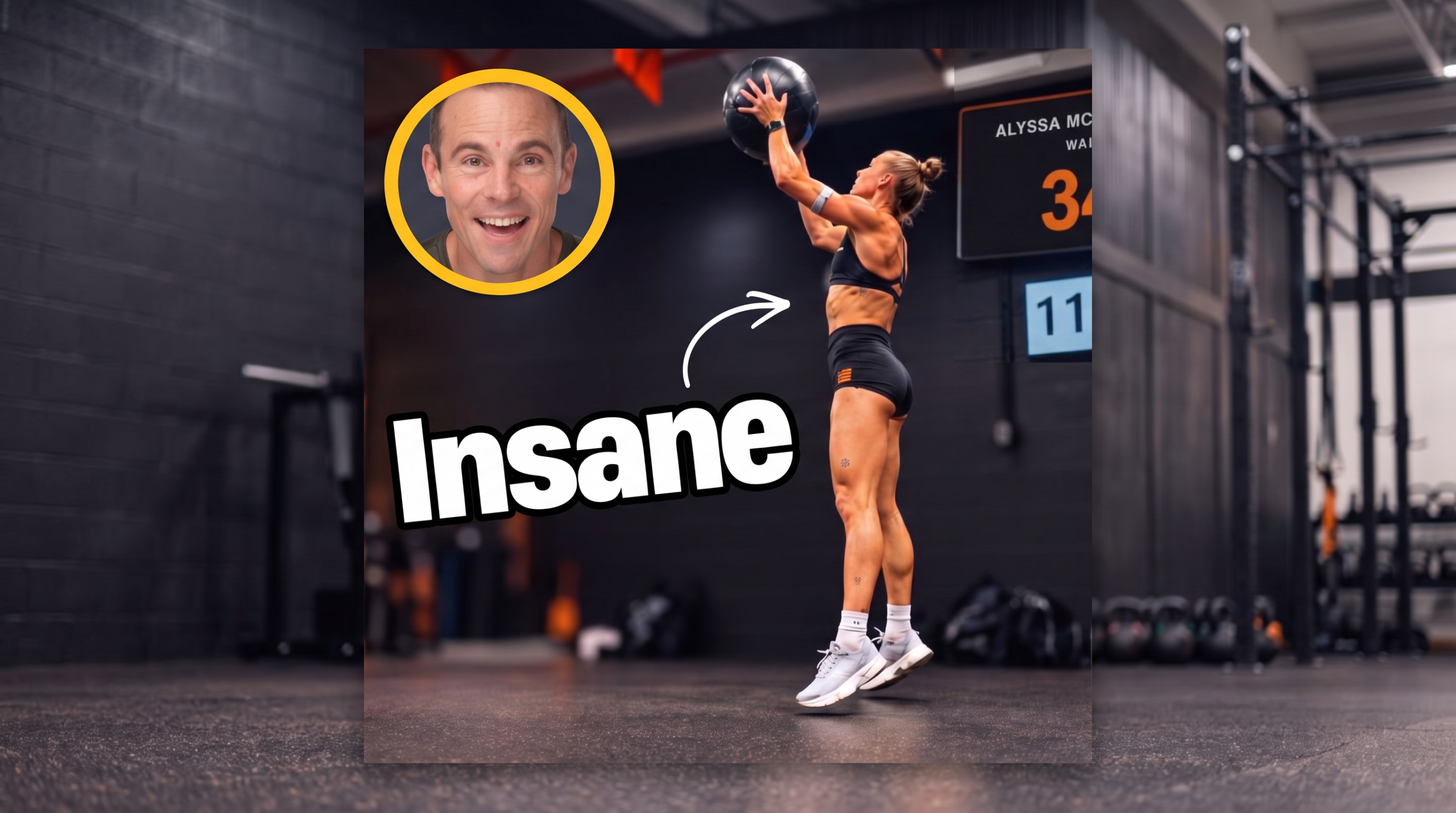
But what makes this performance physiologically possible for elite athletes like McKenna, while remaining out of reach for most of us?
Recent testing at Adidas headquarters revealed the unique biomechanics and aerobic capacity that separate world-class Hyrox competitors from everyday athletes.
Jump to:
- The Science Behind the Unbreakable Pace
- McKenna’s Threshold: Where Elite Performance Begins
- The Five-Rep Difference That Changes Everything
- The Pacing Strategy of Champions
- Average Athletes Face a Different Reality
- When Functional Movements Become Fully Aerobic
- The Threshold Training Revolution for Hyrox
- Testing Technology Meets Performance
- What This Means for Your Training
The Science Behind the Unbreakable Pace
To understand McKenna’s performance, researchers conducted a specialized incremental test designed specifically for Hyrox athletes. Unlike traditional cycling or running tests, this assessment mimics the mixed-modality demands of competitive Hyrox racing.
Athletes perform burpee broad jumps, wall balls, and treadmill running at progressively increasing intensities until they reach exhaustion. Each interval lasts approximately four to five minutes, with the difficulty ramping up until the athlete can no longer maintain the prescribed pace.

If you want something simple that actually works, this is one of the most effective tools I’ve used to build strength, conditioning, and endurance without needing a full gym setup.
- Full-body training with one weight using swings, squats, and presses
- Solid cast iron build that feels stable and lasts for years
- Comfortable grip that makes high-rep workouts easier to handle
For elite athletes like McKenna, this test can last 50 to 60 minutes. For recreational competitors, expect 30 to 40 minutes of work before hitting that breaking point.
McKenna’s Threshold: Where Elite Performance Begins
During her assessment, McKenna’s lactate threshold—the intensity she can sustain for 30 to 50 minutes—was measured at round nine of the protocol.
At this sustainable pace, she performed:
- 13 burpee broad jumps per minute
- 26 wall balls per minute
- Running at 17.1 kilometers per hour (approximately 6:35 per mile pace)
These numbers represent what McKenna could theoretically maintain during an actual Hyrox race, though the exact transfer from threshold testing to race pace varies by individual.
The critical finding? Her threshold wall ball pace of 26 reps per minute sits remarkably close to her maximum effort of 31 reps per minute.
The Five-Rep Difference That Changes Everything
McKenna’s 350 unbroken wall balls averaged 30.9 reps per minute (350 reps completed in 678 seconds). Compare this to her threshold pace of 26 reps per minute, and you find only a five-rep difference.
If you want something simple that actually works, this is one of the most effective tools I’ve used to build strength, conditioning, and endurance without needing a full gym setup.
- Full-body training with one weight using swings, squats, and presses
- Solid cast iron build that feels stable and lasts for years
- Comfortable grip that makes high-rep workouts easier to handle
Think of it like running: if your threshold pace is 13 kilometers per hour and you run an all-out 3K effort, you might hit 14 or 15 kilometers per hour. That’s a similar proportional increase to what McKenna demonstrated with wall balls.
For comparison, when a well-trained but non-elite male athlete underwent the same testing, his threshold sat at just 20 wall balls per minute. If he attempted a maximum-effort set at 31 reps per minute, the 11-rep gap between his threshold and max effort would limit him to perhaps five minutes of work before complete exhaustion.
McKenna, on the other hand, maintains her near-maximal pace for more than eleven minutes because her aerobic system can support that intensity almost indefinitely—or at least for durations that would make most athletes quit long before muscular failure.
The Pacing Strategy of Champions
Biomechanical analysis using motion sensors revealed another fascinating detail: McKenna’s rep speed during threshold testing was actually faster than during her record attempt.
During testing, she completed each wall ball in approximately 1.7 seconds. During her 350-rep effort, she slowed slightly to 1.9 seconds per rep.
This demonstrates sophisticated pacing awareness. Like a 5K runner who doesn’t sprint the opening 200 meters, McKenna instinctively calibrated her effort to a sustainable rhythm—one she knew from experience she could maintain for the entire duration.
If you want something simple that actually works, this is one of the most effective tools I’ve used to build strength, conditioning, and endurance without needing a full gym setup.
- Full-body training with one weight using swings, squats, and presses
- Solid cast iron build that feels stable and lasts for years
- Comfortable grip that makes high-rep workouts easier to handle
She essentially has a “second gear” available, choosing not to redline from the start but rather settling into a cruising speed just below her maximum capacity.
Average Athletes Face a Different Reality
Testing data from recreational Hyrox competitors—those finishing races in 75 to 90 minutes—paints a starkly different picture.
Their average threshold wall ball pace registers at approximately 2.2 seconds per rep. To hit 30 reps per minute, they would need to accelerate well above their sustainable threshold, forcing them into anaerobic territory where fatigue accumulates rapidly.
It’s equivalent to being asked to run 17 kilometers per hour when your comfortable threshold sits at 15. You simply can’t maintain that pace for more than a few minutes before the metabolic cost becomes overwhelming.
When Functional Movements Become Fully Aerobic
At the elite level, Hyrox is increasingly becoming a pure endurance event rather than a strength-endurance competition.
For athletes with McKenna’s aerobic development, the prescribed wall ball weight becomes so manageable that the movement resembles continuous cardio equipment like a ski erg or rowing machine—both of which also operate at 30 to 35 strokes per minute.
If you want something simple that actually works, this is one of the most effective tools I’ve used to build strength, conditioning, and endurance without needing a full gym setup.
- Full-body training with one weight using swings, squats, and presses
- Solid cast iron build that feels stable and lasts for years
- Comfortable grip that makes high-rep workouts easier to handle
Wall balls for McKenna don’t generate the massive lactate accumulation they would for less-trained athletes. Instead, her cardiovascular system efficiently supplies oxygen to working muscles, clearing metabolic byproducts almost as quickly as they’re produced.
There’s a caveat here: wall balls will never be purely aerobic in the way steady-state running is. The movement involves brief peaks of high instantaneous power during each concentric (upward) phase, creating uneven power distribution compared to the smooth, continuous work of running.
However, when athletes develop sufficient aerobic capacity and work with relatively light loads, even these “high-intensity functional movements” shift dramatically toward aerobic metabolism. Glycolytic activity—the anaerobic pathway that produces lactate—contributes far less than it would in less-conditioned athletes.
The Threshold Training Revolution for Hyrox
This research has practical applications for anyone training for Hyrox or similar competitions.
Threshold pace isn’t just relevant for running intervals or machine work—it applies directly to functional movements. When athletes understand their individual threshold for movements like wall balls, deadlifts, or burpees, they can design tempo workouts that develop sustainable race pace without unnecessary fatigue.
Imagine knowing that your lactate threshold for wall balls sits at 17 reps per minute, or that you can maintain 15 deadlifts per minute at 50 kilograms. Armed with this data, you could construct threshold sessions that specifically target the physiological adaptations needed for race day.
If you want something simple that actually works, this is one of the most effective tools I’ve used to build strength, conditioning, and endurance without needing a full gym setup.
- Full-body training with one weight using swings, squats, and presses
- Solid cast iron build that feels stable and lasts for years
- Comfortable grip that makes high-rep workouts easier to handle
Rather than guessing or relying purely on perceived exertion, athletes can now train with precision across 15 different whole-body movements, each calibrated to their individual metabolism.
Testing Technology Meets Performance
The biomechanical assessment that revealed McKenna’s capabilities utilizes wearable motion sensors that track center of gravity movement through time and space.
These devices automatically detect which movement is being performed at any moment, calculate power output, and provide detailed reports on individual threshold zones across multiple exercises.
Athletes can now replicate this testing protocol in their own gyms, receiving automated feedback about their specific threshold paces for burpee broad jumps, wall balls, running, and more.
The device generates personalized training zones—showing, for example, that an athlete’s threshold might correspond to 17 deadlift reps per minute at 50 kilograms, or 13 burpee broad jumps per minute.
What This Means for Your Training
McKenna’s 350 unbroken wall balls isn’t just an impressive party trick—it’s a window into how elite endurance has evolved in functional fitness.
If you want something simple that actually works, this is one of the most effective tools I’ve used to build strength, conditioning, and endurance without needing a full gym setup.
- Full-body training with one weight using swings, squats, and presses
- Solid cast iron build that feels stable and lasts for years
- Comfortable grip that makes high-rep workouts easier to handle
The performance demonstrates that with sufficient aerobic base development, movements once considered purely anaerobic can be sustained at intensities that would destroy less-conditioned athletes.
For competitive Hyrox athletes, the message is clear: aerobic capacity matters more than ever. Building your engine isn’t just about running faster—it’s about raising the ceiling on sustainable pace across every functional movement station.
The athletes who dominate aren’t necessarily the strongest in absolute terms. They’re the ones who can maintain high output across mixed modalities without accumulating debilitating fatigue.
Threshold training for functional movements represents the next evolution in Hyrox preparation. Instead of simply doing high-volume work and hoping for adaptation, athletes can now target specific intensities that develop sustainable race pace.
McKenna’s achievement shows us that the limiting factor in Hyrox performance increasingly isn’t strength or power—it’s the ability to operate at high percentages of maximum capacity for extended periods.
That’s an aerobic game, and one that responds to intelligent, measured training built around individual threshold zones.
If you want something simple that actually works, this is one of the most effective tools I’ve used to build strength, conditioning, and endurance without needing a full gym setup.
- Full-body training with one weight using swings, squats, and presses
- Solid cast iron build that feels stable and lasts for years
- Comfortable grip that makes high-rep workouts easier to handle