Forget endless wrist curls and grip squeezes that deliver minimal results.
There’s a game-changing technique borrowed straight from elite gymnasts that simultaneously builds crushing forearm strength and unlocks advanced calisthenics skills most people only dream about.
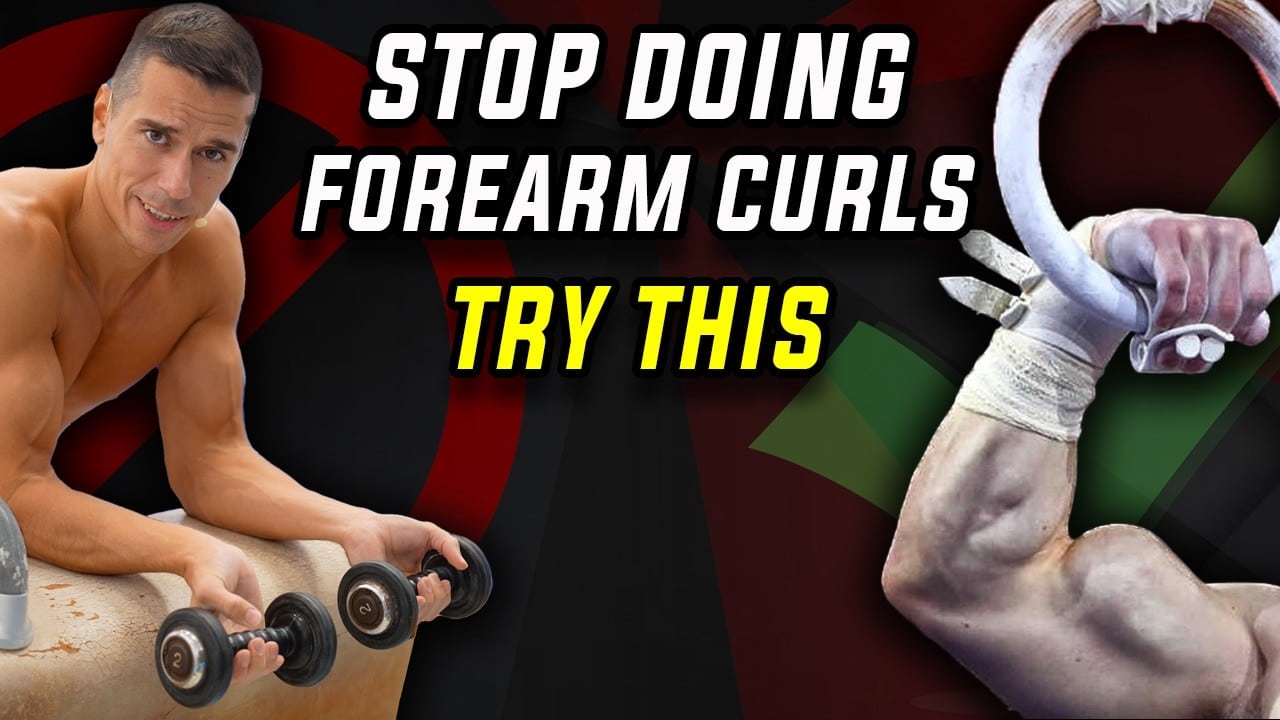
Adam Grosi from Gymnastics Method recently broke down the false grip—a specialized hand position that transforms forearm development while creating the foundation for slow-motion bar muscle-ups, ring work, and other spectacular movements.
The best part? It’s functional strength that actually transfers to impressive skills, not just isolated muscle work.
Jump to:
What Makes False Grip Different
False grip represents a fundamental shift in how gymnasts approach hanging exercises. Instead of wrapping fingers around equipment with palms facing away, this technique positions the wrist over the bar or rings.
The grip runs diagonally through the palm—from the index finger down to the pisiform bone, which acts as a hook point. This positioning drastically reduces leverage, making complex movements more manageable.
This is a typical gymnastic grip that they use on the rings mostly for decreasing the leverage.
Gymnasts rely on false grip for nearly every ring skill—from iron crosses to muscle-ups. Watch any high-level gymnastics routine and you’ll notice this grip constantly.
The shortened arm position enables the critical transition from hanging below equipment to supporting bodyweight above it. Without false grip, that transition becomes exponentially harder.
Why Forearms Explode With This Technique
The forearm development from false grip training isn’t accidental—it’s biomechanical necessity.
Maintaining proper position demands intense isometric contraction from forearm flexor muscles. These muscles must fire continuously to keep wrists flexed over the equipment.
If you take a look at the ring specialist gymnast, you will see these muscles, the forearm flexor muscles are really pumped up and really advanced.
Ring specialists develop noticeably larger, more defined forearms compared to other athletes. The constant tension under bodyweight load creates a training stimulus traditional exercises can’t match.
Standard wrist curls isolate small muscle groups with minimal functional carryover. False grip training integrates forearm strength into full-body movements, building practical power alongside aesthetics.
Mobility Comes Before Strength
Attempting false grip without adequate wrist mobility invites frustration and potential injury. Grosi emphasizes establishing range of motion first, then progressively loading that movement pattern.
The primary mobility requirement is wrist flexion—the ability to bend wrists forward significantly.
Back-of-Hand Mobility Circles
This foundational drill stretches forearm extensors while improving wrist flexion capacity. Start in a kneeling position with hands flat on the ground, palms down.
- Easiest variation: Fingers pointing toward each other
- Moderate difficulty: Fingers pointing backward
- Most challenging: Fingers pointing forward
Perform circular motions, shifting weight gradually onto hands. Those with limited mobility should place a pillow under hands initially, removing support as flexibility improves.
Complete minimum five circles each direction. Individuals with particularly stiff forearms benefit from 10-20 circles per session.
I had a client who worked in construction, so he always used machines and hammers and stuff like that. So he had super stiff forearm and we had to work a lot on this mobility.
Building Baseline Strength
Once mobility exists, strengthening forearm flexors becomes priority. Palm poses provide accessible entry-level training.
From kneeling support position, elevate palms while keeping fingers grounded. Hold this position, feeling flexor muscles engage along forearm undersides.
Range of motion varies considerably between individuals. Don’t compare your flexibility to others—focus on gradual personal improvement.
Target 15 controlled repetitions in kneeling position. Advanced practitioners can progress to wall variations, full push-up position holds, or increased duration.
Ring Progressions: The Easier Path
Rings provide more forgiving learning environment than bars due to their mobility. Grosi recommends mastering ring false grip before transitioning to fixed bars.
Progression 1: Assisted False Grip
Grab one ring in false grip position while opposite hand assists by holding the ring normally or gripping the strap. Pull to chest-height and maintain position.
I recommend doing the force grip in a chest to bar or chest to ring position. So the full range of motion, you don’t want to do it this way because we want to get used to the full range of motion.
Hold minimum 15 seconds per arm. Patience-builders can extend to 30 seconds for additional adaptation.
Progression 2: Bent-Arm Hang
Both hands assume false grip. Pull to chest-to-rings position and hold. Never drop into straight-arm position during holds—maintain bent-arm posture throughout.
Again, 15-second minimum with 30 seconds recommended for thorough adaptation.
Progression 3: Inverted Rows
Horizontal pulling introduces straight-arm hanging in false grip. Begin with higher ring position for reduced difficulty, gradually lowering angle as strength improves.
Follow standard inverted row progression: 45-degree angle, horizontal bent-knee, straight body, then elevated legs.
The shortened effective arm length makes chest-to-rings contact significantly easier than standard grip. Aim for three sets of 15 repetitions before advancing.
Progression 4: Passive Hang
Transition from horizontal to vertical. Grab rings in false grip and hang with arms extended, bodyweight fully supported.
This feels intensely uncomfortable initially. Discomfort is normal—injury pain is not. Learn the difference.
Build to 15-30 second holds before progressing.
Progression 5: Pull-Ups
Final ring progression combines all previous elements. Perform pull-ups while maintaining false grip throughout entire movement.
Standard pull-up proficiency is prerequisite. The reduced leverage makes top position easier to achieve, creating foundation for muscle-up transitions.
Once you have the right technique for the muscle up, you from here basically just lean forward, turn the rings under your shoulders and dip. And you have the nice slow ring muscle up.
Bar False Grip: Advanced Challenge
Fixed bars increase difficulty substantially. The inability to rotate equipment means hand positioning requires more deliberate technique.
Bar placement remains identical—diagonal through palm from index finger to pisiform bone. The bone creates the critical hook point over the bar.
Progress through identical steps used for rings:
- Assisted single-arm holds (15+ seconds)
- Both-hand chest-to-bar holds (15+ seconds)
- Inverted rows with false grip
- Passive dead hangs
- Strict pull-ups
Critical technique note: Keep thumbs under the bar, not over it. Wrapping thumbs underneath provides superior grip security and proper wrist positioning.
Some practitioners use tennis balls or similar implements to build flexor strength. While potentially beneficial, Grosi advocates mastering proper grip mechanics on actual equipment first.
Why Function Beats Isolation
Traditional forearm training isolates small muscle groups through repetitive movements. Results appear slowly and transfer poorly to real-world strength demands.
False grip training integrates forearm development into compound movements. Every rep simultaneously builds pulling strength, grip endurance, and movement skill.
The technique opens doors to advanced calisthenics previously inaccessible. Slow-motion muscle-ups, extended ring holds, and complex transitions all become achievable.
You will see your forearms blowing up and it’s not going to just look good, but it’s going to be functional.
Aesthetic development happens as byproduct of functional capacity rather than isolated pursuit. Muscles grow because they’re performing demanding work, not because they’re being artificially stimulated.
Realistic Timeline and Expectations
False grip mastery requires patience. Individual progression speed varies based on starting mobility, grip strength, and training consistency.
Those with construction backgrounds, manual labor history, or repetitive gripping patterns often need extended mobility work. Desk workers might progress faster through flexibility phases but require more strength building.
Expect initial discomfort. Skin may protest, forearms will fatigue quickly, and positions feel awkward. These sensations diminish with consistent practice.
Most dedicated practitioners achieve functional false grip within 4-8 weeks of focused training. Advanced applications like muscle-ups require additional months of refinement.
The investment pays dividends beyond forearm development—unlocking movement vocabulary that distinguishes advanced practitioners from casual gym-goers.
Rather than chasing isolated muscle pumps through endless wrist curls, consider adopting techniques elite athletes rely on. False grip represents efficient training that delivers multiple benefits simultaneously—exactly what evidence-based programming should provide.