Halle Berry isn’t just aging gracefully—she’s rewriting what’s possible after 50.
At 57, the Oscar-winning actress maintains a physique that rivals professional athletes decades younger, combining elite-level martial arts skills with functional strength that most gym-goers half her age would envy.
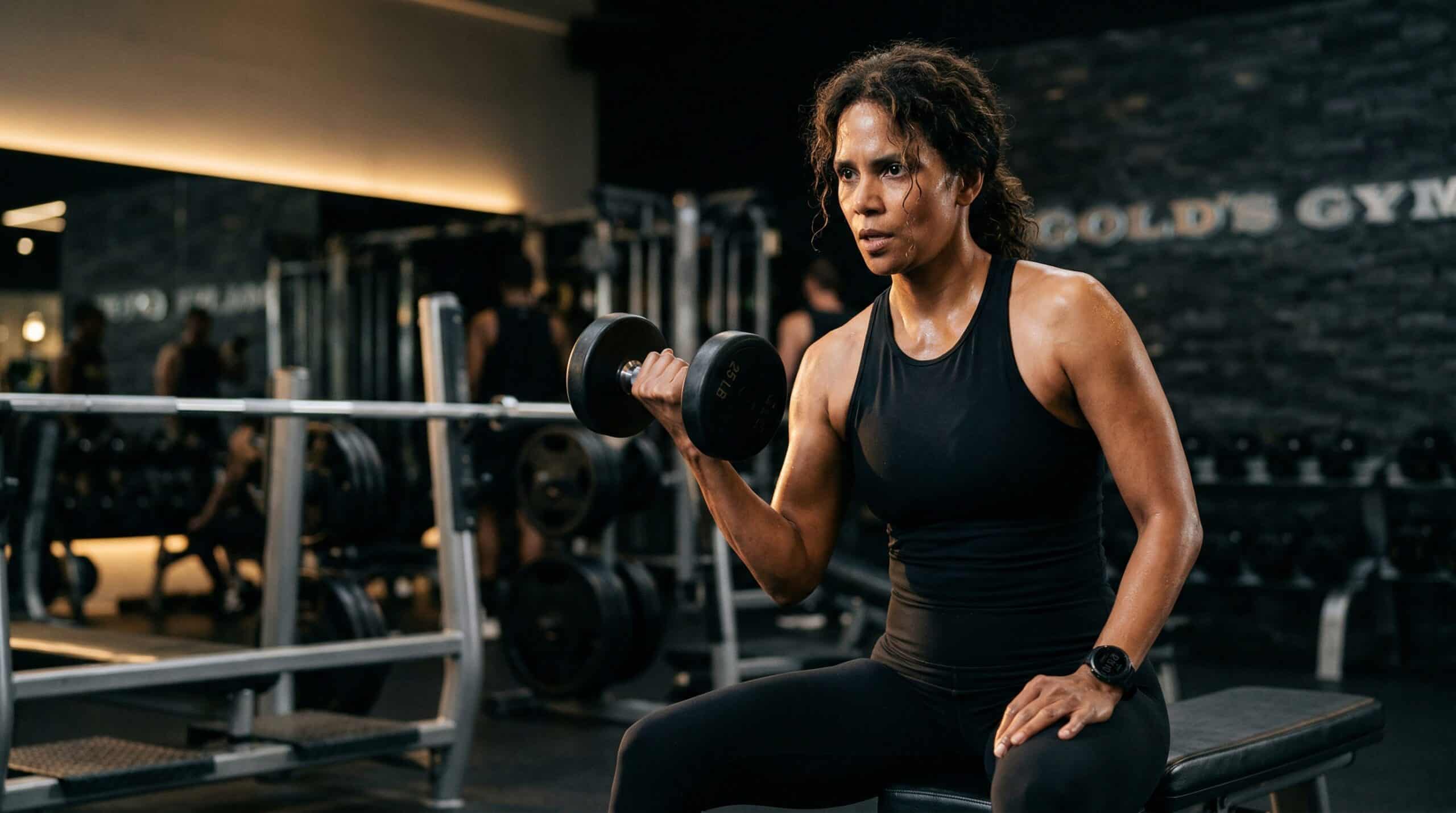
Her transformation from Hollywood star to legitimate combat sports practitioner didn’t happen by accident.
It’s the result of years working with celebrity trainer Peter Lee Thomas, following a strict ketogenic diet, and adopting what Berry calls “movement as medicine”—a philosophy that’s kept her training consistently at high intensity for decades.
Jump to:
The Foundation: Movement as Medicine
Berry’s approach to fitness fundamentally differs from typical celebrity workout routines. She doesn’t train for aesthetics—she trains for capability.
This mindset shift transformed exercise from obligation into investment. When workouts focus on what your body can do rather than how it looks, motivation becomes self-sustaining in ways appearance-based goals simply cannot replicate.

If you want something simple that actually works, this is one of the most effective tools I’ve used to build strength, conditioning, and endurance without needing a full gym setup.
- Full-body training with one weight using swings, squats, and presses
- Solid cast iron build that feels stable and lasts for years
- Comfortable grip that makes high-rep workouts easier to handle
Thomas, who has worked with Hollywood’s most physically demanding actors, immediately recognized Berry wasn’t seeking a maintenance routine. She wanted to become a different kind of athlete entirely.
Martial Arts: The Core of Berry’s Training
Combat sports sit at the heart of Berry’s current programming. She trains in jiu-jitsu, boxing, Muay Thai, and kali (Filipino stick and blade fighting), often incorporating multiple disciplines within the same training week.
Her preparation for Bruised—her 2020 directorial debut where she played a former MMA fighter—required over a year of intensive MMA training. Coaches didn’t make concessions for her celebrity status.
She was treated as an athlete who needed to perform, and she met that standard with remarkable consistency. Berry sustained a broken rib during filming but performed the majority of fight sequences herself.
Why Martial Arts Work for Longevity
Combat sports training delivers benefits traditional cardio and weightlifting alone cannot match:
- Full-body integration: Every movement requires coordination across multiple muscle groups and planes of motion
- Cognitive engagement: Technique work keeps training mentally stimulating, reducing burnout
- Functional power development: Striking and grappling build explosive strength with real-world application
- Enhanced proprioception: Martial arts dramatically improve body awareness and injury prevention
Functional Strength Training
Berry’s weight training prioritizes compound movements that build real-world strength—deadlifts, squats, overhead pressing, loaded carries.
If you want something simple that actually works, this is one of the most effective tools I’ve used to build strength, conditioning, and endurance without needing a full gym setup.
- Full-body training with one weight using swings, squats, and presses
- Solid cast iron build that feels stable and lasts for years
- Comfortable grip that makes high-rep workouts easier to handle
Muscle isolation for aesthetic purposes? Not part of the program.
Every exercise serves to improve performance in foundational lifts and martial arts disciplines. Her routine includes Bulgarian split squats for unilateral leg strength, pull-ups for back development, and kettlebell swings for posterior chain power.
Sled pushes and Pallof presses round out her training, building the kind of core stability and functional conditioning that translates directly to athletic performance.
The Training Split
Berry trains 5-6 days per week, with sessions lasting 60-90 minutes. A typical week might look like:
- Monday: Heavy compound lifts + boxing rounds
- Tuesday: Jiu-jitsu training
- Wednesday: Functional strength circuit + Muay Thai
- Thursday: Active recovery—yoga and mobility work
- Friday: Power movements + pad work
- Saturday: Full MMA-style training session
- Sunday: Rest or light movement
Volume and intensity remain high, but exercise selection changes frequently to prevent overuse injuries and maintain engagement.
The Ketogenic Diet Protocol
Berry has followed a ketogenic approach for years, initially adopting it to manage Type 1 diabetes.
If you want something simple that actually works, this is one of the most effective tools I’ve used to build strength, conditioning, and endurance without needing a full gym setup.
- Full-body training with one weight using swings, squats, and presses
- Solid cast iron build that feels stable and lasts for years
- Comfortable grip that makes high-rep workouts easier to handle
Over time, she discovered keto didn’t just stabilize blood sugar—it dramatically improved body composition, mental clarity, and recovery from training.
She typically keeps carbohydrate intake below 20 grams daily, fueling demanding workouts with dietary fat and moderate protein. Combined with intermittent fasting windows she’s discussed publicly, this approach maintains sub-15% body fat year-round without extreme caloric restriction.
A Typical Day of Eating
Berry intermittent fasts through the morning, breaking her fast around noon:
- Noon: Eggs and avocado, often with olive oil
- Mid-afternoon: Protein and non-starchy vegetables
- Dinner: Fatty protein source like salmon or ribeye with leafy greens
- Snacks: Nuts, cheese, or low-carb protein sources when needed
Processed foods, sugar, and grains are completely eliminated. This isn’t a diet with cheat days—it’s a metabolic strategy maintained with consistency.
Recovery: The Missing Piece
Berry treats recovery as seriously as training itself. Sleep is prioritized. Cold exposure and sauna protocols are regular practices.
Yoga and mobility work counteract the physical demands of martial arts training, maintaining joint health and movement quality.
If you want something simple that actually works, this is one of the most effective tools I’ve used to build strength, conditioning, and endurance without needing a full gym setup.
- Full-body training with one weight using swings, squats, and presses
- Solid cast iron build that feels stable and lasts for years
- Comfortable grip that makes high-rep workouts easier to handle
This attention to recovery explains her ability to train at high intensity consistently. Many athletes in their 20s and 30s underinvest here and plateau or get injured as a result.
Berry’s approach demonstrates what becomes possible when recovery is treated as a performance variable rather than an afterthought.
What This Means for Aging and Fitness
Berry’s fitness story challenges dominant cultural narratives about aging. The typical message around fitness after 50 emphasizes managed decline—maintaining what you have, avoiding injury, accepting limitation.
Berry’s trajectory runs directly counter to that narrative.
She is more capable, more skilled, and arguably in better shape at 57 than at 37. Her story proves the ceiling on physical development in middle age sits far higher than most believe.
The most important variable? Simply the willingness to train with intention and consistency over time.
If you want something simple that actually works, this is one of the most effective tools I’ve used to build strength, conditioning, and endurance without needing a full gym setup.
- Full-body training with one weight using swings, squats, and presses
- Solid cast iron build that feels stable and lasts for years
- Comfortable grip that makes high-rep workouts easier to handle
Key Takeaways for Training After 50
- Progressive skill development matters: Learning complex movements like martial arts keeps training engaging
- Nutrition discipline compounds over decades: Berry’s keto approach has been consistent for years, not months
- Recovery investments prevent decline: Mobility work, sleep, and stress management enable sustained high performance
- Aesthetic goals alone won’t sustain motivation: Performance-based training creates intrinsic drive that appearance goals cannot
Can You Follow This Program?
Berry’s exact routine requires significant time investment and access to martial arts coaching. But the principles are universally adaptable.
Start with foundational movement patterns if you’re new to compound lifting. Build proficiency in basic exercises—goblet squats, push-ups, inverted rows—before progressing to loaded barbells.
For martial arts, begin with boxing or kickboxing classes at a local gym. The technical learning curve provides cognitive benefits while building conditioning.
The ketogenic diet Berry follows can be effective for body composition but should be discussed with a physician, particularly if you have metabolic conditions. Keto isn’t necessary to achieve excellent results—dietary consistency and protein adequacy matter more than macronutrient ratios for most people.
The Long Game
Berry’s physique at 57 isn’t the result of a 12-week transformation program. It’s the compound interest of decades of disciplined training.
She hasn’t found a shortcut—she’s simply refused to quit. That consistency, applied year after year, produces results that look extraordinary but are simply the inevitable outcome of sustained effort.
If you want something simple that actually works, this is one of the most effective tools I’ve used to build strength, conditioning, and endurance without needing a full gym setup.
- Full-body training with one weight using swings, squats, and presses
- Solid cast iron build that feels stable and lasts for years
- Comfortable grip that makes high-rep workouts easier to handle
Her partnership with Thomas has now spanned years, demonstrating the value of finding a coaching relationship that challenges and supports long-term development rather than delivering quick fixes.
The most important lesson from Berry’s approach isn’t any specific exercise or diet strategy. It’s that physical capability can expand rather than decline with age—if you’re willing to train like an athlete rather than maintain like a retiree.
That mindset shift, more than any workout program, separates those who remain capable deep into middle age from those who accept decline as inevitable.