The Western States 100 is more than just the oldest 100-mile footrace on the planet — it’s a living laboratory where elite ultrarunners make split-second decisions that can mean the difference between a podium finish and a DNF.
And nothing sparks more debate in the trail running world than what’s on their feet.
This year’s 2026 edition didn’t disappoint — delivering two stunning new course records and a seismic shift in the shoe landscape that nobody saw coming.
A brand that didn’t even crack the top 15 at last year’s race just stormed onto the start line and rewrote the pecking order — and the established giants are starting to feel the pressure.
Jump to:
Course Records Fall as the Race Delivers a Historic Day
Before diving into the footwear drama, it’s worth acknowledging just how fast this year’s race was.
France’s Vincent Bouillard shattered the men’s course record with a jaw-dropping time of 13:46:15, while Jenn Lichter claimed the women’s record in 15:28:05.

If you want something simple that actually works, this is one of the most effective tools I’ve used to build strength, conditioning, and endurance without needing a full gym setup.
- Full-body training with one weight using swings, squats, and presses
- Solid cast iron build that feels stable and lasts for years
- Comfortable grip that makes high-rep workouts easier to handle
The Western States 100 course — running through Olympic Valley, California — features roughly 18,000 feet of elevation gain and 22,000 feet of descent, making it a net-downhill, highly runnable route where shoe selection isn’t just a preference. It’s a performance decision.
Hoka Still Leads — But the Gap Is Closing Fast
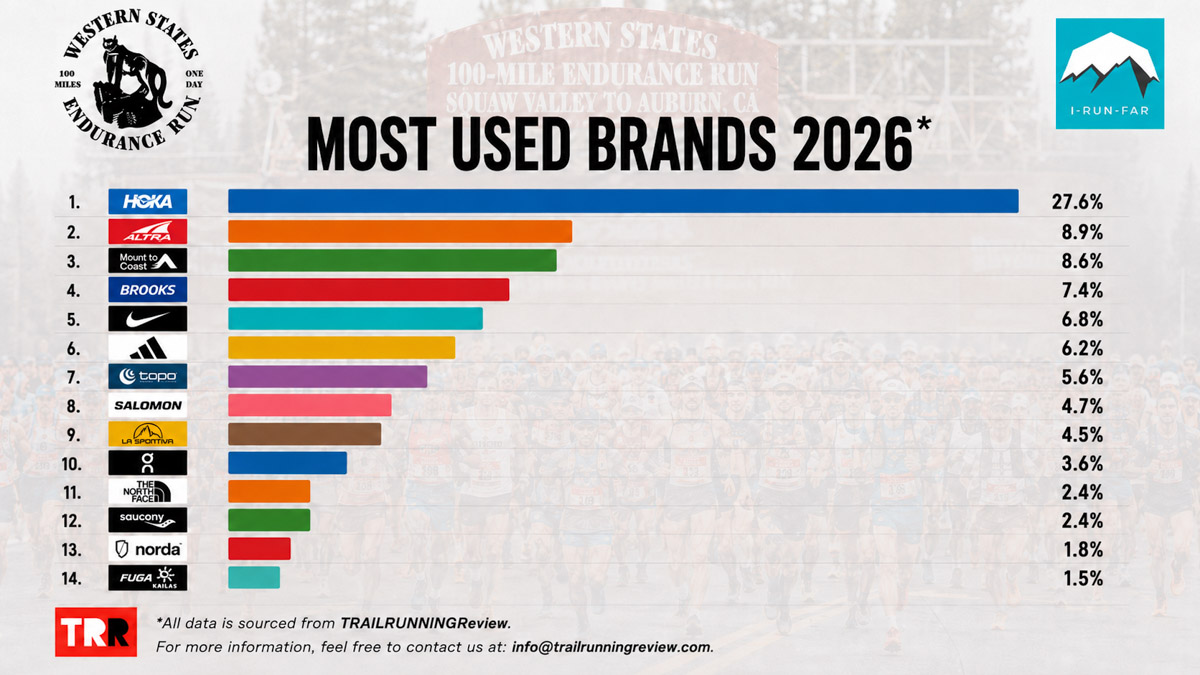
Data collected from 337 documented pairs of shoes — representing the vast majority of the 369-runner field — revealed 70 unique models across 23 brands at the 2026 start line.
Hoka retained its crown as the most popular brand, but the margin of dominance has narrowed considerably. After commanding 32.6% of the start line in 2025, that figure slipped to 27.6% this year.
The brand’s staying power continues to rest on its signature plush midsoles, trusted Vibram outsoles, and carbon-plated options like the Hoka Tecton X 3 and Hoka Rocket X Trail. The Hoka Speedgoat remains the single most popular individual model for a second consecutive year — with the Speedgoat 7 proving especially prevalent — though its combined share across versions dipped from 13.4% to 12.5%.
The Hoka Tecton X held second place among models, though it also eased from 8.2% down to 6.8%.
The Brand Nobody Expected: Mount to Coast Changes Everything
Here’s where things get genuinely surprising.
If you want something simple that actually works, this is one of the most effective tools I’ve used to build strength, conditioning, and endurance without needing a full gym setup.
- Full-body training with one weight using swings, squats, and presses
- Solid cast iron build that feels stable and lasts for years
- Comfortable grip that makes high-rep workouts easier to handle
Mount to Coast — a brand that didn’t register anywhere in the top 15 at the 2025 race — launched straight to third place overall in 2026, capturing an 8.6% share of the start line with its H1, T1, and M1 models.
To put that in perspective, that’s nearly matching Altra’s entire presence in a single year of debut visibility. The Mount to Coast H1 alone claimed a 5.0% share among individual models, while the T1 added another 3.6% — both landing inside the top seven.
It’s the kind of breakthrough that signals a brand has gone from niche curiosity to legitimate contender almost overnight.
Winners and Losers Among the Established Names
Not every legacy brand had a reason to celebrate this year.
Altra held second place overall but saw its share slide from 12.9% to 8.9% — a drop that left it nearly within touching distance of a brand that didn’t exist in the conversation twelve months ago.
Salomon suffered the steepest decline among established names, falling from 7.7% and third place in 2025 all the way down to 4.7% and eighth in 2026. NNormal, which held a 2.7% share last year, dropped out of the leading group entirely.
If you want something simple that actually works, this is one of the most effective tools I’ve used to build strength, conditioning, and endurance without needing a full gym setup.
- Full-body training with one weight using swings, squats, and presses
- Solid cast iron build that feels stable and lasts for years
- Comfortable grip that makes high-rep workouts easier to handle
On the flip side, Brooks had a strong year, climbing from 5.2% and sixth place up to 7.4% and fourth. Much of that momentum is credited to the Brooks Cascadia Elite — the same shoe Chris Myers wore to a second-place finish at last year’s Western States.
Nike edged up slightly from 6.3% to 6.8%, and adidas Terrex held firm at 6.2%. The adidas Terrex Agravic Speed Ultra actually gained ground among individual models, climbing from 4.9% to 5.3% and landing in third place overall.
La Sportiva nearly doubled its presence — from 2.7% to 4.5% — powered largely by the La Sportiva Prodigio Pro, which broke into the top five models with a 3.9% share.
New Faces, Disappearing Acts, and the Rise of Prototypes
Several brands made notable first appearances in the upper tier this year.
On climbed from 1.7% to 3.6%, while The North Face entered the top group for the first time, registering at 2.4%. Kailas Fuga — another brand absent from the 2025 count altogether — debuted with a 1.5% share.
Topo improved meaningfully from 4.4% to 5.6%, while Saucony slipped back from 4.4% to 2.4%. Norda held its ground, remaining virtually unchanged at 1.8%.
If you want something simple that actually works, this is one of the most effective tools I’ve used to build strength, conditioning, and endurance without needing a full gym setup.
- Full-body training with one weight using swings, squats, and presses
- Solid cast iron build that feels stable and lasts for years
- Comfortable grip that makes high-rep workouts easier to handle
One of the more intriguing data points? Unclassified prototypes increased in visibility from 2.2% to 3.6%, reflecting the growing number of brands using this iconic course as a real-world testing ground for unreleased footwear.
Some of tomorrow’s most talked-about shoes may already be somewhere out on that trail — they just don’t have a name yet.
What the Numbers Actually Tell Us
Perhaps the most telling takeaway from this year’s data isn’t any single brand’s rise or fall — it’s the broader trend of fragmentation.
In 2025, the top two brands combined for 45.5% of the start line. In 2026, that figure dropped to just 36.5%. Runners are spreading their loyalty across a wider field of options than ever before, and newer brands are earning genuine trust at the sport’s most demanding stage.
With 70 unique models from 23 brands documented at a single race start, the trail running shoe market has never looked more competitive — or more exciting for the athletes who depend on every advantage the right pair of shoes can provide.