Hollywood’s most dramatic body transformations don’t happen in makeup trailers.
They unfold over months of punishing training regimens that would send most fitness enthusiasts running for the nearest couch.
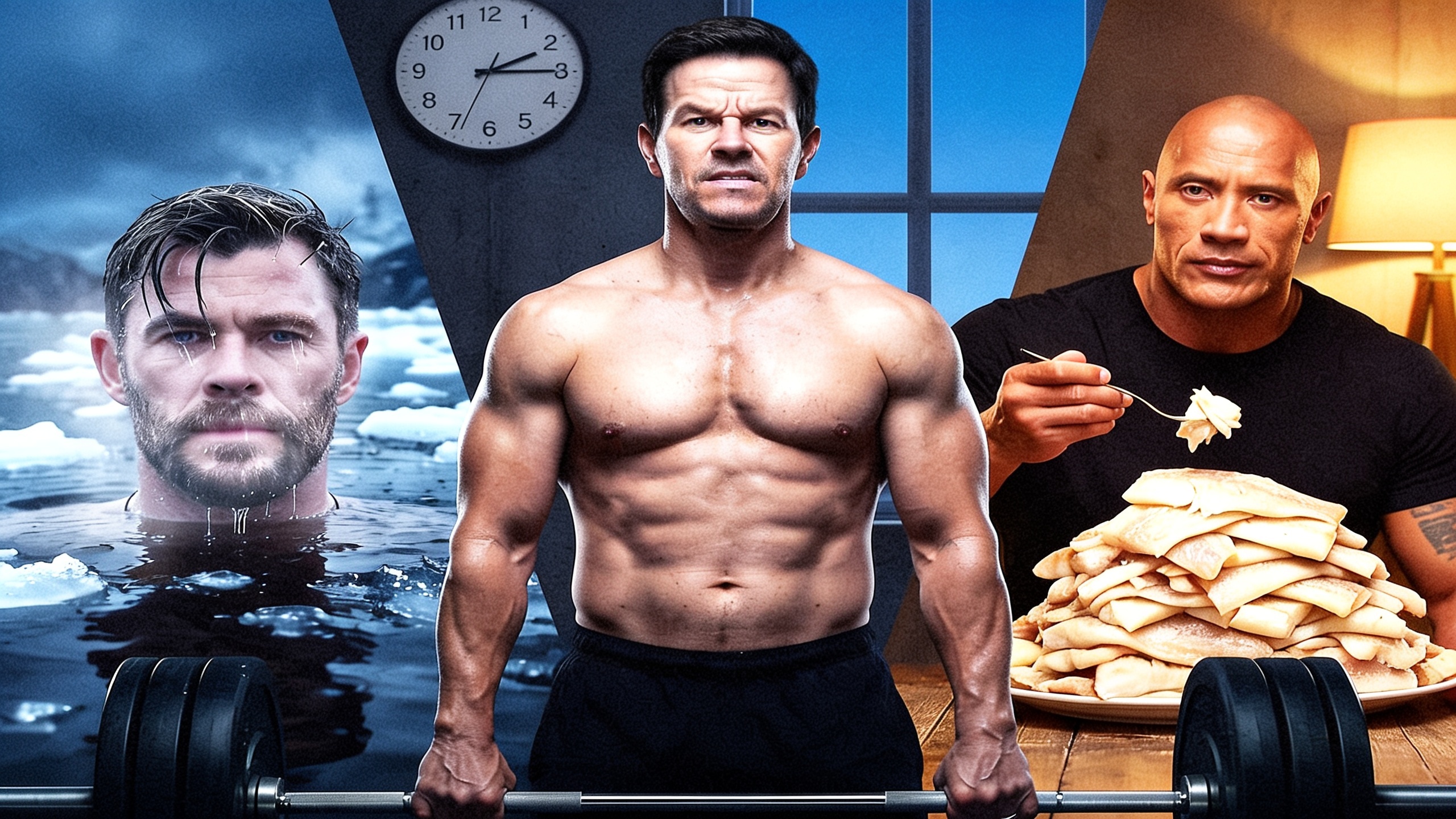
From waking in the dead of night to chug protein shakes to holding your breath underwater for over seven minutes, A-list actors routinely push their bodies to extremes that blur the line between dedication and danger.
What emerges is a world where access to unlimited resources meets contractual pressure—and where the numbers behind these transformations reveal as much about Hollywood’s mythology as they do about actual fitness science.
Jump to:
- The Two Thousand Sit-Up Question
- Midnight Protein and Sleep Disruption
- Seven Minutes Without Air
- The Infrastructure Behind Impossible Bodies
- The Spartacus Protocol
- Female Bodies Under Scrutiny
- What Gets Left Out of Press Junkets
- Contractual Obligations and Commercial Pressure
- The Gap Between Hollywood and Evidence-Based Training
- When the Cameras Stop Rolling
- The Mythology and the Reality
- Sources
The Two Thousand Sit-Up Question
Jake Gyllenhaal’s preparation for Southpaw became the stuff of gym legend.
The 2015 boxing drama required Gyllenhaal to embody a professional fighter, and according to widely reported accounts, he performed 2,000 sit-ups daily as part of his training protocol. He worked alongside former world champion Miguel Cotto’s team and trained under boxing coach Terry Claybon.

If you want something simple that actually works, this is one of the most effective tools I’ve used to build strength, conditioning, and endurance without needing a full gym setup.
- Full-body training with one weight using swings, squats, and presses
- Solid cast iron build that feels stable and lasts for years
- Comfortable grip that makes high-rep workouts easier to handle
But fitness experts have questioned whether such extreme volume represents optimal training—or just makes for compelling publicity.
Terry Claybon, one of Gyllenhaal’s trainers, was quoted by Esquire UK cautioning general audiences against replicating such protocols.
Even the fittest athletes know the value of rest to repair and rebuild.
The reality is that excessive abdominal training carries significant overtraining risks, including muscle fatigue, decreased performance, and potential injury. Sports scientists note that muscle development occurs during recovery periods, not during the workout itself.
Whether Gyllenhaal actually completed exactly 2,000 repetitions every single day remains unverified—the figure originates from promotional interviews rather than training logs independently reviewed by fitness professionals.
Midnight Protein and Sleep Disruption
Hilary Swank’s transformation for Million Dollar Baby took dedication to another level entirely.
The actress reportedly set alarms to wake during the night specifically to consume protein shakes, ensuring her muscles received constant fuel during her intense training period. The commitment earned her a second Academy Award for Best Actress in 2004.
If you want something simple that actually works, this is one of the most effective tools I’ve used to build strength, conditioning, and endurance without needing a full gym setup.
- Full-body training with one weight using swings, squats, and presses
- Solid cast iron build that feels stable and lasts for years
- Comfortable grip that makes high-rep workouts easier to handle
Director Clint Eastwood later praised her physical preparation as among the most committed transformations he’d witnessed in his decades-long career.
But the strategy of interrupted sleep for nutrient timing raises questions among sports nutritionists.
While muscle protein synthesis does occur during sleep, and protein consumption supports this process, disrupting sleep cycles may actually undermine recovery more than the midnight protein helps. Quality sleep is itself one of the most powerful recovery tools athletes possess.
Sports scientists generally recommend consuming approximately 1.5 grams of protein per kilogram of bodyweight for muscle building. Excess protein beyond this threshold doesn’t convert to additional muscle—it’s typically stored as fat or used for energy.
Seven Minutes Without Air
Kate Winslet’s preparation for Avatar: The Way of Water ventured into territory few humans ever experience.
The actress held her breath underwater for 7 minutes and 14 seconds during filming—a feat verified by multiple entertainment outlets including Variety and The Hollywood Reporter. Her achievement reportedly surpassed even co-star Tom Holland’s previous on-set record.
If you want something simple that actually works, this is one of the most effective tools I’ve used to build strength, conditioning, and endurance without needing a full gym setup.
- Full-body training with one weight using swings, squats, and presses
- Solid cast iron build that feels stable and lasts for years
- Comfortable grip that makes high-rep workouts easier to handle
Director James Cameron, himself an experienced diver who has explored the deepest ocean trenches, attempted to beat Winslet’s record but fell short.
Breath-holding at this duration requires specialized freediving training that focuses on CO2 tolerance, mental conditioning, and cardiovascular adaptation. Elite freedivers spend years developing these capabilities under expert supervision.
For context, the average person can hold their breath for 30 seconds to 2 minutes. Winslet’s performance places her in rarefied company—the current world record for static apnea (holding breath while stationary) exceeds 11 minutes, but such achievements require years of dedicated training.
The Infrastructure Behind Impossible Bodies
What separates celebrity transformations from typical fitness journeys isn’t just willpower.
It’s unlimited access to resources that most people will never encounter in a lifetime of gym memberships.
A-list actors preparing for physically demanding roles typically work with:
If you want something simple that actually works, this is one of the most effective tools I’ve used to build strength, conditioning, and endurance without needing a full gym setup.
- Full-body training with one weight using swings, squats, and presses
- Solid cast iron build that feels stable and lasts for years
- Comfortable grip that makes high-rep workouts easier to handle
- Full-time personal trainers who design and supervise every workout session
- Dedicated nutritionists who calculate macro ratios and meal timing down to the gram
- Personal chefs who prepare every meal according to precise specifications
- On-call medical professionals who monitor health markers and address injuries immediately
- Physical therapists who provide daily recovery work and injury prevention
Daniel Craig’s trainer Simon Waterson told GQ that after just months of focused training for his James Bond role, Craig was performing like a competitive athlete.
After a few months of training, Craig was lifting and performing like an athlete, with full focus and discipline.
This level of transformation becomes possible when training is your full-time job—when you’re not balancing workouts around a 9-to-5 schedule, family obligations, or budget constraints.
The Spartacus Protocol
The cast of Spartacus: Blood and Sand followed what became one of television’s most notorious training protocols.
Actors reportedly completed approximately four hours of circuit training daily while consuming six protein shakes per day to maintain their gladiator physiques throughout filming.
The regimen produced undeniably dramatic visual results—but also raised questions about sustainability and long-term health impacts.
Four-hour daily training sessions exceed what most sports scientists recommend even for elite athletes in peak training phases. Such volume leaves little time for the recovery that actually builds strength and muscle.
If you want something simple that actually works, this is one of the most effective tools I’ve used to build strength, conditioning, and endurance without needing a full gym setup.
- Full-body training with one weight using swings, squats, and presses
- Solid cast iron build that feels stable and lasts for years
- Comfortable grip that makes high-rep workouts easier to handle
Six daily protein shakes suggest protein intake far beyond evidence-based recommendations, potentially stressing kidneys and digestive systems while providing no additional muscle-building benefit beyond what moderate, well-timed protein consumption would achieve.
Female Bodies Under Scrutiny
Female actors face unique pressures during physical transformations.
Daisy Ridley trained five hours daily, five days per week preparing for her role as Rey in Star Wars: The Force Awakens. Her reported diet consisted primarily of fish, legumes, and spirulina shakes—a highly restrictive protocol designed to build lean muscle while maintaining Hollywood’s exacting standards for female body composition.
Where male actors are frequently celebrated for gaining mass and appearing “powerful,” female actors must navigate narrower expectations that demand athleticism without bulk, strength without size.
Charlize Theron and Hilary Swank both gained significant muscle for boxing roles, yet both faced commentary about their bodies that male actors in similar transformations rarely encounter.
The psychological toll of these preparations—including disrupted sleep patterns, restrictive eating, and intense training volumes—can extend well beyond filming. Some actors have spoken publicly about struggling to return to normal eating patterns or exercise relationships after months of extreme protocols.
If you want something simple that actually works, this is one of the most effective tools I’ve used to build strength, conditioning, and endurance without needing a full gym setup.
- Full-body training with one weight using swings, squats, and presses
- Solid cast iron build that feels stable and lasts for years
- Comfortable grip that makes high-rep workouts easier to handle
What Gets Left Out of Press Junkets
Entertainment media coverage of celebrity transformations tends to focus on willpower and dedication.
What receives far less attention are the medical interventions that accelerate recovery and enable training volumes impossible for unassisted athletes.
Industry insiders note that platelet-rich plasma (PRP) injections for rapid injury recovery have become relatively common among actors preparing for action roles. These treatments, while legal, represent significant medical interventions that speed healing beyond natural rates.
More controversially, widespread speculation exists about performance-enhancing substances in Hollywood transformations—particularly when middle-aged actors add 20+ pounds of muscle in months while simultaneously dropping body fat to single-digit percentages.
The industry remains largely silent on this topic, and actors rarely address such questions directly in interviews.
Contractual Obligations and Commercial Pressure
Behind every dramatic transformation lies a complex web of professional incentives.
If you want something simple that actually works, this is one of the most effective tools I’ve used to build strength, conditioning, and endurance without needing a full gym setup.
- Full-body training with one weight using swings, squats, and presses
- Solid cast iron build that feels stable and lasts for years
- Comfortable grip that makes high-rep workouts easier to handle
Major studio contracts increasingly include specific physical appearance clauses that actors must meet or face financial penalties. For superhero franchises and action films, maintaining a particular physique becomes a contractual requirement that extends across multiple films and years.
Box office performance often correlates with lead actors’ physical transformations in action and biographical films. Studios know that before-and-after photos generate publicity and social media engagement that translates to ticket sales.
The competitive nature of A-list casting creates additional pressure. When every other actor auditioning for a role is willing to undergo extreme preparation, refusing to match that commitment can mean losing career-defining opportunities.
The Gap Between Hollywood and Evidence-Based Training
Sports scientists emphasize that optimal training looks dramatically different from celebrity protocols.
Evidence-based muscle building prioritizes:
- Progressive overload rather than extreme daily volume
- Adequate recovery periods between intense training sessions
- Moderate protein intake distributed throughout the day
- Uninterrupted sleep as a primary recovery tool
- Sustainable training volumes that can be maintained long-term without injury
The extreme protocols that make headlines often represent exactly what fitness professionals advise against for long-term health and sustainable results.
If you want something simple that actually works, this is one of the most effective tools I’ve used to build strength, conditioning, and endurance without needing a full gym setup.
- Full-body training with one weight using swings, squats, and presses
- Solid cast iron build that feels stable and lasts for years
- Comfortable grip that makes high-rep workouts easier to handle
Overtraining syndrome, hormonal disruption, metabolic adaptation, and increased injury risk all become more likely as training volume and dietary restriction increase beyond evidence-based recommendations.
For general populations seeking fitness improvements, consistency trumps intensity every time. Modest, sustainable training protocols followed for years will always outperform extreme measures that lead to burnout, injury, or abandonment.
When the Cameras Stop Rolling
Few entertainment outlets follow up on what happens after filming wraps.
Many actors report difficulty returning to normal exercise and eating patterns after months of extreme preparation. Some describe feeling unmoored without the structure of mandatory training sessions and precise meal timing.
Others experience rebound effects—rapid weight gain, loss of muscle mass, or disrupted relationships with food and body image that persist long after the premiere.
The temporary nature of most Hollywood transformations reveals an important truth: these protocols aren’t designed for health or longevity. They’re designed to create a specific appearance for a limited time period, regardless of long-term consequences.
If you want something simple that actually works, this is one of the most effective tools I’ve used to build strength, conditioning, and endurance without needing a full gym setup.
- Full-body training with one weight using swings, squats, and presses
- Solid cast iron build that feels stable and lasts for years
- Comfortable grip that makes high-rep workouts easier to handle
Christian Bale’s repeated dramatic weight fluctuations for roles—dropping to 120 pounds for The Machinist before bulking up for Batman Begins months later—prompted his doctor to warn him about potential permanent damage to his metabolism and cardiovascular system.
The Mythology and the Reality
Celebrity transformation stories serve a specific narrative function in entertainment media.
They demonstrate commitment, generate publicity, and create compelling behind-the-scenes content that extends a film’s marketing reach. Whether every reported detail is precisely accurate matters less than the story it tells about dedication and sacrifice.
The exact number of Gyllenhaal’s daily sit-ups or the precise timing of Swank’s midnight protein shakes may be less important than what these stories represent: a willingness to push boundaries that separates serious actors from everyone else.
But for audiences consuming these stories, distinguishing between inspiration and unrealistic expectation becomes crucial.
What works for someone with unlimited resources, contractual obligations, and a career riding on physical transformation should never become the standard by which regular people judge their own fitness journeys.
If you want something simple that actually works, this is one of the most effective tools I’ve used to build strength, conditioning, and endurance without needing a full gym setup.
- Full-body training with one weight using swings, squats, and presses
- Solid cast iron build that feels stable and lasts for years
- Comfortable grip that makes high-rep workouts easier to handle
The most sustainable transformations happen slowly, prioritize health over appearance, and can be maintained long after any hypothetical cameras stop rolling.
Sources
- Esquire UK: Hollywood workout tips — https://www.esquire.com/uk/life/fitness-wellbeing/a32203276/hollywood-workout-tips-christian-bale-tom-hardy-dwayne-johnson/
- Variety: Kate Winslet breath-holding record
- The Hollywood Reporter: Avatar Way of Water production details
- GQ: Daniel Craig training interview