From manicured lawns to towering skyscrapers, some careers demand more than just skill—they require relentless physical endurance.
What happens when one person attempts to tackle America’s most grueling jobs in rapid succession?
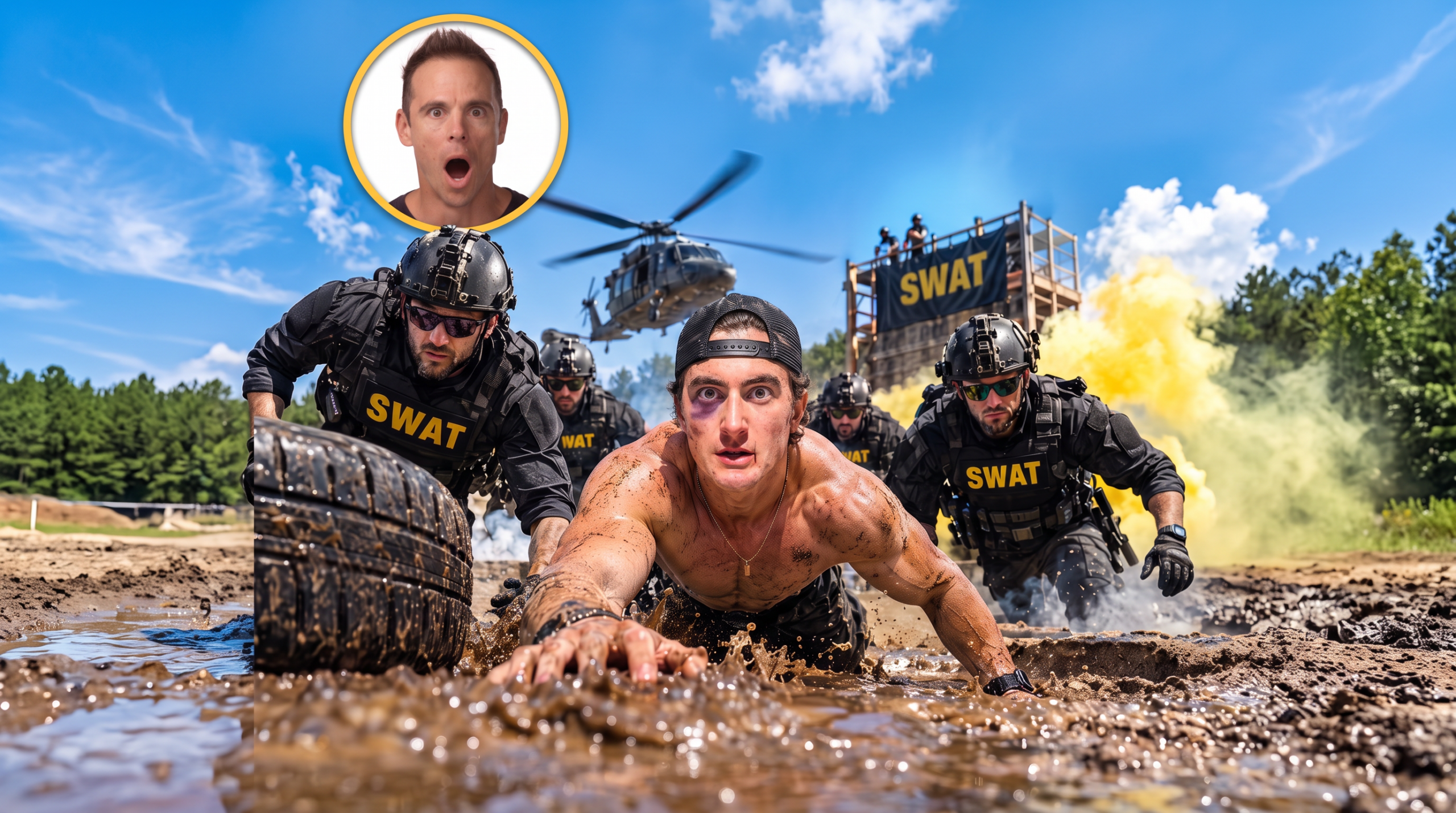
The answer involves torn hands, burning lungs, and a profound respect for the workers who make these punishing careers look routine.
In an eye-opening journey through the nation’s most physically demanding professions, fitness content creator Jesse James West discovered that gym strength doesn’t always translate to real-world toughness—and that the hardest jobs often belong to the people we see every day but rarely truly notice.
Jump to:
- The Landscaping Gauntlet: Where Trees Fight Back
- Roofing: Fighting Gravity and Fear Simultaneously
- Farming: Where Every Muscle Gets Its Turn
- Timber Sports: Where Lumberjacks Become Athletes
- Construction: Demolition as Full-Body Workout
- Firefighting: The Crown of Physical Careers
- Olympic Athletes: When Fitness Becomes Art
- SWAT Academy: The Ultimate Test of Relentlessness
- What Makes Work Truly Demanding?
- The Relentless Worker Award: Brian’s Victory
- Lessons from the Hardest Jobs in America
The Landscaping Gauntlet: Where Trees Fight Back
Landscaping a $10 million property sounds glamorous until you’re shoulder-deep in dirt, wrestling a 300-pound tree from its roots.
West’s first challenge involved exactly that: excavating mature trees from a backyard and replanting them in the front—a task that immediately humbled his gym-trained physique.
I feel like I’m not doing anything. I’m like trying really hard, but nothing’s really happening. I feel like they’re doing a lot more than me.
The crew, led by experienced landscapers, made the work appear effortless while West struggled with basic tasks.
The physical demands weren’t limited to tree removal. Hauling river rock by wheelbarrow, placing each stone by hand, and maintaining perfect precision on a multi-million-dollar property added layers of pressure beyond raw strength.
Doing a different job than usual requires such different muscles in the body where my forearms and like fingers, like the hand muscles are really tired.
One landscaper stood out among the crew: Arnulfo, whose work ethic caught West’s attention immediately.
This encounter planted the seed for West’s “most relentless worker” award, though he wisely decided not to hand it out on day one.
Roofing: Fighting Gravity and Fear Simultaneously
Heights and steep slopes create a psychological battle that compounds the physical challenge of roofing.
West’s second job took him dozens of feet into the air, balancing on a pitched roof while ripping off old shingles—a task that burns approximately 590 calories per hour while simultaneously triggering primal survival instincts.
It doesn’t look that high when you’re on the ground, but then when you’re up here, it’s way more scary. It is actually very tiring. It’s like digging holes, but you are fighting adrenaline cuz you feel like you’re going to die.
The work involved three main tasks: removing old shingles, repairing damaged roof sections, and installing new materials.
Each required different skill sets, from the brute force of tearing away old materials to the precision of cutting replacement plywood to exact specifications.
Brian, the roofing company owner supervising West, demonstrated the vast gap between amateur and professional performance.
What took West minutes to accomplish, experienced roofers completed in seconds—a disparity that would repeat itself across nearly every job in this challenge.
Farming: Where Every Muscle Gets Its Turn
Modern farming still demands old-fashioned physical labor, as West discovered at Braglio Farms.
Under Roman’s guidance, the day’s agenda included clearing hay feeders, mucking pig pens, chopping firewood, and wrangling cattle—each task engaging different muscle groups in unexpected ways.
Farmers probably burn so many calories a day.
Research confirms this observation: farmers burn approximately 600 calories every hour on average, making it one of the most calorically demanding professions.
The pig pen cleaning proved particularly challenging, not for the physical exertion but for the sensory assault.
I’m fighting every urge to gag. Oh, it makes me light-headed.
Mental toughness matters as much as physical strength in farming. Workers must push through unpleasant conditions while maintaining focus on safety and animal welfare.
The firewood chopping segment revealed yet another layer of farm work complexity.
While the traditional axe method provided a workout, modern farmers use hydraulic splitters for efficiency—a reminder that even physically demanding jobs evolve with technology.
Timber Sports: Where Lumberjacks Become Athletes
Competitive timber sports transforms traditional logging skills into high-intensity athletic events.
West entered his first timber sports competition with minimal preparation, learning from Matt Cogar, the world’s number one timber sports athlete, just hours before competing.
The competition included five disciplines: springboard chop, stock saw, standing block chop, single buck saw, and underhand chop.
Each required specialized technique that took competitors years to master.
Everything you’re learning here is exactly the same thing that they were learning in the timber industry in the forest in the 1900s.
The sport’s origins date back to 1880, when loggers would compete during breaks to determine who possessed superior skills.
Despite the crash course, West managed to place fourth in one event—a surprising achievement given his inexperience.
However, his final underhand chop event nearly ended in disaster when the axe flew dangerously close to his head, illustrating why these competitions require extensive safety equipment and training.
Construction: Demolition as Full-Body Workout
Construction work combines strength, endurance, and problem-solving in ways that gym training rarely replicates.
Returning to work with Brian, West tackled demolition tasks that can burn up to 700 calories per hour—tearing out plaster walls, removing ceilings from above, and hauling a cast-iron bathtub down narrow stairs.
It’s like a bunch of overhead presses, a bunch of Russian twists with a medicine ball. All those things in the gym apply in here.
The work proved deceptively complex.
Removing ceiling plaster required attacking it from above, standing on joists while avoiding falling through—a task demanding balance and spatial awareness alongside brute strength.
The bathtub removal became the day’s defining challenge.
Weighing an estimated 400 pounds, it required careful maneuvering through doorways and down stairs without damaging the property or injuring the workers.
Firefighting: The Crown of Physical Careers
If one profession stands above all others for physical demands, firefighting claims that title.
West trained with Miami-Dade firefighters, who showed him why their job consistently ranks as America’s most physically challenging career.
Firefighters can burn up to 840 calories per hour while on duty. But raw calorie expenditure only tells part of the story—they must maintain peak readiness 24/7, never knowing when an emergency will demand maximum output.
The physical abilities test that begins fire academy training set an immediate benchmark.
West had to run six stories of stairs while hauling heavy hoses, completing 12 total laps (equivalent to 1.6 miles) in full gear weighing 120 pounds.
The one thing we didn’t mention when we started was tank, gear, boots, helmet plus the pack, you’re probably 120 lbs heavier than you normally are.
The simulated fire rescue pushed West to his limits.
Crawling through smoke-filled corridors, dragging a dummy victim to safety, then immediately responding to a “firefighter down” scenario tested not just strength but decision-making under extreme stress.
Why Firefighting Tops the List
Several factors combine to make firefighting uniquely demanding:
- Equipment weight: The 120 pounds of protective gear turns every movement into a resistance exercise
- Environmental hazards: Extreme heat, toxic smoke, and zero visibility compound physical challenges
- Unpredictability: Unlike most jobs with routine schedules, firefighters must maintain peak condition for emergencies that strike without warning
- Life-or-death stakes: Mistakes don’t just affect productivity—they can cost lives
Safety’s number one priority. Don’t enter a timbersport woodsport without actual practice. This just shows you this is the craziest sport in the world.
Olympic Athletes: When Fitness Becomes Art
West’s journey included competitions against Olympic and Paralympic athletes across multiple disciplines.
From diving with Allison Schmitt to track and field with Ashton Eaton, wrestling with Toccara Winchester, and rugby with Team USA members, each encounter revealed the enormous gap between general fitness and sport-specific excellence.
The diving competition with four-time Olympic gold medalist Schmitt showcased this disparity perfectly.
Despite West’s athletic background, his diving form earned gentle mockery from judges who gave both competitors identical 9.5 scores—likely more from kindness than accuracy.
Track and field proved equally humbling.
Pole vaulter coaches demonstrated jumps clearing nearly 18 feet while West celebrated clearing a bar set at just 6 feet.
So, right there. What? So, yeah, you can uh go for that one. What the heck, bro? You Are you lying right now?
The One Victory: Women’s Rugby Fitness Test
West finally achieved victory against Olympic competition in the “Bronco” test—a brutal fitness challenge used by women’s rugby teams.
The course required sprinting to progressively distant cones and back, five times total.
Completing it in 4:36, West beat the team’s best time of 4:46—his only win against Olympic-level athletes throughout the entire journey.
SWAT Academy: The Ultimate Test of Relentlessness
West concluded his journey by attempting to survive a 50-hour SWAT academy selection course.
Led by Cadre Dennis Medina, the experience combined extreme physical demands with psychological warfare designed to identify candidates who could perform under pressure.
The academy began with a seemingly generous gesture: donuts to fuel the day ahead.
But this was actually the first test—would West stop at six donuts as instructed, or push beyond to demonstrate maximum effort?
If I tell you it’s 50 push-ups in 2 minutes, when you get to 50 push-ups, you’re going to stop or you going to keep going until the 2 minutes are over? What type of person are you?
Physical challenges came in relentless waves: distance runs without knowing the endpoint, treading water for 15 minutes, swimming laps while fighting exhaustion, and over 100 repetitions of pulling himself out of the pool while memorizing Teddy Roosevelt’s “Man in the Arena” speech.
The Mental Game
SWAT training revealed that mental resilience matters more than physical capability.
Instructors deliberately withheld information, changed expectations without warning, and pushed candidates past their perceived limits to identify who would quit versus who would adapt.
During the pool exercises, West reached his breaking point, struggling against nausea and exhaustion.
Officer Orlando refused to let him quit, delivering a lesson about pushing beyond comfort zones in controlled environments.
You’re in 5 ft of water. What’s going to happen? There’s a fire rescue going to happen. So why quit? If any world you could push it, it’s here. Where you’re in your safe zone.
Day Two: When Pain Becomes Purpose
The second day included helicopter water rescue drills, boat casting exercises, building repelling, and culminated with controlled exposure to tear gas—three separate exposures of increasing intensity to train officers for chemical agent deployment scenarios.
The tear gas exposure provided the academy’s most visceral lesson.
West first experienced it with a mask on, then with the mask briefly opened, and finally with no protection while reciting his memorized speech.
The burning sensation across every exposed skin surface demonstrated why chemical agents prove so effective for crowd control and why SWAT officers must build tolerance to operate in contaminated environments.
What Makes Work Truly Demanding?
After experiencing over a dozen physically challenging careers, certain patterns emerged about what separates merely difficult work from truly grueling professions.
Duration matters more than intensity. Short bursts of maximum effort—like competitive athletics—differ fundamentally from eight-to-twelve-hour shifts of sustained physical labor.
Landscapers, construction workers, and farmers can’t recover between sets; they maintain constant output throughout entire workdays.
Environmental factors multiply difficulty. Roofers battle height-induced fear alongside physical exertion. Farmers work through oppressive heat and unpleasant conditions. Firefighters operate in life-threatening environments where every breath requires filtering through equipment.
Unpredictability creates unique stress. Firefighters and SWAT officers must maintain constant readiness, never knowing when a call will demand immediate maximum performance. This 24/7 vigilance takes psychological tolls that scheduled workouts never approach.
Skill requirements exceed raw strength. Timber sports competitors weren’t necessarily stronger than West—they possessed years of refined technique. Olympic athletes demonstrated that sport-specific training creates advantages that general fitness can’t overcome.
The Relentless Worker Award: Brian’s Victory
Throughout his journey, West carried a plaque for the “most relentless employee,” planning to award it to someone who exemplified exceptional work ethic.
The winner? Brian, the roofing company owner who also supervised construction work—a man who built successful businesses through the same physical labor he continued to perform daily.
For showing the most passion, grit, and hard work across their position, you have won the most relentless employee.
Brian’s recognition highlighted an important truth: the hardest workers often lead by example rather than from behind desks.
Lessons from the Hardest Jobs in America
West’s journey through physically demanding careers offers insights that extend beyond fitness and work.
Respect for skilled trades should increase. The landscapers, roofers, construction workers, and farmers who build and maintain society’s infrastructure perform work that proves far more demanding than most people realize.
Physical preparation alone doesn’t guarantee success. Technique, experience, and mental toughness often matter more than raw strength or cardiovascular fitness.
Discomfort creates growth. Whether in SWAT training’s deliberate challenges or timber sports’ learning curve, pushing past comfort zones reveals capabilities that otherwise remain dormant.
Community matters in hard work. From landscaping crews working in synchronized efficiency to firefighters depending on each other in life-threatening situations, the hardest jobs rarely succeed through individual effort alone.
Perhaps most importantly, West’s experience demonstrated that truly challenging work combines physical demands with mental resilience, skill development, and purpose beyond personal achievement.
The people performing America’s hardest jobs don’t do so for recognition or social media content—they do it because someone must, because they’ve developed rare skills, and because their work matters to communities that depend on them.
From the $10 million property landscaper to the firefighter running into burning buildings, these workers demonstrate daily what relentlessness actually means—not a single heroic effort captured on camera, but sustained excellence through conditions most people never experience and couldn’t imagine enduring.