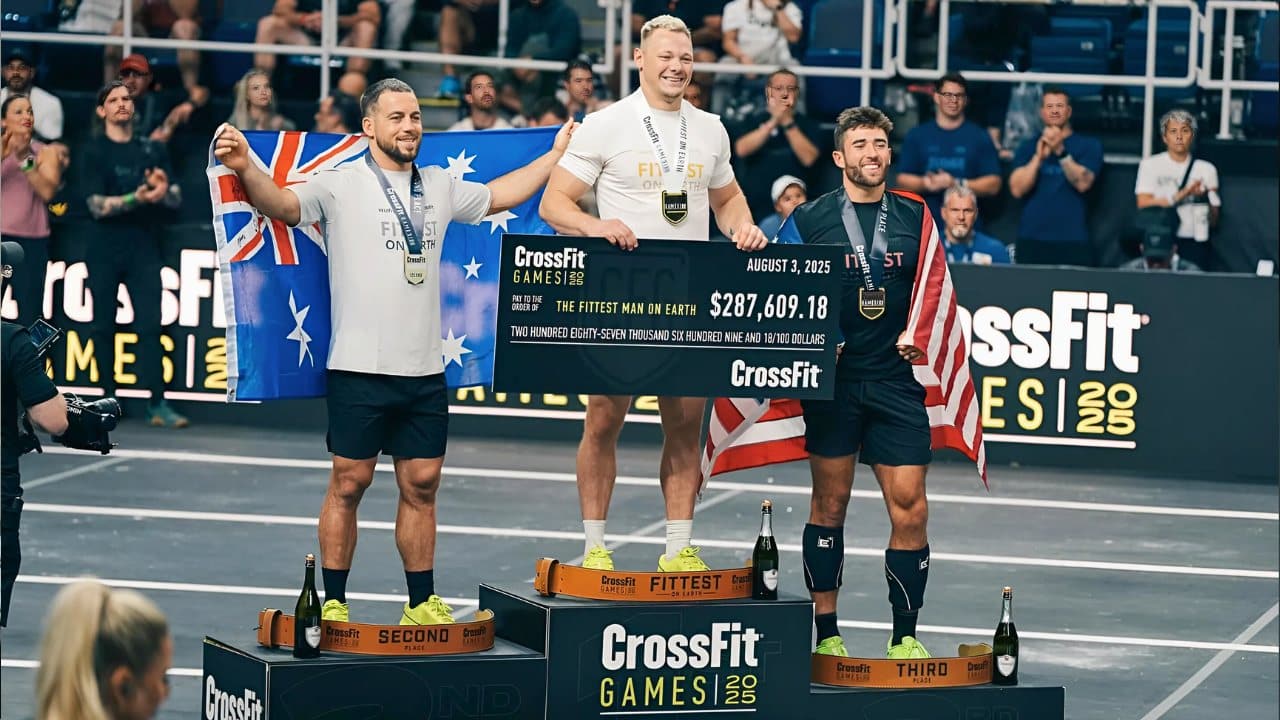
Jason Hopper’s journey to becoming the 2025 CrossFit Games champion wasn’t about chasing a magic competition weight — it was about chasing the magic of intensity.
For Hopper, the turning point came after a disappointing 2023 season where he showed up at 230 pounds, only to be cut early. At the time, he thought the number on the scale was the problem.
It wasn’t.
“I realized it was more of a training effect,” Hopper says. “I wasn’t doing a lot of intensity in training. I was just beating my head into a wall with too much volume and not enough quality. I was overtrained and flat.”
Jump to:
Weight Was Never the Real Enemy
After dropping down to 210 the following year, Hopper competed at Rogue Invitational around 220 and hit the podium for the first time. That result convinced him it might be his “working weight.” But as the 2025 season wore on, his body naturally crept back up to 230.
Some of that gain, he admits, came from inflammation due to high training loads. But instead of forcing a cut, he decided to fuel fully for performance.
“I can’t starve myself. I have to keep eating for training. The intensity was the highest it’s ever been in my career, and if I cut weight, I’d risk injury or losing that edge.”
He noticed the extra mass made gymnastics feel harder, but not enough to outweigh the benefits of being fully fueled and recovered.
The Shift From Volume to Intentional Intensity
Hopper’s Vermont training experience taught him a key lesson: not all training pieces deserve to be finished if they can’t be done at full intent.
“There were times this summer where I stopped mid-workout. If I couldn’t give 100%, it wasn’t worth it. The purpose of the workout matters — if the intent is high speed and emptying the tank, doing it at 85% is just wasted volume.”
This approach meant skipping or cutting back sessions, even when others might push through for the sake of completing them.
It wasn’t laziness — it was precision.
Why Training Alone Became a Superpower
One of the biggest changes this season was Hopper’s decision to train mostly alone — no music, no training partners, no adrenaline boosts from head-to-head races.
“I wanted to focus on racing the clock and getting everything out of myself. I didn’t want music to pump me up. I wanted to listen to my breath, fight my own mental battles, and learn to go dark.”
He drew inspiration from top athletes like Justin Medeiros and Patrick Vellner, who consistently perform at an elite level in solo settings. By removing external motivators, Hopper trained himself to generate intensity from within — a skill that paid off when it mattered most.
Embracing Discomfort and Distraction
Hopper even used environmental distractions — like kids running and screaming in the gym — as training tools. Instead of blocking them out, he leaned in.
“I’ve learned to love that. You can’t control the noise at the Games. Learning to focus despite distractions is huge.”
The Takeaway: Intensity Brings Adaptation
While heavy back squat cycles and high training loads built his raw strength, Hopper says none of it would matter without the right intensity on key sessions.
“You’ll still get adaptation without intensity — it just won’t be as great. The magic is in going hard when it counts.”
For Hopper, the win in 2025 was the result of training smarter, not just harder — knowing when to push, when to pull back, and how to self-generate the competitive fire without external crutches.
Key Lessons From Hopper’s 2025 Season:
- Fuel to match your output — under-eating can tank performance faster than extra bodyweight.
- Prioritize workout intent over sheer volume — not every session is worth finishing if the quality isn’t there.
- Train alone to sharpen mental toughness — remove crutches like music and training partners to build intrinsic drive.
- Accept distractions — adapt to chaos instead of trying to control it.
- Intensity is the driver of adaptation — volume without purpose risks injury and stagnation.
Hopper’s story shows that being the “Fittest on Earth” isn’t about hitting a magic number on the scale — it’s about building a body and mind that can deliver 100% effort, exactly when it matters most.
And sometimes, that means turning off the music, closing your circle, and going to war with nothing but the clock.