What happens when you push some of the world’s fittest athletes to their breaking point—while capturing every rep, heartbeat, and watt of power they produce?
In a recent video, the team behind high-performance training platform Strive, in collaboration with W Motions, designed and ran a groundbreaking ramp test using CrossFit movements to find out.
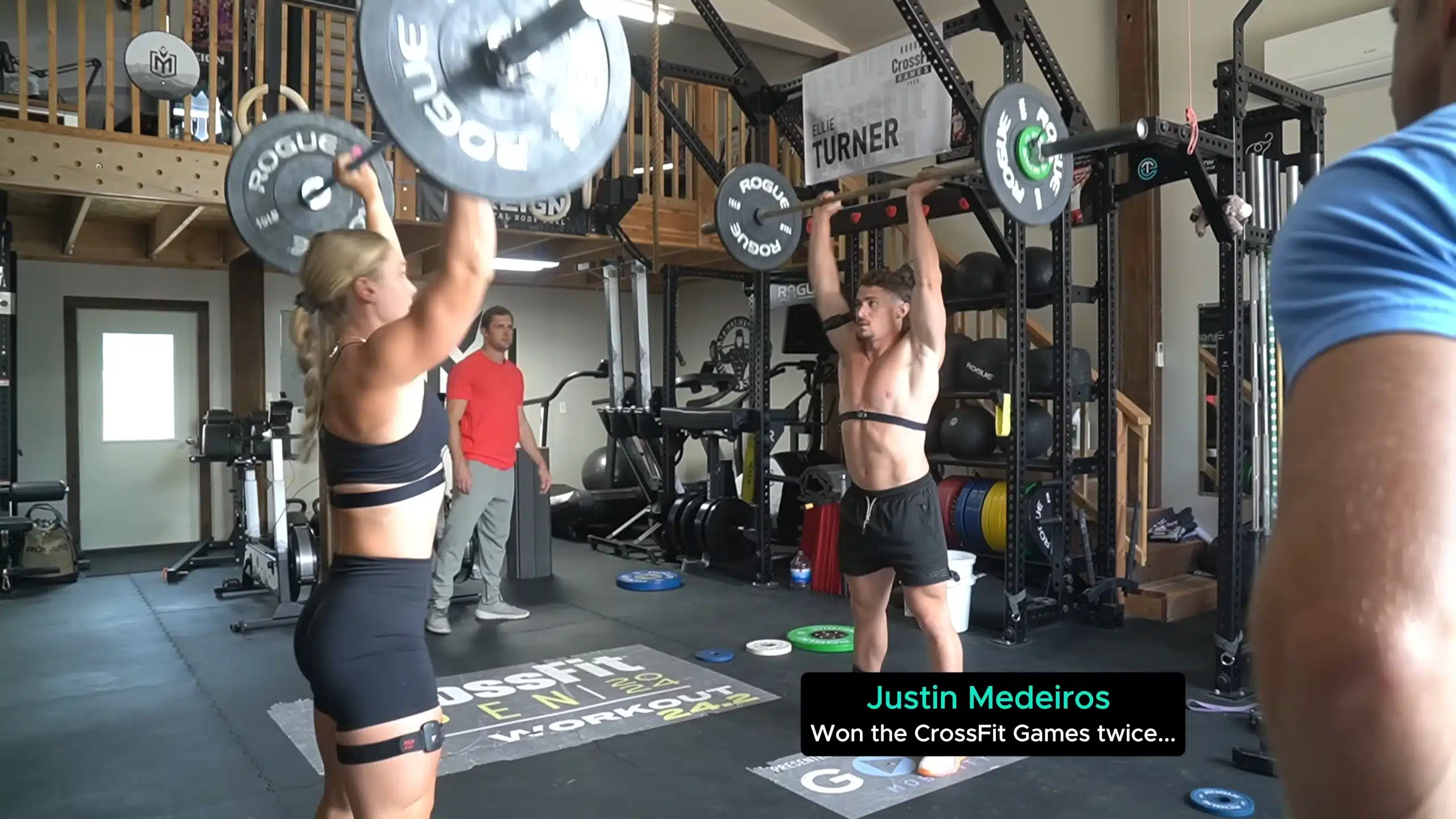
The result? Not just incredible footage of athletes going to the edge, but never-before-seen physiological data that might reshape how we train for elite performance.
This wasn’t just a challenge for bragging rights. It was a deep, science-backed experiment aimed at decoding efficiency, fatigue, and metabolic thresholds.
Here’s what happened when Justin Medeiros, Ellie, Trista, Adam, and others tackled the ramp-to-failure test—and what it could mean for your training.
Jump to:
- What Is a Ramp Test—And Why Turn It Functional?
- The Test: EMOM to Exhaustion
- The Science: What We Measured
- Translating Watts from Thrusters to Snatches—and Beyond
- Why This Matters: Practical Benefits for Athletes
- Building Endurance in CrossFit: The New Approach
- The Takeaway: Smart Recovery, Smarter Programming
What Is a Ramp Test—And Why Turn It Functional?
Ramp tests are a staple in endurance sport science. They involve gradually increasing intensity—in watts for cyclists, or pace for runners—until the athlete reaches total exhaustion. This helps scientists determine thresholds: when the body shifts from aerobic to anaerobic energy use, and when it begins accumulating fatigue faster than it can recover.
For years, this method couldn’t be easily applied to CrossFit or functional training. Movements like burpees or thrusters don’t have simple watt or pace metrics like a treadmill or bike. But thanks to a sensor called W Motions—developed by PhD student Mariah at KTH in Stockholm—this is now possible.
How the Sensor Works
- It tracks real-time movement and displacement using motion capture and biomechanical models.
- Power output is calculated based on body mechanics, acceleration, and load.
- The data measures total power, separating concentric (lifting up) versus eccentric (lowering down) movements.
The sensor was validated against gold-standard lab equipment, allowing for real-world data collection during functional workouts.
The Test: EMOM to Exhaustion
Here’s how the functional ramp test worked:
- Structure: 5-minute EMOM (Every Minute On the Minute) blocks repeated until failure.
- Movements: Minute 1 – 12 thrusters. Minute 2 – 6 burpees. This repeated for 4 minutes, followed by 1 minute of rest with blood lactate measurements and RPE feedback.
- Progression: With each new round, thruster weight increased by 5 lbs, and one extra burpee was added per burpee round (6 → 7 → 8…).
The result? Each round became exponentially harder, just like on a bike ramp test, but using full-body functional movements.
The Science: What We Measured
Lactate Curve
Lactate levels rose in a predictable curve:
- Phase 1: Low lactate → aerobic energy dominant.
- Phase 2: Steady increase → mixed aerobic/anaerobic metabolism.
- Phase 3: Exponential spike → full anaerobic, unsustainable fatigue.
Justin Medeiros had a remarkable curve: his lactate remained low far longer, indicating a massive aerobic base and delayed fatigue. This allowed him to outperform all other athletes and nearly complete 13 brutal rounds.
Calculated vs. Actual Power Output
Using the W Motions sensor, the team compared two metrics:
- Calculated power: Based on textbook mechanics—no wasted motion.
- Actual power: Includes real-world inefficiencies—think shifting posture, shaky elbows, or excessive bouncing.
Movement Efficiency
The ratio of calculated to actual power revealed movement efficiency. Athletes started the test with lower efficiency—likely due to being unaccustomed to slow pacing—but efficiency increased under fatigue as they locked into rhythm.
Justin’s efficiency climbed to nearly 100% during the heaviest rounds. No wasted energy. Every watt counted. In contrast, Adam showed much higher actual power than calculated—suggesting excessive, potentially inefficient movements that drained him earlier.
Translating Watts from Thrusters to Snatches—and Beyond
One of the most exciting innovations was the ability to map power output from thrusters and burpees to different movements—like pull-ups, wall balls, and snatches. This unlocks a new frontier in CrossFit training: building custom workouts that target individual thresholds precisely.
The team tested this by designing a 30-minute EMOM using four functional movements:
- Pull-ups
- Wall balls
- Power snatches
- Deadlifts
Each athlete was given a personalized rep scheme to match their individual threshold based on watts. For example, Justin’s snatch reps were set at 8 based on science—but he was told to do 12. The results showed this pushed his lactate above threshold, proving how delicate and important the correct dosage is.
Why This Matters: Practical Benefits for Athletes
This kind of precise threshold testing has major implications:
Better Training Zones
When you know exactly what wattage equates to your anaerobic threshold, workouts can be tailored with surgical precision.
Recovery Optimization
Training below threshold sharply reduces recovery time. Perfect between competitions or in off-season building periods.
Movement Coaching
Measuring movement efficiency highlights areas to target for improvement—be it strength imbalances, excessive vertical travel, or form breakdowns.
Custom Programming
This data enables coaches to program threshold-based sessions using individual work capacities—making randomized classes a thing of the past.
Building Endurance in CrossFit: The New Approach
Traditionally, CrossFitters train hard—almost always above threshold. In contrast, endurance athletes perform 70-80% of their volume below threshold. According to the research shared, adding 30-40% of low to threshold-effort training (even just once or twice a week) can build a massive aerobic base, reduce fatigue, and prevent burnout.
Examples of ways to incorporate this:
- EMOMs with lighter weights targeting RP 6–8
- Zone 2-style 90-minute workouts using basic CrossFit movements
- Two-a-days pairing threshold work in AM, intensive work in PM
The Takeaway: Smart Recovery, Smarter Programming
Elite fitness isn’t just about suffering harder—it’s about understanding exactly how your body responds to stress and adapting accordingly. Tools like W Motions allow that knowledge to go beyond elite athletes. Recreational athletes, gym owners, and even group class participants can tap into training personalization that once felt impossible without a lab.
Looking to break through plateaus or prevent overtraining? Take a page out of Justin Medeiros’ playbook. Dial in your thresholds. Train smarter. And get more from every rep.