Most fitness enthusiasts believe they need to spend hours in the gym six days a week to achieve serious results.
But what if that’s actually holding you back?
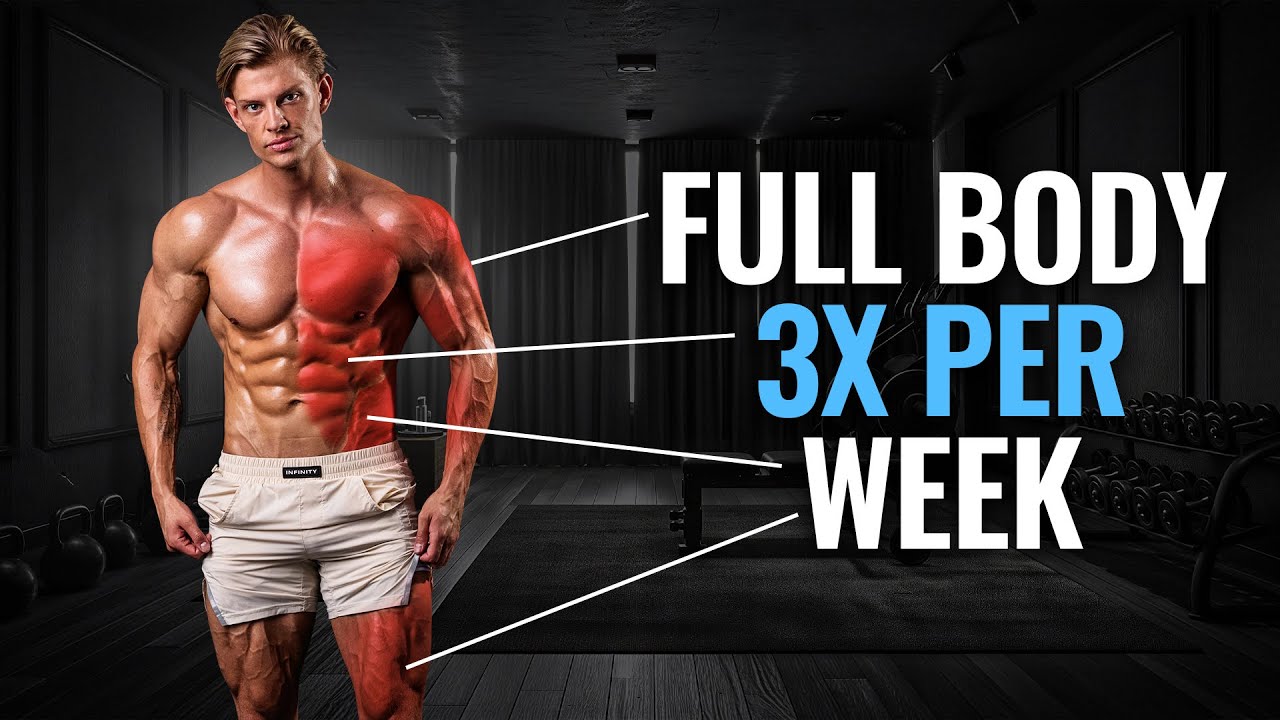
A fitness coach recently shared how he reached 7% body fat while training just three days per week, 45 minutes per session—and the science behind why this approach might work better than traditional high-volume programs.
The results challenge everything we’ve been told about workout frequency and volume.
Jump to:
- The Three-Day Revolution: Why Less Can Be More
- Unexpected Gains on Minimal Volume
- Why Traditional Full-Body Programs Feel Boring
- The RIR System: Training Smart, Not Just Hard
- Calibrating Your Effort: Learning To Judge RIR
- The Four To Eight Rep Range: Optimal Efficiency
- Debunking The Joint Health Myth
- The Essential Warm-Up Protocol
- Workout A: Building The Foundation
- Workout B: Maximizing Efficiency
- The Recovery Advantage
The Three-Day Revolution: Why Less Can Be More
Traditional bodybuilding splits require 90 minutes in the gym, five to six days weekly. That’s simply unrealistic for most people juggling careers, families, and other responsibilities.
Full-body training three times weekly was actually standard practice before performance-enhancing drugs changed the landscape. Legends like Dorian Yates and Mike Mentzer built exceptional physiques using low-volume, high-intensity approaches.
I got to 7% body fat training just three days a week, 45 minutes a session with six to eight sets per muscle group.
The coach designed this program after turning 30 and purchasing a home in Marbella, Spain. With new responsibilities consuming his time and mental energy, he couldn’t maintain his previous six-day training schedule.
Initially, he expected to simply maintain his physique. Instead, something unexpected happened.
Unexpected Gains on Minimal Volume
Rather than losing muscle, he actually made impressive progress. Fat melted away while strength increased during his cut—something typically considered abnormal.
Energy levels soared thanks to improved recovery between sessions. The reduced training frequency allowed his body to fully recuperate before the next workout.
This approach differs dramatically from conventional programs. Instead of performing four sets per exercise, you complete just two hard sets of most movements—sometimes even one.
Each muscle group receives six to eight total sets weekly, significantly less than typical recommendations of 15-20 sets.
Why Traditional Full-Body Programs Feel Boring
Most full-body routines focus exclusively on major compound movements: squats, bench press, deadlifts. When performing three to four sets per exercise, there’s no time for variety.
This low-volume approach changes everything. With only one to two sets per exercise, you can incorporate significantly more movement variety.
For chest development, traditional programs might include only bench press. This program adds flies and machine presses, creating a more engaging and complete training stimulus.
Personally, that just motivates me a lot more, and I go harder on each set because I know it’s only one or two. There is no I’ll save this for the next set mentality.
The RIR System: Training Smart, Not Just Hard
Reps in Reserve (RIR) measures how many additional repetitions you could complete before true muscular failure. If you stop at eight reps but could’ve done ten, you trained with two RIR.
Here’s what most people miss: your set only truly counts when bar speed slows down. That’s when muscle fibers receive meaningful growth stimulus.
I don’t count my sit-ups. I only start counting when it starts hurting because they are the only ones that count.
While Muhammad Ali wasn’t discussing hypertrophy, his principle applies perfectly. This program targets one to two RIR—close to failure without crossing that line.
This differs from Mike Mentzer’s approach of training to absolute failure with forced reps and negatives. Mentzer trained each body part every four to seven days, providing ample recovery time.
Training full-body every 48-72 hours requires a different strategy. Destroying yourself each session prevents adequate recovery for the next workout, sacrificing frequency—one of the program’s main advantages.
Calibrating Your Effort: Learning To Judge RIR
Accurately estimating RIR takes practice. Beginners often stop sets early out of habit, while other times they’ll hit failure when they believed reps remained.
Start practicing on machines where safety isn’t compromised. Try leg press or chest press, stopping when two reps remain.
Film your sets. Review the footage to see if you accurately gauged your proximity to failure. Bar speed visibly slows as you approach true muscular exhaustion.
Over time, you’ll develop internal calibration—recognizing the difference between discomfort and genuine inability to complete another rep.
The Four To Eight Rep Range: Optimal Efficiency
For years, conventional wisdom preached that 8-12 reps created the “hypertrophy zone” for muscle growth. Recent research tells a different story.
Studies demonstrate that rep ranges from five to thirty all stimulate similar muscle growth—provided you train close to failure. However, theory doesn’t always match real-world application.
High-rep training (20-30 reps) creates several problems:
- Intense metabolic burn that feels more like cardio than strength training
- Mental exhaustion that causes premature set termination
- Difficulty distinguishing between muscular failure and metabolic discomfort
- Reduced mechanical tension on muscle fibers
With high reps, people often stop because burning sensations force them to quit—not because their muscles actually failed.
Debunking The Joint Health Myth
Many assume heavier weights damage joints. Research suggests the opposite may be true.
Studies indicate that heavier loads with lower reps may actually benefit joint health. Powerlifting and Olympic weightlifting show relatively low injury rates—averaging just 1 to 4.4 injuries per 1,000 training hours.
Higher rep ranges aren’t inherently problematic, but for a three-day-per-week program with limited volume, mechanical tension through four to eight reps maximizes efficiency.
The Essential Warm-Up Protocol
Never skip warming up, even when time is limited. This quick routine prepares your body and prevents injuries.
Start with 3-5 minutes of light cardio—cycling or treadmill walking increases heart rate and blood flow. Follow with targeted movement drills for lower body, lower back, and upper body (10 reps each).
For upper body movements, use a cable set at the lowest weight rather than dumbbells. Cables provide constant tension throughout the movement path, unlike gravity-dependent free weights.
Working Set Warm-Ups
Before your first exercise for each muscle group, perform progressive warm-up sets:
- Empty bar or very light weight: 10 reps
- 50% of working weight: 6 reps
- 75% of working weight: 3 reps
- Begin working sets
Advanced lifters should add one additional set at 90% for a single rep.
Workout A: Building The Foundation
Romanian Deadlifts
This posterior chain builder targets glutes, hamstrings, and lower back. Training barefoot optimizes stability, while lifting straps prevent grip from becoming the limiting factor.
Keep the bar in contact with your legs throughout the entire movement—imagine shaving your legs as the bar glides from upper thighs to mid-shin. Descend only as far as hamstring flexibility allows while maintaining a flat back.
Leave two reps in reserve to build maximum strength without compromising recovery.
Incline Bench Press
Position thumbs at the beginning of the bar’s textured grip area, then move palms outward—this creates proper grip width just outside shoulder width.
Retract shoulder blades back and down, locking them against the bench for torso stability. Lower the bar slowly to just above your upper chest with elbows tucked approximately 45 degrees.
Pause briefly on your chest before explosively pressing upward. This ensures you’re pressing from the pecs rather than bouncing the weight.
Chest-Supported Rows
T-bar row machines work best, but incline bench dumbbell rows serve as excellent alternatives. The key is eliminating lower back involvement and momentum.
Drive elbows back without excessive tucking—this emphasizes midback and traps. Follow immediately with one quality set of lat pulldowns to target lats specifically.
Additional Exercises In Workout A
- Leg Extensions: Develop the quad sweep (vastus medialis), which squats don’t adequately target
- Incline Lateral Raises: Perform kneeling on a slightly inclined bench to eliminate cheating, leading with elbows
- Incline Skull Crushers: Keep elbows behind your head to stretch the triceps long head fully
- Dumbbell Preacher Curls: One arm at a time, focusing on complete range of motion and lengthened position
- Standing Calf Raises: Superior to seated variations for overall development; train to complete failure
Workout B: Maximizing Efficiency
Hex Bar Squats
This machine locks movement into a fixed path, allowing harder effort closer to failure without balance concerns or spinal loading. Recovery happens faster, crucial for three-day-per-week training.
Weighted Pull-Ups
Despite emphasis on machine stability, weighted pull-ups uniquely combine maximum overload, range of motion, and functional strength. They’re also incredibly satisfying to progress.
Avoid excessively wide grips—position hands slightly wider than shoulders. Pull your chest toward the bar rather than craning your chin upward. Drive elbows down and inward to maximize lat activation.
Machine Chest Press
Converging chest press machines work best, where handles move closer as you press. Maintain 45-degree elbow angle with forearms perpendicular to torso.
Pause one second at the bottom before explosively pressing upward.
Strategic Exercise Pairings
- Low-To-High Cable Flyes: Emphasize upper chest through adduction, complementing pressing movements
- Hyperextensions: Focus on hip extension, squeezing glutes at the top rather than arching your back
- Seated Leg Curls: Superior to lying variations due to enhanced stimulus in the lengthened position
- One-Arm Cable Rear Delt Flyes: Extended range of motion across your body creates superior stretch
- Cable Lateral Raises: Superset immediately after rear delts using the same setup
- Cable Pushdowns + Neutral Grip Curls: Arm superset targeting all heads while building forearm strength
The Recovery Advantage
Training frequency represents one of this program’s primary advantages. Hitting each muscle group every 48-72 hours provides consistent growth stimulus without excessive fatigue.
Pushing to absolute failure each session would require week-long recovery periods, eliminating the frequency benefit entirely. The one-to-two RIR approach balances intensity with sustainability.
Exercise variety keeps workouts engaging rather than monotonous. When you’re performing only one or two sets per movement, you can include more exercises without extending workout duration.
This psychological advantage shouldn’t be underestimated. Motivation directly impacts effort, and effort determines results. If you genuinely enjoy your training, you’ll push harder and remain consistent long-term.
The program proves that smart training design trumps sheer volume. By prioritizing mechanical tension, managing fatigue, and training with purpose, three 45-minute sessions can produce remarkable results—even reaching single-digit body fat percentages while maintaining or building strength.