In a sport built on foundational movements like the squat, the absence of squatting in both the WFP Online Qualifier and Age Group Semifinal workouts left many CrossFit athletes and fans scratching their heads.
From competitive veterans to program directors, the community is still unpacking what it means for the direction of the sport—and whether CrossFit is heading toward a programming identity crisis or simply evolving with the times.
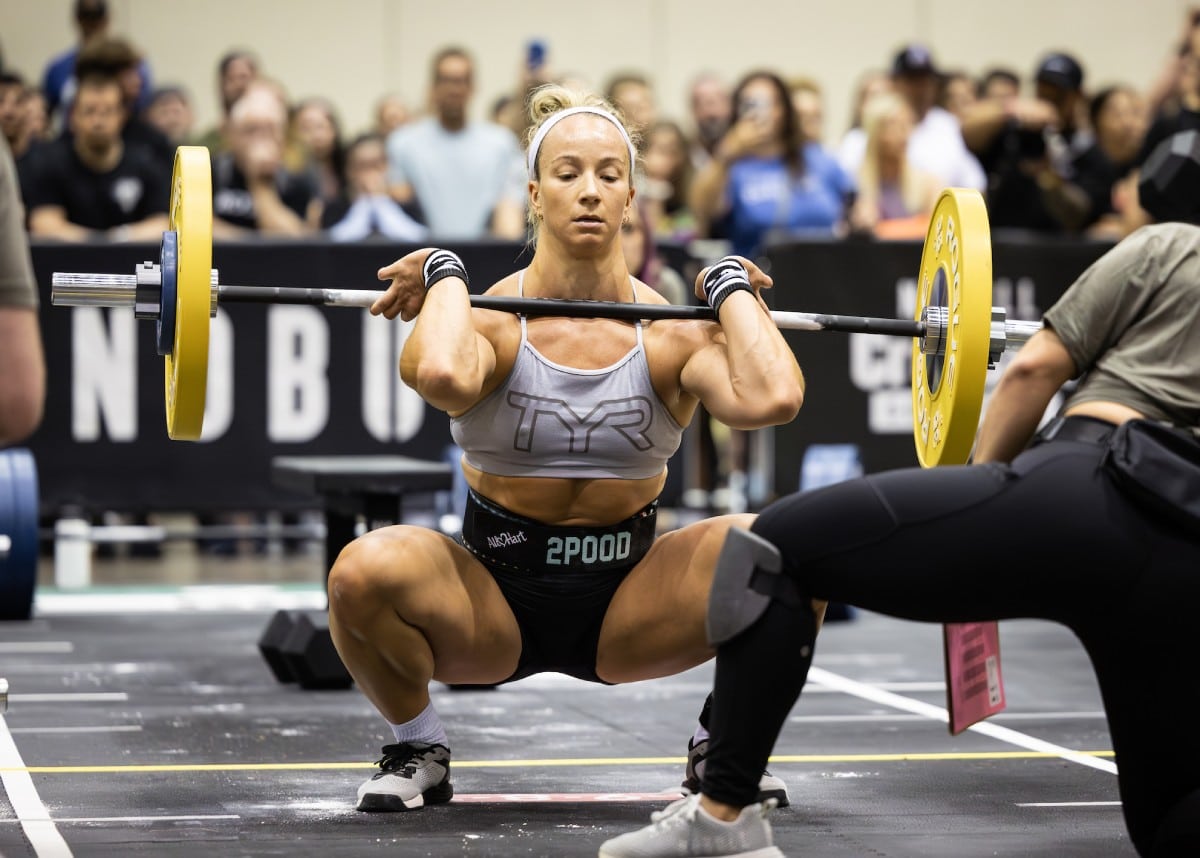
“It was also interesting ’cause a lot of people hated on WFP for not having squatted, and then the Age Group came out and I was like, ‘Oh okay, I guess we’re not squatting anymore,’” said one coach on the Training Think Tank podcast, a popular CrossFit content hub. “It felt like people just wanted a reason to get mad at WFP.”
Jump to:
- Two major qualifiers. Zero squatting. A programming oversight—or a conscious shift?
- Community divided over the absence of a staple
- Why WFP dropped squats—and what it reveals about judging concerns
- Athletes question whether “testing fitness” should be filtered by video ease
- What about lunges—do they count as “squat substitutes”?
- CrossFit’s programming identity is shifting—and everyone has a bias
- Age Group Online Qualifier: heavy barbells, light on squats
- Movement substitutions—and the search for fairness
- Scoring philosophy: Should the Open scores carry forward?
- In-person events like Crash Crucible are keeping the community spirit alive
- Programming transparency is key—even if the tests aren’t perfect
- Squats may return at the in-person events. But their absence now still matters.
Two major qualifiers. Zero squatting. A programming oversight—or a conscious shift?
Both the WFP Qualifier and the Age Group Online Semifinals were expected to test the sport’s cornerstone elements. Yet neither included barbell squats, wall balls, or thrusters—movements that typically show up in nearly every stage of the CrossFit season. It’s a move that, for some, signals a potential overcorrection in programming or a logistical adjustment driven by online competition challenges.
Community divided over the absence of a staple
Reactions were swift and divided. On one hand, some athletes celebrated the break from notoriously demanding squat-heavy workouts. As one Training Think Tank athlete joked, “I’m not mad—my knees are not mad about it.”
But others raised serious concerns about whether omitting such a fundamental movement undermines the legitimacy of the tests.
“There’s been Opens where every test had squatting in it,” another voice from the podcast noted. “This feels like a hard correction to the other side of that.”
For a methodology built around constantly varied, functional movement, leaving out something as basic as squatting felt, to many, like a glaring omission.
Why WFP dropped squats—and what it reveals about judging concerns
Will B., programmer behind WFP, offered insight into the decision during conversations with Training Think Tank post-submission. According to Will, a major reason for removing squat cleans from one of the workouts was the difficulty in standardizing judging in an online format.
“He said that the wall walk that went into the cleans was originally squat cleans,” the host explained. “But he removed that for judging standards and to make sure everything was accurate on video.”
It wasn’t just about reps—it was about ensuring fairness. Power cleans offer a clearer viewing standard compared to squat variations, especially on video submissions where depth can be subjective. Will also cited athlete load management across the season as a factor—recognizing that many athletes would move from the WFP directly into semifinals and later into in-person events.
Athletes question whether “testing fitness” should be filtered by video ease
Not everyone agreed with the decision to tailor workouts for judging ease. While some accepted the tradeoff, others wondered whether the sport risks watering down its standards.
“I’ve always been a fan of—don’t dictate how we do the rep. Just give us a start point and an end point,” said one athlete from Training Think Tank. “It’s those little boxes we have to tick—especially in things like wall walks—that create so much ambiguity.”
Confusion around standards wasn’t limited to squats. Wall-facing handstand push-ups, burpees over dumbbells, and shuttle run rules all raised similar issues. Athletes praised the intent behind simpler standards—like optional stepping over equipment instead of requiring two-foot takeoffs—but worried that the flexibility introduced even more gray area.
What about lunges—do they count as “squat substitutes”?
Some argued that heavy dumbbell lunges included in the WFP Qualifier fulfilled the lower-body strength stimulus.
“I still felt like I had done squatting,” one competitor said. “My legs were blown up in the same way. That was definitely knee flexion being tested.”
Others disagreed. Without axial loading or traditional squat mechanics, the lunges were viewed as a compromise—not a replacement.
And the reality remained: “There was no squat. Not one rep,” one athlete emphasized. “And it wasn’t just WFP. The Age Group had none either.”
CrossFit’s programming identity is shifting—and everyone has a bias
As independent competitions like WFP rise in influence, so too do the biases of their programmers. Training Think Tank coaches noted that Will—himself a former competitive athlete—has programming tendencies that lean toward engine-heavy, threshold-based tests, especially ones that de-emphasize potential physical breakdowns like back blowups from heavy lifts.
“He’s very enduring. He wants to test that peak threshold,” one coach said. “So yeah, we might not see squats in the qualifier—but we know they’re coming at the next stage.”
The broader point is clear: CrossFit is no longer just one vision of fitness. With Dave Castro no longer at the helm of every phase, programming is increasingly dictated by individuals with unique philosophies. What was once a unified definition is now a mosaic of interpretations—and athletes are being tested by different values at each level.
Age Group Online Qualifier: heavy barbells, light on squats
While the Open leaned heavily on bodyweight and engine tests, the Age Group Online Semis shifted dramatically. Athletes were met with three heavy barbell workouts, including:
- Row + Shoulder-to-Overhead
- Heavy Isabel
- Bar Muscle-Up + Clean Ladder
“It’s going to pay to be big and strong,” one Training Think Tank coach said. “The clean ladder especially—if you’re a smaller athlete, it’s going to catch up to you.”
But even with the increase in loading, the same question lingered: Why still no squatting?
Especially puzzling was the choice to repeat bar muscle-ups from the Open instead of introducing ring muscle-ups or squat-based movements.
“They did bar muscle-ups in the Open. Why not rings now?” one host asked. “We’re just repeating tests.”
Movement substitutions—and the search for fairness
One silver lining? There were subtle improvements in scaling and progression logic. For the first time, the Age Group programming adjusted weights across all divisions—a long-overdue move that many in the masters community had been calling for.
For example:
- Masters 55+ had lower barbell loads and bar muscle-ups scaled to chest-to-bar or eliminated entirely.
- Teens 16–17 saw a 155/105 barbell for Isabel—arguably too light, but at least accessible across the board.
“I love that,” said one athlete. “Let the fittest express their skills later in the workout. You can get there if you’re good enough, but you’re not stopped early.”
That kind of inclusive progression—especially the “bar muscle-up at round 6+” format—got strong praise.
Scoring philosophy: Should the Open scores carry forward?
Another big question raised during the conversation: should scores from earlier stages factor into later-stage leaderboards?
“I wonder what it would look like if Open scores actually mattered in Age Group Semis,” one coach said. “You’re good at bodyweight stuff in the Open, but it doesn’t mean anything now.”
This prompted debate over fairness vs. simplicity. Carrying scores forward would reward well-roundedness and punish one-dimensional athletes. But it could also penalize elite competitors who treat the Open as a formality—especially when video standards are looser.
In-person events like Crash Crucible are keeping the community spirit alive
With so much of the CrossFit season now online, team-based in-person events like Crash Crucible are becoming vital to athlete morale. Training Think Tank athletes who participated in the event praised the semi-style programming, use of the worm, and the meaningful challenge of synchronized team workouts.
“Crash doesn’t qualify you for anything,” one athlete explained. “But it reminded us why we love the sport. It felt like regionals again.”
Especially with CrossFit reducing team opportunities and cutting semifinals to 20 teams worldwide, competitions like Crash fill a critical void for high-level athletes who don’t make it to the Games.
Programming transparency is key—even if the tests aren’t perfect
Ultimately, the CrossFit season has become more segmented, more programmer-driven, and more open to interpretation. But the consensus across Training Think Tank was clear:
“It’s not about being perfect—it’s about transparency,” one coach emphasized. “If programmers like Will are willing to learn, iterate, and respond to feedback, the sport will be better for it.”
Squats may return at the in-person events. But their absence now still matters.
Yes, athletes expect squatting to appear at WFP Finals in Indiana. Yes, many believe the best still rose to the top despite the omission. But in a sport where every stage can be an endpoint for 99% of participants, the choice of what isn’t tested can matter just as much as what is.
Until then, the conversation continues.