Building muscle after 40 doesn’t require an expensive gym membership or a garage full of equipment.
According to fitness experts, just five carefully selected dumbbell exercises can train every major muscle group in your body—efficiently and effectively.
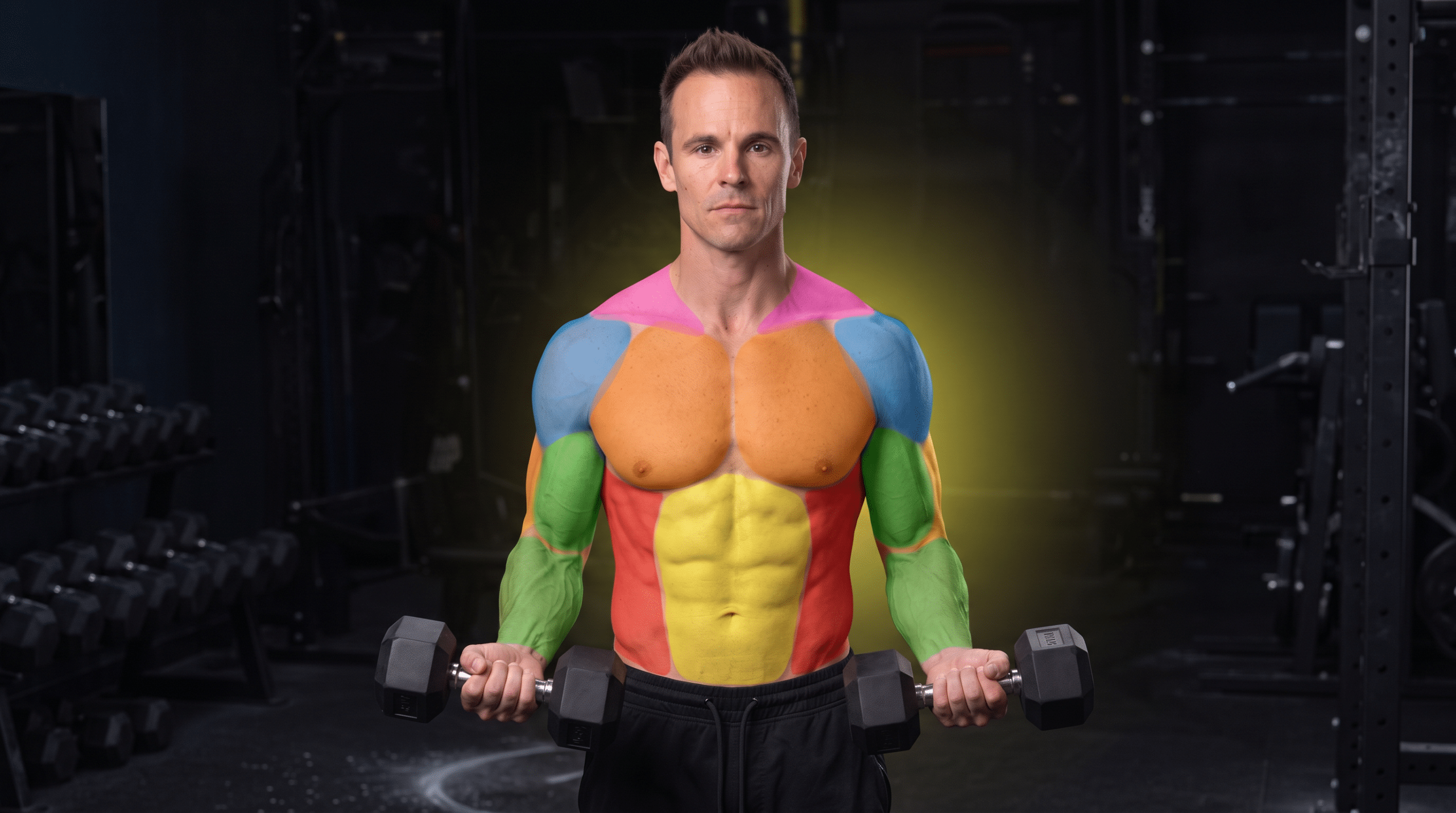
Whether you’re training at home or simply want to streamline your workouts, this minimalist approach can deliver serious results without the complexity.
Here’s exactly which movements to focus on and why they work so well for building strength and size after 40.
Jump to:
Low Incline Dumbbell Press: Build a Complete Chest
When it comes to chest development, the bench press reigns supreme. But if you could only choose one dumbbell variation, the low incline press should be it.
A flat press does build chest mass effectively, but it tends to neglect the upper pecs. Research comparing flat and incline bench pressing found that both produced similar growth in the middle and lower chest, but incline pressing led to significantly greater upper pec development.
The angle you choose matters tremendously. As incline increases, so does front deltoid involvement.
Studies comparing different bench angles found that 30 degrees produced the greatest upper pec activation, while steeper inclines shifted emphasis toward the shoulders. For optimal results, set your bench between 15 to 30 degrees.
Dumbbells offer a distinct advantage over barbells: your arms aren’t locked into a fixed bar path. This freedom allows a deeper stretch at the bottom and the ability to bring your arms inward as you press—critical because horizontal adduction is a primary chest function.
Rather than pressing straight up, think about bringing your biceps toward each other throughout the movement. Keep elbows moderately tucked at roughly 40 to 60 degrees from your torso to better align with upper chest fibers.
Done correctly, this single exercise trains your entire chest while building shoulders and triceps simultaneously.
Chest-Supported Dumbbell Row: Target Your Entire Back
Building back thickness requires horizontal pulling movements. Among dumbbell row variations, the chest-supported version stands out for one key reason: it eliminates lower back fatigue.
Traditional bent-over rows demand significant lower back effort just to maintain position. Research comparing rowing variations found that bent-over rows produced significantly greater lower back muscle activation compared to supported versions.
As weight increases, your spinal erectors can fatigue before the mid-upper back muscles you’re actually trying to grow. Supporting your chest against an incline bench removes this limitation, allowing stricter reps with better focus on target muscles.
Here’s where this exercise becomes truly versatile: by changing grip and pull direction, you can emphasize different back regions.
Lat-Focused Variation
- Use a neutral grip (palms facing each other)
- Keep elbows tucked close to your body
- Drive elbows down toward your hips
- This emphasizes shoulder extension, a primary lat function
Upper Back Variation
- Rotate palms into a pronated grip (palms facing down)
- Allow elbows to flare outward
- Introduce horizontal shoulder abduction
- Increases demand on rear delts, traps, and rhomboids
For maximum upper back engagement, don’t lock your shoulder blades in place. Allow them to move forward at the bottom before pulling them back together at the top, training scapular retraction through a greater range of motion.
One exercise, two distinct back-building variations.
B-Stance Romanian Deadlift: Hamstrings and Glutes
For lower body development, the B-stance Romanian deadlift offers a smart solution to a common dumbbell training problem: challenging your legs with limited weight.
Similar to traditional Romanian deadlifts but with one key difference—you shift most workload onto one leg at a time. This allows you to challenge hamstrings and glutes with significantly less total weight.
Romanian deadlifts excel at placing tension on hamstrings in a stretched position, which matters because research suggests training muscles at longer lengths may produce greater hypertrophy.
One study comparing seated and lying leg curls found that training hamstrings in a more lengthened position produced significantly greater muscle growth. While this research didn’t examine Romanian deadlifts specifically, it highlights why challenging hamstrings in a stretched position proves so effective.
How to Perform It
- Place one foot slightly behind the other with back heel raised
- Hold dumbbells in front of your body
- Back leg acts as a kickstand; front leg does most work
- Keep front knee slightly bent, brace core
- Push hips backward, lowering dumbbells toward floor
- Get a deep stretch in the front leg hamstring
- Drive hips forward to return to starting position
Focus on feeling that stretch in your working leg’s hamstring—that’s where the magic happens.
Dumbbell Bulgarian Split Squat: Quad Development
While B-stance RDLs target hamstrings and glutes, Bulgarian split squats place primary emphasis on quadriceps.
Regular dumbbell squats face a significant limitation: eventually, the amount of weight you can hold becomes the limiting factor. Split squats solve this by training one leg at a time, challenging quads with significantly less total weight—perfect for home training with limited dumbbells.
This exercise also offers versatility. Depending on execution, you can shift emphasis toward quads or glutes. Since glutes were covered with Romanian deadlifts, the goal here is maximizing quad engagement.
Technique for Quad Focus
- Place rear foot on a bench
- Position front foot far enough forward for comfortable deep squat
- Keep torso relatively upright
- Allow front knee to travel forward as you descend
- Don’t fear knee going past toes—it’s normal and beneficial
Allowing forward knee travel helps achieve greater knee flexion, increasing quad demand. Research comparing squat depths found that deeper squats produced greater increases in thigh muscle size than shallower squats.
Don’t sacrifice depth to keep your torso perfectly upright. Focus on lowering yourself as far as you comfortably can while maintaining control.
This doesn’t mean forcing yourself into positions your mobility doesn’t allow—but it does mean avoiding unnecessarily shortened range of motion.
Seated Dumbbell Shoulder Press: Complete Shoulder Development
If one muscle makes the biggest visual impact on physique, it’s shoulders. The seated dumbbell shoulder press delivers comprehensive deltoid development.
This exercise effectively trains both front and side delts simultaneously. Research comparing shoulder press variations found that dumbbells produced greater muscle activation in both front and side delts compared to barbells.
The same study revealed subjects could lift approximately 10% more weight when performing seated versus standing dumbbell presses. This likely comes down to stability.
Standing presses require core and stabilizing muscles to work harder maintaining body position. Seated pressing provides a more stable base, allowing greater focus on pressing weight overhead.
Maximize Shoulder Development
Allow elbows to move slightly out to your sides rather than keeping them tucked directly in front of your body. This positions shoulders so both front and side delts can contribute to the movement.
While you shouldn’t overthink it, this small adjustment can significantly enhance deltoid engagement.
Putting It All Together
These five dumbbell exercises create a complete training program targeting every major muscle group:
- Low incline dumbbell press – chest, shoulders, triceps
- Chest-supported dumbbell row – lats, upper back, rear delts
- B-stance Romanian deadlift – hamstrings, glutes
- Bulgarian split squat – quadriceps
- Seated dumbbell shoulder press – shoulders
Choosing effective exercises is only half the equation. How you organize them, training frequency, and progressive overload matter just as much for long-term results.
For lifters over 40, proper programming becomes even more critical. Recovery takes longer, joint health matters more, and training smart beats training hard.
Focus on mastering these foundational movements with proper form before chasing heavier weights. Your joints will thank you, and your muscles will still grow.
The beauty of this minimalist approach is its sustainability. You don’t need elaborate equipment or complicated programs—just consistent effort with proven exercises that deliver results.