Androgenic alopecia research may be on the verge of a paradigm shift.
For decades, scientists believed DHT was the primary driver of pattern hair loss—but a growing faction of researchers now argues another hormone deserves equal, if not greater, attention.
That hormone is prolactin, and the evidence supporting its role comes from some of the most dramatic hair regrowth photos ever documented in primates.
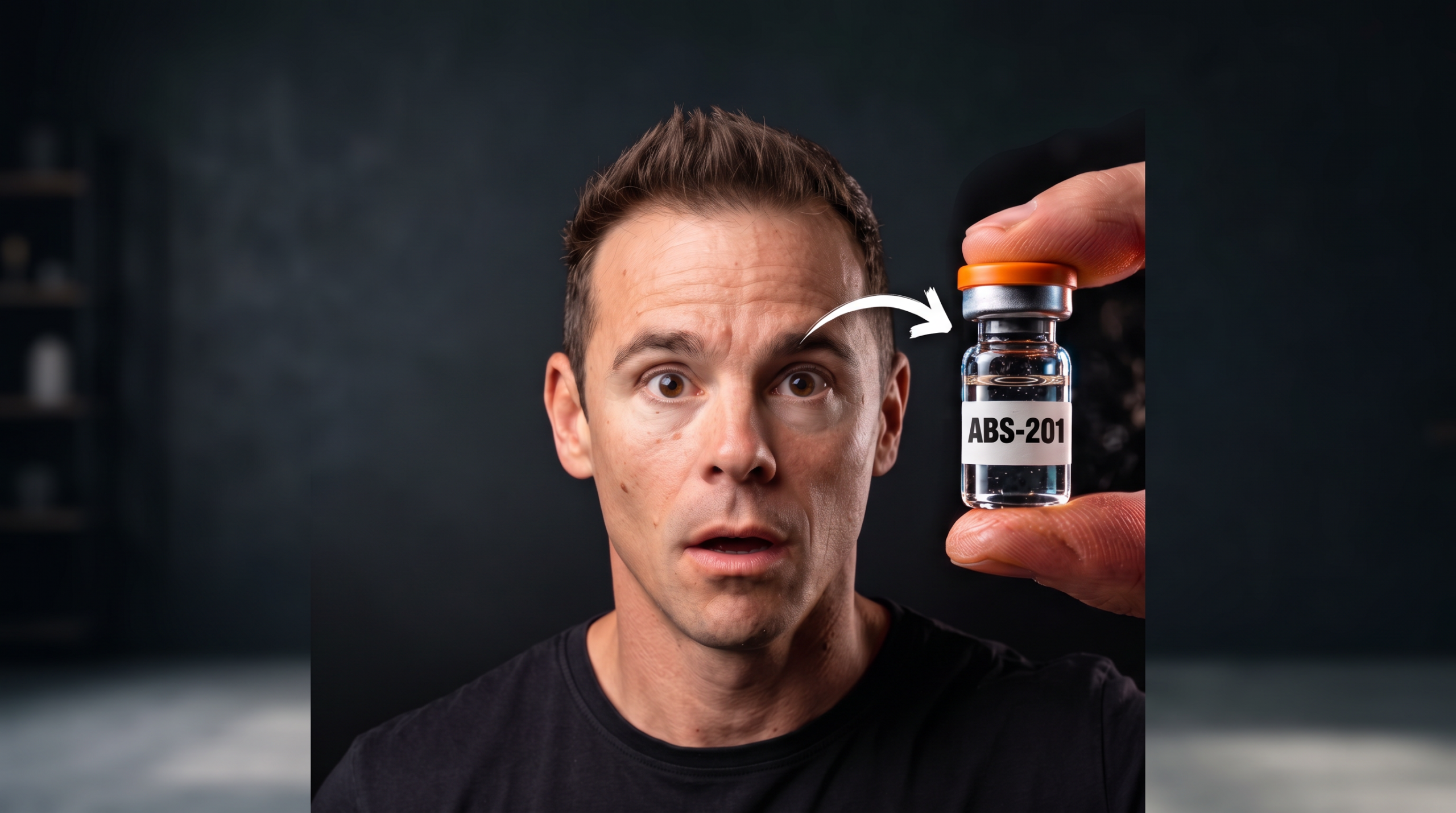
Now, an AI-powered pharmaceutical company called Absci is testing a novel drug designed to block prolactin—and the results could redefine how we treat hair loss forever.
Jump to:
The Monkey Study That Changed Everything
Nearly a decade ago, researcher Andreas Buch at Bayer Pharmaceuticals was investigating a drug called HMI-115 for endometriosis treatment.
The drug worked by lowering prolactin signaling in cells, and when Buch tested it in mice, something unexpected happened: the mice regrew hair faster than controls.
Most researchers would have dismissed this as noise—after all, nearly everything regrows hair in mice, from peppermint oil to copper peptides.
But Buch pushed further.
He convinced Bayer to test HMI-115 in stumptail macaques, a species of monkey that naturally develops pattern baldness—much like humans.
The results were staggering.
After six months of treatment, the monkeys had regrown significant amounts of hair. But here’s where it gets wild: even after stopping the injections, the monkeys continued regrowing hair for four more years.
Their gray hairs even repigmented back to their natural color.
Rob English, a hair loss researcher who reviewed the data, couldn’t believe what he was seeing.
In all other monkey and human hair loss research that I have ever seen, when a treatment is officially withdrawn, you inevitably lose all the hair that you’ve regained. But in this study, the opposite happened.
This wasn’t just hair maintenance—it was regeneration.
The Human Trial That Flopped
Naturally, excitement exploded.
Bayer licensed HMI-115 to Hope Medicine, and by 2023, phase 1 and phase 2 human trials were underway.
The hair loss community held its breath for over a year, waiting for results that could change everything.
Then… silence.
In 2024, Hope Medicine announced the phase 2 trials had completed—but never published the data.
A year later, a press release on the phase 1 study revealed disappointing news: HMI-115 appeared safe, but it only regrew about 14 hairs per square centimeter—a far cry from the 100+ hairs per square centimeter seen in monkeys.
Enthusiasm around prolactin as a hair loss target collapsed almost overnight.
But Andreas Buch wasn’t convinced the hypothesis was wrong—he believed the humans were simply underdosed.
Enter Absci and ABS-2011
That conviction led Buch to Absci, an AI-powered pharmaceutical company founded by Sean McClain.
Together, they developed a new drug: ABS-2011, designed specifically to overcome the dosing problems that plagued HMI-115.
In a recent interview, McClain explained why he believes prolactin—not just DHT—sits at the root of androgenic alopecia.
Prolactin has maybe had a bad rap. Everyone thinks of it as a lactation hormone, but prolactin is expressed all throughout the body in males and females. It sits on this stress inflammatory axis, and it plays a really interesting role in metabolism, immunology, and hair loss.
McClain’s team discovered something critical: prolactin isn’t just circulating in your blood—it’s also manufactured locally in your scalp.
Two people can have identical blood prolactin levels, but vastly different amounts in their hair follicles.
How Prolactin May Drive Hair Loss
According to McClain, prolactin doesn’t work alone—it amplifies the effects of DHT.
Here’s the proposed cascade:
- Prolactin increases androgen receptor expression, making hair follicles more sensitive to DHT
- Prolactin degrades collagen 17A, a protein that anchors hair follicle stem cells
- Without that anchor, stem cells can’t regenerate hair properly, limiting regrowth even when DHT is suppressed
This could explain why drugs like finasteride and dutasteride—which lower DHT—help slow hair loss but rarely produce dramatic regrowth, especially in advanced cases.
They’re only addressing part of the problem.
McClain’s team tested their hypothesis in human scalp biopsies. When they treated balding hair follicles with ABS-2011, they saw:
- Increased hair growth within three days
- More follicles entering the active growth phase
- Protection of stem cell populations
- Increased collagen 17A expression
They also analyzed genetic data from over 165,000 men in the UK Biobank and found that men with genes linked to higher prolactin receptor expression had more severe balding.
Why HMI-115 Failed (According to Absci)
The key difference between HMI-115 and ABS-2011 comes down to something called receptor occupancy.
Prolactin receptors have what’s known as “spare receptors”—meaning your cells express far more receptors than they actually need for prolactin to exert its effects.
In some tissues, prolactin only needs to occupy 35% of receptors to achieve maximum biological activity.
That means blocking 65% of receptors would still be completely useless.
McClain argues that in the monkey study, HMI-115 achieved 90% receptor occupancy—enough to produce dramatic regrowth.
But in humans, based on publicly released pharmacokinetic data, HMI-115 only reached about 70-73% receptor occupancy, and it oscillated.
When you block prolactin receptor, you actually get an increase in prolactin levels. And if you dip below a certain receptor occupancy threshold, you could actually be activating the prolactin receptor with the increased levels of prolactin. You’re inadvertently going between growth and shedding phases.
ABS-2011, by contrast, is designed to maintain greater than 90% receptor occupancy for six months straight.
The Clinical Trial Underway Now
Absci is currently running a phase 2 clinical trial testing ABS-2011 in men and women with androgenic alopecia.
In December 2025, the company plans to release preliminary 13-week data.
McClain was refreshingly candid about expectations.
The 13-week data readout is going to be directional. We want to see that the mechanism is working and that there is a path to 30-plus hairs per square centimeter at 26 weeks. My guess is that at 9 to 12 months, you continue to see an increase from there.
Importantly, McClain committed to transparent reporting—no subgroup analyses, no statistical manipulation, just clear-cut data.
That alone is a breath of fresh air in an industry notorious for cherry-picked press releases.
Why We Should Be Cautiously Optimistic
There’s a lot to like about this story, but there are also reasons to temper expectations.
What’s compelling:
- The monkey data showed unprecedented regrowth and repigmentation
- Genetic, mechanistic, and early interventional data all point in the same direction
- ABS-2011 was specifically designed to overcome HMI-115’s dosing limitations
- The company is committed to transparent data reporting
What’s uncertain:
- Monkey models rarely translate perfectly to humans. Minoxidil and latanoprost both showed dramatic results in stumptail macaques but produced modest effects in people
- The mechanistic data lacks non-balding controls. Without comparing ABS-2011’s effects on healthy versus balding scalp tissue, it’s hard to know if the observed changes are truly specific to androgenic alopecia
- Safety questions remain. Lowering prolactin in women is associated with infertility and lactation problems. How adverse events are tracked and reported in this trial will be critical
- Phase 2 is where most hair loss treatments fail. Prostaglandin D2 inhibitors like setipiprant had equally compelling preclinical data—and produced zero results in humans
Even if ABS-2011 fails, it won’t necessarily disprove the prolactin hypothesis—it might just mean we need an even more powerful receptor blocker.
What to Watch For
When the 13-week data drops in December, don’t focus exclusively on hair counts.
Remember: the monkeys took four years to show maximum regrowth.
What matters most at this stage is safety—specifically adverse events related to fertility, libido, and other hormonal markers.
If the drug proves safe and shows even modest directional efficacy, that’s reason for cautious optimism.
If it fails spectacularly, we’ll have learned something critical about prolactin’s role—or lack thereof—in pattern hair loss.
Either way, this is one of the most fascinating developments in hair loss research in years, and it deserves close attention from anyone following the science.
Sources
Note: The research brief provided did not include verifiable external sources for independent citation. All claims discussed are based on the interview transcript and company-provided data.