Chelsea, a plant-based weight loss coach, once weighed every bite of tofu to hit a daily protein target.
In a recent YouTube video, she explained why she walked away from macro counting.
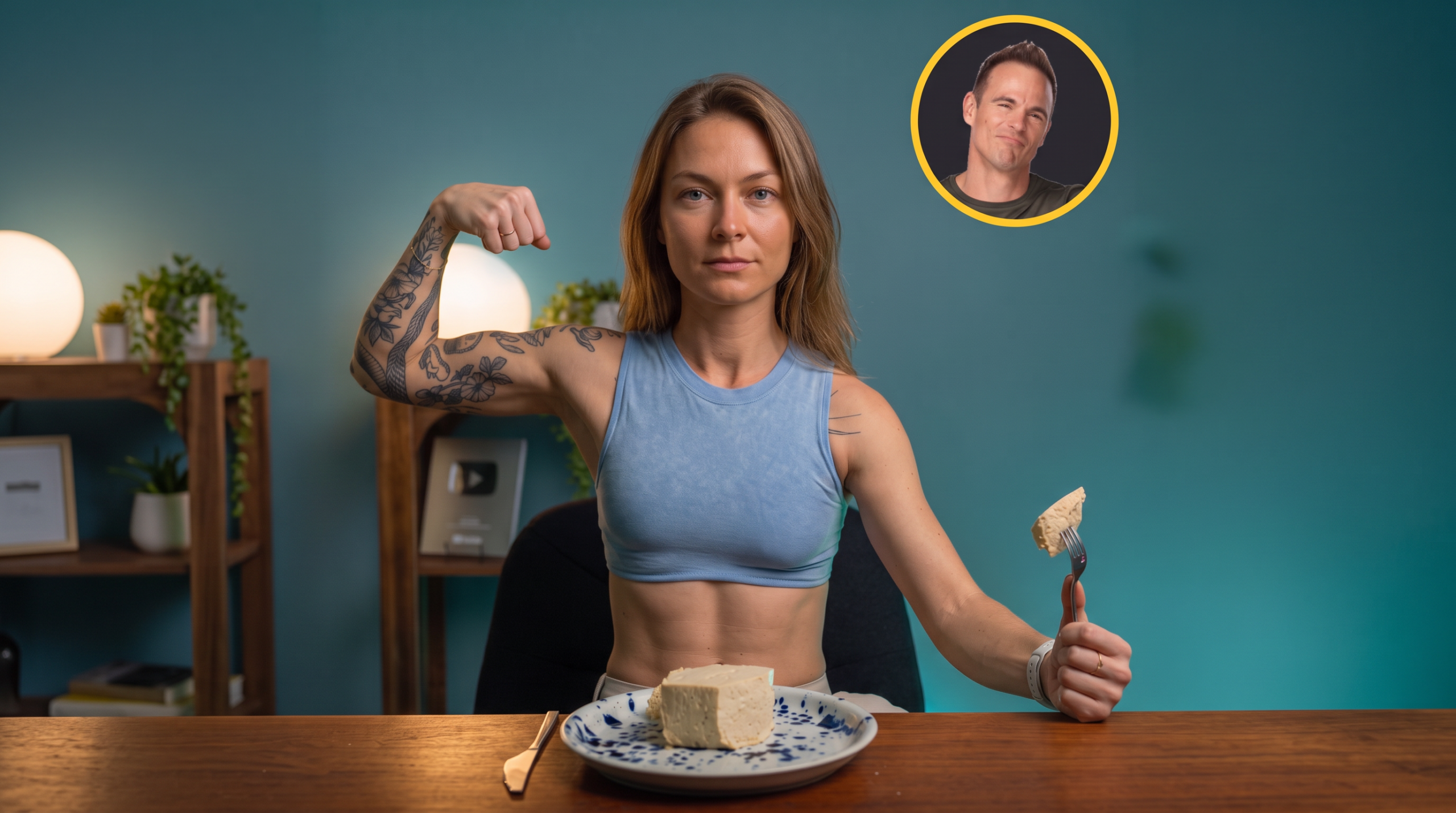
Her research turned up findings that surprised even her.
Muscle matters more than ever for women approaching menopause, yet the “right” protein number depends on which camp answers.
One big analysis, she says, reveals exactly where extra protein stops paying off.
Her personal target? Lower than most Instagram reels suggest.

If you want something simple that actually works, this is one of the most effective tools I’ve used to build strength, conditioning, and endurance without needing a full gym setup.
- Full-body training with one weight using swings, squats, and presses
- Solid cast iron build that feels stable and lasts for years
- Comfortable grip that makes high-rep workouts easier to handle
Jump to:
Why Women Over 40 Face the Most Protein Confusion
Most of Chelsea’s coaching clients are between 40 and 70. She describes them as:
the most targeted and also the most confused, understandably, about how much protein to actually be eating.
She points to a study that tracked women’s bodies through menopause. Fat gain reportedly doubled while lean mass and muscle declined.
Team One vs. Team Two: A Massive Gap
Chelsea splits the debate into two camps. Calculations for both rely on goal weight, not current weight.
- Team One: roughly 1 g per pound of lean or goal weight, often 120 g or more
- Team Two: about 50 to 60 g daily
At 5’8″, Chelsea would land near 140 g in one camp and 50 to 60 g in the other. She calls that gap “big,” then adds a teaser: a middle ground rarely gets airtime.
What the High-Protein Camp Gets Right
Protein Is Big Business
History helps explain the obsession. Starting in 1950, the UN spent roughly twenty years loading malnourished kids with protein, and one scientist later labeled it the “protein fiasco.”
Those children lacked calories, not protein. Yet the notion of widespread deficiency stuck around, and supplements now rake in tens of billions of dollars.
If you want something simple that actually works, this is one of the most effective tools I’ve used to build strength, conditioning, and endurance without needing a full gym setup.
- Full-body training with one weight using swings, squats, and presses
- Solid cast iron build that feels stable and lasts for years
- Comfortable grip that makes high-rep workouts easier to handle
protein is undeniably very big business.
Chelsea herself enjoys vegan protein powders. Still, she argues, commercial incentives shape what social media tells us we need.
More Protein Builds More Muscle, Up to a Point
Studies pairing strength training with higher intake, especially during a calorie deficit, show faster muscle growth. Most of that research spans weeks to a few months, though, and focuses purely on maximizing size.
Then comes her headline finding. A pooled analysis of 49 studies found gains leveled off near 1.6 g per kilo, which works out to about 100 g for Chelsea.
Individual responses vary, and some people may squeeze out slightly more. Past that threshold, however, returns diminish fast.
Protecting Muscle During Fat Loss
Fat loss demands a calorie deficit, period. Without strength training, roughly a quarter of weight lost could be lean mass, according to Chelsea.
Her reframe is the real gem. Skip “how much can I eat?” and ask what amount is adequate. She compares it to a choice between:
If you want something simple that actually works, this is one of the most effective tools I’ve used to build strength, conditioning, and endurance without needing a full gym setup.
- Full-body training with one weight using swings, squats, and presses
- Solid cast iron build that feels stable and lasts for years
- Comfortable grip that makes high-rep workouts easier to handle
how can I have the biggest mansion that I can possibly have versus asking how can I have a house that I like that fits all my needs and isn’t leaking?
The Hidden Motivation: Eating More Food
Chelsea suspects many people chase muscle because it allows bigger meals. Teammate Caleb, who lost 40 pounds, confirmed as much:
I love eating a lot. I really, really love eating.
Muscle does let you afford somewhat more food. The question she poses: what sacrifices come attached?
The Longevity Case for Lower Protein
Team Two recommends about 0.8 g per kilo of lean weight, close to World Health Organization guidance. That equals roughly 46 to 55 g for an average woman.
Chelsea notes that nutrition researcher Michael Greger considers around 50 g adequate for most people. Plant-based doctors, she adds, often suggest keeping protein near 10% of total calories.
She highlights several arguments:
- Calories: eating less is the most consistent longevity signal, and high-protein diets usually mean higher intake overall
- Okinawans: about 69% of their diet came from sweet potatoes, with protein near 9% (around 40 g)
- Adventists: among 73,000 participants, vegetarians had 12% lower death rates, and vegan men fared even better at 28%
- Protein source: large studies tying red meat swaps for plant protein to a 34% lower risk of death
Worth remembering: population studies like these are observational. They reveal associations, not proof of cause, since lifestyle differences travel with diet choices.
If you want something simple that actually works, this is one of the most effective tools I’ve used to build strength, conditioning, and endurance without needing a full gym setup.
- Full-body training with one weight using swings, squats, and presses
- Solid cast iron build that feels stable and lasts for years
- Comfortable grip that makes high-rep workouts easier to handle
What About Soy?
Soy draws plenty of fear over estrogen. Chelsea calls the backlash “propaganda.”
She cites a Shanghai study of over 5,000 breast cancer survivors. Higher soy eaters had a 29% lower risk of dying and a 32% lower risk of recurrence.
A small edamame trial reportedly cut hot flushes by 84%. Chelsea herself says to take that one “with a grain of salt.”
Where Chelsea Lands: Behavior First
Her verdict? Team behavioral change. Chasing 120 to 150 g daily, she argues, crowds out filling foods and wrecks consistency.
The highest satiety food on the planet is a potato.
Her “natural GLP-1” comparison is a colorful figure of speech, not a literal equivalence. Potatoes do rank high for fullness, though.
Her routine skips tracking entirely. Meals revolve around:
If you want something simple that actually works, this is one of the most effective tools I’ve used to build strength, conditioning, and endurance without needing a full gym setup.
- Full-body training with one weight using swings, squats, and presses
- Solid cast iron build that feels stable and lasts for years
- Comfortable grip that makes high-rep workouts easier to handle
- Tofu, potatoes, and veggies in the morning
- Seitan tacos, sushi bowls, and lentil soups
- Peas, plenty of them
That lands her around 80 to 100 g daily, roughly 25 g per meal. Training three to four times weekly, she has built 11 pounds of muscle over seven years.
Pick Your Priority and Accept the Trade-Offs
There are no solutions in life. There are only trade-offs.
Chelsea outlines three goals, each with its own playbook:
- Lose fat sustainably: aim for 80 to 100 g with filling meals and zero tracking. Swapping oat milk for soy adds roughly 6 to 10 g via a latte.
- Build significant muscle: target at least 1.6 g per kilo, train hard with progressive overload, and consider a calorie surplus. She admits losing some muscle during her own cut.
- Optimize overall health: weight loss comes first for most people. Add a pound of veggies daily, plenty of potatoes, and plant proteins.
Past 65, she says, both camps agree protein needs rise. Hitting the 80 to 100 g range usually covers it.
Her Final Word
Chelsea admits she is “not a protein expert” and expects heated comment-section debate.
So I think less about optimization and more about what I can actually maintain.
I don’t need to look like a bodybuilder. I don’t need to stress about my meals and I don’t think that you need to either.