Balance might just reveal more about lifespan than any blood test ever could.
Researchers have discovered five straightforward movement tests that predict heart disease risk and mortality with stunning accuracy—often catching warning signs years before traditional medical screenings.
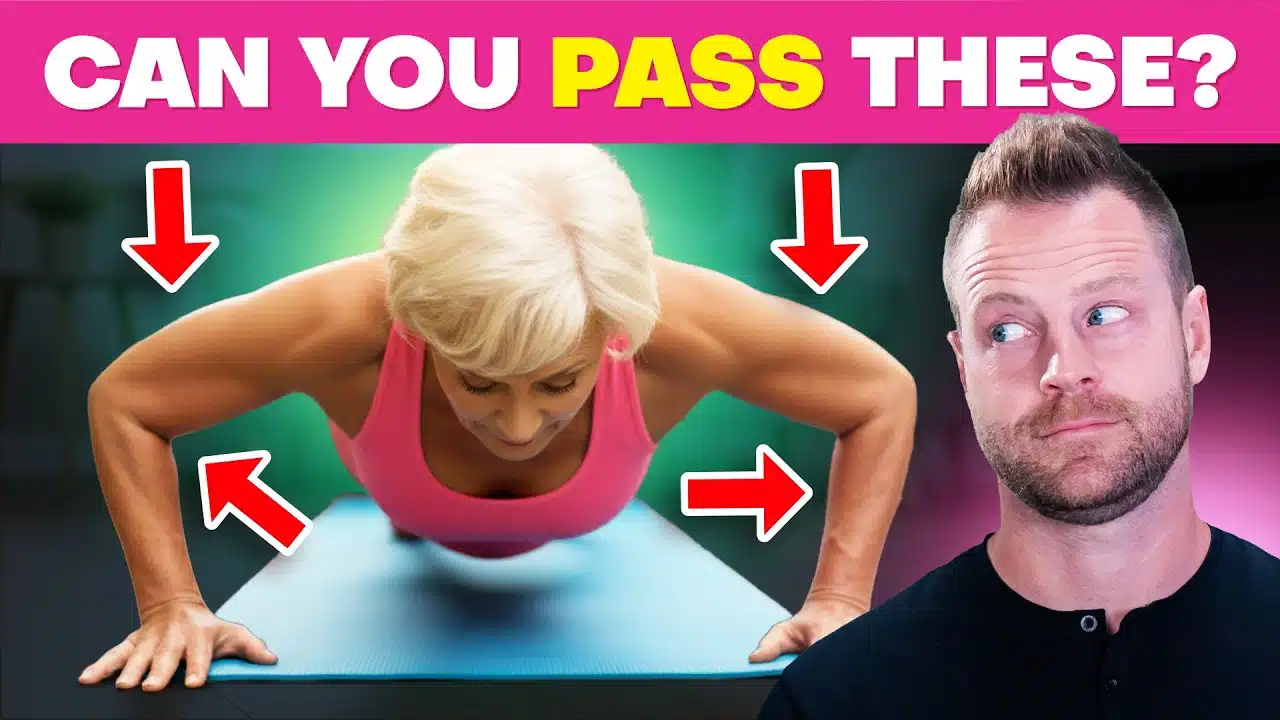
What makes these assessments particularly sobering is how many people, especially those over 50, struggle to pass them.
Failing even one suggests the body is aging faster than it should, but the good news is that targeted exercises can reverse these declines within weeks.
Jump to:
The 10-Second Balance Test That Predicts Mortality
Single-leg balance declines faster than strength, speed, or mobility as people age, making it the body’s most sensitive early warning system for accelerated aging.
A major study tracking more than 1,700 adults over 50 found something remarkable: those unable to hold a one-leg stance for just 10 seconds faced a four-fold higher risk of death within the next decade.
The test itself couldn’t be simpler. Stand tall with hands on hips and feet together, lift one foot roughly six inches off the floor, keep eyes straight ahead, and start counting.
Holding steady for 10 seconds or more indicates healthy aging. Wobbling, touching the raised foot down, or losing balance before 10 seconds signals accelerated physical decline.
Why Balance Matters More Than You Think
Balance isn’t controlled by legs alone—it requires seamless coordination between muscles, nervous system, eyes, and inner ear, all communicating with the brain.
When balance starts dropping, the entire system is aging faster than it should, not just lower body strength.
Four Steps to Rebuild Balance at Home
Fortunately, wobbly balance responds remarkably well to targeted practice that can begin immediately.
Step one: Start with supported single-leg stands. Hold a counter or sturdy chair, lift one foot, balance for 10-30 seconds, then switch legs. Gradually reduce hand support as stability improves.
Step two: Add variety to standing positions. Try heel-to-toe stance, feet touching side by side, or standing on an unstable surface like a folded towel. Changing the base of support forces muscles, joints, and balance sensors to adapt.
Step three: Incorporate gentle movement while balancing. Turn the head slowly side to side, lift arms, or shift weight back and forth. This trains the body to maintain stability during real-world movement.
Step four: Challenge the brain simultaneously. While balancing, try talking, counting backwards, or naming animals. This builds the ability to focus and balance while multitasking—the kind of control that prevents falls in everyday situations.
Practicing these exercises 10-15 minutes three times weekly produces noticeable improvement within weeks, with significant progress typically appearing around 12 weeks.
The 30-Second Sit-to-Stand Test
This assessment predicts whether someone will maintain independence or start requiring assistance with basic tasks as they age.
The moment rising from a chair without using hands becomes impossible, independence begins fading. It’s one of the most powerful measures of real-world strength and longevity available.
To perform it: Sit toward the front edge of a sturdy chair with feet flat, shoulder-width apart. Cross arms over chest, stand completely, then sit back down. Repeat as many times as possible in 30 seconds.
Age-Based Performance Standards
Research provides clear benchmarks for healthy aging:
- Early 50s: Men average 19 reps, women around 15
- Late 50s: Men hit 18, women maintain 15
- 60s: Strong performance means 17 for men, 14 for women
- 70s: About 14 for men, 11 for women
- Beyond 80: Maintaining 10 reps for men or 8 for women signals excellent mobility
Scoring below these ranges indicates the body is losing power—one of the earliest signs of physical decline.
Rebuilding Lower Body Power
Several simple movements performed at home can reverse this decline:
Chair squats: Sit down and stand up slowly without using hands, focusing on control rather than speed. This rebuilds quads, glutes, and hips.
Seated knee extensions: Sit tall, straighten one leg, hold briefly, then switch sides. This isolates quadriceps that drive upward movement.
Mini step-ups: Use the lowest stair with rail support. Step up and back down repeatedly to improve coordination and build strength for daily movement.
Seated glute squeezes: Tighten glutes for five seconds, then release. This strengthens stabilizers protecting hips and back.
Ten minutes three days weekly produces improvement within a month for most people.
The Sit-Rise Test: A 10-Point Scale for Longevity
This assessment measures how well the entire body works together, not just isolated strength or flexibility.
A massive 12-year study following more than 4,000 adults revealed that those scoring lowest were up to six times more likely to die early from natural or cardiovascular causes.
Even more striking: every single point higher on the scale lowers mortality risk by 20-25%.
How to Perform the Test
Start standing tall on flat ground without holding anything. Lower all the way to the floor (crossing legs is acceptable), then stand back up the same way.
Begin with 10 points. Subtract one point for each time a hand, knee, or arm provides support. Subtract half a point for wobbly or unstable movement.
A score of eight or higher indicates healthy aging. Below eight, health risks climb sharply. Scoring four or below dramatically increases odds of early death because the body is expending excessive effort on basic movements—and when that happens, every other system pays the price.
Improving a Low Score
Several exercises build the coordination and strength needed:
- Half get-ups: Lower halfway to floor and rise back up using one hand for balance
- Cross-legged sit-to-stand: Practice rising from cross-legged position on a cushion, using progressively less support
- Deep squat holds: Drop into deep squat and hold 10-20 seconds to open hips and ankles
- Seated twists: Sit tall and gently twist side to side to maintain spinal mobility
Just a few minutes daily produces better balance, smoother movement, and less stiffness within weeks.
The Push-Up Test for Heart Health
This assessment reveals cardiovascular health without ever visiting a doctor’s office.
A Harvard study tracking over 1,100 men for a decade produced staggering results: those completing 40 or more push-ups had a 96% lower risk of heart disease compared to men barely managing 10.
For roughly every 10 extra push-ups, the risk of heart problems dropped another 15 to 20%.
Each push-up acts like a mini stress test—forcing the heart to pump harder, push blood faster, and adapt under pressure. This training keeps arteries flexible, circulation strong, and cardiovascular function decades younger.
Testing Your Heart Fitness
Start in plank position with hands under shoulders and body forming a straight line. Lower until chest almost touches floor, then push back up.
Maintain steady rhythm—roughly one push-up per second—stopping when good form becomes impossible.
For men over 50, hitting 15-20 consecutive push-ups indicates strong cardiovascular health. Women should aim for 10-15 modified push-ups from knees or an inclined position off a bench or stairs.
Building Up Safely
Those unable to complete standard push-ups can build strength through progression:
Wall push-ups: Face wall with hands at chest height, step back slightly, lower chest toward wall, then push away.
Countertop push-ups: Once wall push-ups feel easy, progress to countertop or stair height, maintaining straight body alignment.
Knee push-ups: Drop to knees on floor, keeping core tight and body straight from head to knees.
Training three times weekly typically raises push-up count by 30-50% within a month.
Grip Strength: The Ultimate Longevity Predictor
Grip strength might be the simplest and most accurate predictor of lifespan.
One of the largest health studies ever conducted tracked over 140,000 adults across 17 countries for nearly a decade. Results were unambiguous: for every 5 kg drop in grip strength, early death risk rose 16%, heart disease risk climbed 17%, and stroke risk increased 9%.
This correlation proved stronger than blood pressure measurements.
Grip strength isn’t just about hands—it reflects total body vitality, including muscle mass, nervous system function, energy metabolism, and cardiovascular health. Weakening grip signals whole-body decline.
Three Ways to Test Grip Strength
Hand dynamometer: This handheld device measures squeeze force. Hold at your side, squeeze maximally for three seconds, record best of three tries. Men in their 50s should score 85-90 pounds of force; women 55-60 pounds.
Household hold test: Grab a heavy grocery bag, water jug, or suitcase. Hold it by your side as long as possible. If grip gives out before 30 seconds, endurance and overall muscle health need work.
Hang test: Find a sturdy pull-up bar or overhead beam. Grip with both hands and hang (toes can lightly touch ground for partial support). Hold as long as possible. Inability to hang 30 seconds signals grip endurance needs attention.
Strengthening Grip at Home
Farmer’s carries: Hold two heavy objects (grocery bags, dumbbells, milk jugs) and walk 20-30 steps while standing tall. Rest and repeat three times.
Towel holds: Loop a towel through a sturdy railing or bar, hold one end in each hand, step back until towel is taut, lean slightly away and hold using just grip for 10-15 seconds.
Squeeze and release: Use a stress ball or rolled towel. Squeeze hard for five seconds, relax for five. Repeat 15-20 times per hand.
Finger extensions: Place rubber band around fingers and extend against resistance for balanced hand strengthening.
Most people feel stronger grip within weeks and see measurable improvement in roughly six weeks.
These five tests provide remarkable insight into biological aging and future health risks. The encouraging reality is that targeted exercises performed consistently—just minutes several times weekly—can reverse declines and add healthy years to life.