Mark Sisson and Thomas DeLauer sat down for a wide-ranging conversation that challenges much of what the biohacking world holds sacred.
In an era obsessed with optimization, these two health veterans argue we’re missing the forest for the trees.
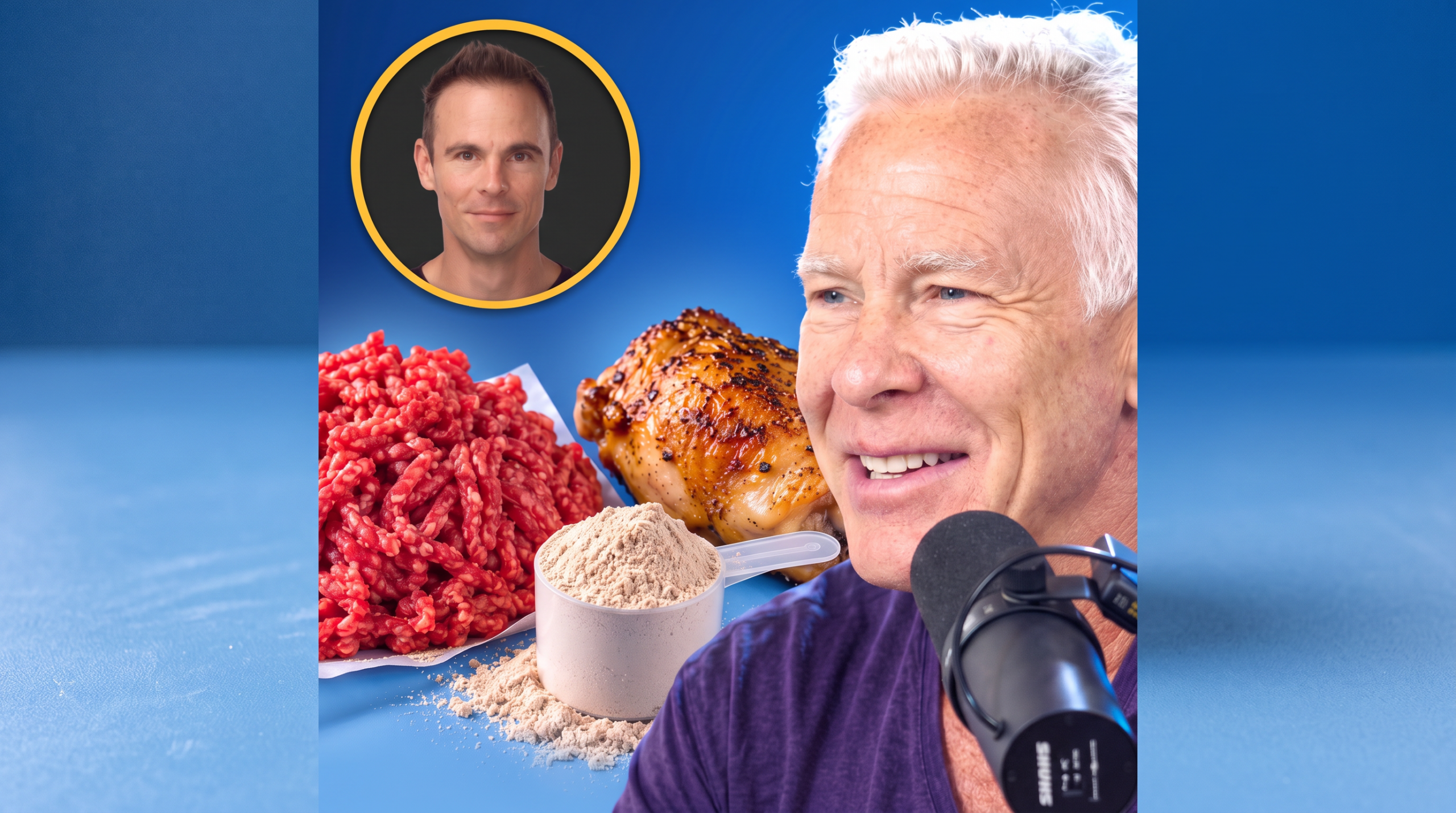
Their discussion touches on everything from protein obsession to barefoot movement, from the pitfalls of constant productivity to why your fancy biohacking gadgets might be holding you back.
What emerges is a philosophy of “unoptimizing”—getting back to basics in a world that’s forgotten what those basics even are.
Jump to:
- The Protein Paradox: Are We Eating Too Much?
- Biohacking: The Day Trading of Health
- Hunger Isn’t What You Think It Is
- Feet: Your Connection to Everything
- Sleep: Stop Outsourcing Your Intuition
- Movement as Medicine
- The GLP-1 Conundrum
- Life in Reserve: The 15% Delta
- Connection: The Only Thing That Matters
- Doing Something Hard Every Day
- Money as Tokenized Energy
- The Longevity Decathlon
- Surrendering to What We’re Made For
- Why We Do Any of This
- The Person Stressing About Meditation
- What Lives Inside Already
- Sources
The Protein Paradox: Are We Eating Too Much?
Sisson opens with what might be heresy in fitness circles: most people are overconsuming protein.
The 73-year-old maintains muscle mass on just 110-120 grams daily, far below the gram-per-pound recommendations flooding social media.
I look at it and I’m like trying to get a gram of protein per pound of lean body mass in some cases per pound of body mass just it just it it’s so out of the realm of uh of of logic of science and I don’t know where it comes from.
DeLauer points to how muscle protein synthesis research has been misinterpreted. Dr. Don Layman’s work, he notes, shows that 50-60% of muscle building comes from the training stimulus itself, not just protein intake.
Research on protein requirements supports a more moderate approach than many influencers suggest. A 2018 meta-analysis in the British Journal of Sports Medicine found that protein intakes beyond 1.6 grams per kilogram of body weight (roughly 0.73 grams per pound) provided no additional benefit for muscle growth in resistance-trained individuals. The push for much higher intakes appears to be more marketing than science.
It is easier to go and eat something that’s protein fortified or loaded with protein or pound extra protein shakes than it is to actually just go lift heavy weights.
The Easy Button Trap
Both men identify a pattern: people latch onto what’s easiest.
Drinking another protein shake feels productive. Actually squatting heavy weight requires effort, discomfort, and time.
Sisson describes his own approach: he doesn’t eat until 1 or 1:30 PM, works out fasted in the morning, and maintains two meals daily. The idea of choking down 150+ grams of protein across multiple meals feels fundamentally wrong to him.
DeLauer adds an intriguing observation about protein sensitivity—the idea that constantly bombarding your system with amino acids might desensitize the very mechanisms you’re trying to optimize.
Have we ever stopped to think that one of the reasons why you need more protein as you get older is perhaps because you’ve actually bombarded the system so much and you have never given yourself a break to actually sensitize that?
The Digestive Load Nobody Talks About
DeLauer mentions something many miss: on days he cuts protein intake, his mental clarity actually improves.
There’s a digestive load, possibly an acute inflammatory response, that comes with high protein consumption.
Sisson agrees, noting that our ancestors evolved in scarcity, not abundance. We have a four-to-six-day “protein sink”—a reservoir of amino acids that doesn’t need daily topping off.
- Mental fog from overfeeding is real
- The body needs digestive rest to function optimally
- Meal timing matters less than we’ve been told
- Hunger is often habitual, not physiological
Biohacking: The Day Trading of Health
Sisson delivers what might be his most quotable line: “Biohacking is the day trading of health.”
Building wealth takes discipline, time, and proven principles. Day trading is gambling—trying to extract dollars from other gamblers in a zero-sum game.
The term hacking implies sort of unauthorized inappropriate access to a system. And so to biohack is to is to look for a shortcut that um maybe involves less work.
He’s not opposed to all biohacking technologies—but only after you’ve built the foundation.
That foundation includes:
- Quality sleep (darkness, regularity, no devices needed)
- Natural sunlight exposure throughout the day
- Movement at multiple intensities and planes
- Real food, eaten intuitively
- Connection with nature and other humans
Get those dialed in, and you’ve captured 85-90% of available benefits based on your genetics.
The Red Light Irony
One example particularly amuses Sisson: people avoiding sunlight because dermatologists warn about cancer risk, then buying expensive red light therapy devices to shine on themselves at home.
The wavelengths they’re trying to recreate? Already available from the sun.
Most home devices don’t even deliver the same wavelengths studied in research showing benefits.
Whenever I’m torn between a device uh or some protocol or some injection or infusion or headband or or chamber, I’m always deferring to nature.
Cold Plunging: Doing Two Hard Things That Cancel Out
Sisson hasn’t cold plunged in two years. He sees some benefits—primarily doing something hard—but questions the broader claims.
The anti-inflammatory effects that made it popular? They actually negate the beneficial inflammation from resistance training when done post-workout.
Research on cold water immersion timing supports this concern. A 2015 study in the Journal of Physiology found that cold water immersion after resistance training blunted muscle protein synthesis and reduced strength gains over time. The inflammation from training is a signal for adaptation—suppressing it too aggressively may limit results. Strategic timing matters if cold therapy is used at all.
People then moved to cryotherapy chambers—spending three minutes in air at 300 below zero—because actual cold plunging is too difficult.
The pattern repeats: technology offers an easier path to benefits that require work to achieve.
Hunger Isn’t What You Think It Is
DeLauer brings up fascinating recent research on ghrelin (the “hunger hormone”) and orexin.
Turns out, hunger is largely circadian—you get hungry at times you habitually eat, not necessarily when you need food.
Ghrelin signals the brain based on your eating schedule. Orexin creates an anticipatory wakefulness that makes you want to eat.
But if you wait 20-30 minutes, that sensation subsides.
We’re seeing that ghrelin is more of like just a signal to stimulate the brain saying hey it’s this time of day.
Sisson’s advice for people struggling with metabolic flexibility? Go for a 20-minute walk when hunger hits.
Walking stimulates energy mobilization and the hunger dissipates. You get past the window without willpower—just movement.
Fractal Eating: Beyond Three Meals
Sisson’s mentor Art De Vany coined the term “eating fractally”—varying meal times, amounts, and frequency.
Why breakfast, lunch, and dinner? Why the same times daily?
- Eat a lot some days if hungry
- Eat little other days if not
- Skip meals without guilt
- Change eating times regularly
- Give your digestive system true rest
This matches how humans evolved—feast and famine, not three square meals delivered on schedule.
Feet: Your Connection to Everything
Both men spend considerable time on something most overlook: foot health.
DeLauer recounts training with Georges St-Pierre, who dedicates a third of his workout to foot exercises. Not because he’s currently fighting—because it’s foundational to movement and injury prevention.
Your feet are your connection with with the world with the universe? That’s what every step you take every time you jump or run or change movement or set up for a golf swing or a baseball bat or whatever it is starts with the feet.
Sisson explains that feet contain tens of thousands of sensory nerve endings.
They want to feel temperature, texture, tilt—everything you step on. This information travels to the brain in milliseconds, optimizing the entire kinetic chain from ankle to neck.
The Cushioned Shoe Problem
Thick, cushioned shoes block that sensory feedback. The brain doesn’t know how to properly adjust.
Result? Impact forces travel up the kinetic chain to hips and lower back.
Injuries haven’t decreased with modern running shoes—they’ve potentially increased as more people think cushioning allows them to run more.
Sisson, who makes minimalist five-toe shoes (Paluva), argues that feet want to be barefoot. Toes want to splay. The big toe should be the last point of contact, engaging glutes properly.
Bind your big toe against other toes, and you can’t engage glutes effectively. Surrounding muscles compensate, often leading to pain and dysfunction.
The Carbon Plate Controversy
Modern running shoes with carbon plates draw particular ire.
DeLauer tried them and laughed—they felt like cheating, removing the soul from running.
It’s like riding an electric bike in a in a bike race. I mean it’s so
Sisson agrees: using devices to circumvent the work defeats the purpose if your goal is improving physiology, not just posting faster times.
Sleep: Stop Outsourcing Your Intuition
Wearables like Oura rings tell you how you slept. But Sisson pushes back: “I know how I slept, and I don’t need a device to tell me that.”
Worse, when you feel great but your device scores you poorly, you spend the day worried about immune suppression and reduced performance.
Bad data is worse than no data.
The eight-hour target? Potentially created by mattress companies in the 1920s as a round number.
Research shows individual sleep needs vary considerably. Some people function optimally on 6.5 hours; others need nine.
Claims about universal eight-hour requirements are less clear-cut than often presented. A 2018 study in the journal Sleep found that while seven to nine hours is associated with better health outcomes for most adults, individual variability is substantial. Some people genuinely thrive on less, and forcing yourself to hit eight hours when you feel rested on less may create unnecessary anxiety. The consistency of sleep timing appears more important than hitting a specific duration target.
What matters more than duration? Consistency—going to bed and waking at similar times.
Sisson’s sleep strategy:
- Darkest room possible
- Regular sleep and wake times
- No devices tracking or judging
- Trust his body’s signals
DeLauer notes the irony of people stressing about their 20-minute meditation schedule—defeating meditation’s entire purpose.
Movement as Medicine
At 73, Sisson’s weekly routine includes:
- 90-minute fat tire bike rides on sand
- Hour-long stand-up paddling sessions
- 45-minute walks every evening
- Occasional sprints when knees feel good
- Strength training sessions
He’s not chasing optimization. He’s maintaining decathlon-level capacity across multiple domains:
- Three-minute plank holds
- Hexbar deadlifting 1.5x bodyweight for 10 reps
- Extended dead hangs
- Single-leg balance with eyes closed
- One-mile run time
His philosophy? Better to be top 10% across all categories than top 2% in one metric (like VO2 max) while unable to play tennis because you can’t move laterally.
If you want to extract the rest like I I tell people you can you know you can develop a a robust V2 max for your your potential. Now, if you want to optimize that, it’s going to take three times the work and three times the risk of injury or burnout. To what end?
Walking: The Quintessential Human Movement
Sisson confesses that as a performance athlete, he questioned why he’d walk when he could jog.
Now? Walking is non-negotiable.
It’s what defines humans as bipedal creatures. Standing still is hard; we’re designed to move.
His nightly 45-minute walk is his favorite time of day—unproductive yet deeply productive for meditation and creativity.
Fascia: The Forgotten System
Both emphasize fascial health, something Sisson admits he neglected as an endurance athlete.
Fascia—the connective tissue webbing throughout the body—wants movement through varied planes and ranges.
Single-plane, repetitive movement (like distance running) fuses fascia, creating dysfunction.
Watch elderly people in Asia practicing Tai Chi—slow movements through every plane of motion. Not for calorie burn. For maintaining the body’s capacity to move.
The GLP-1 Conundrum
Sisson acknowledges that some people will benefit from GLP-1 agonists like Ozempic—particularly those who’ve struggled their entire lives with weight.
But only with concurrent protein intake, resistance training, and lifestyle work.
The problem? These drugs are anhedonic—they reduce appetite broadly.
- Decreased appetite for food
- Decreased libido and sex drive
- Decreased drive for work and business
What’s again ironic here is that you’re taking these theoretically so you can look better, so you can have more sex. And then you’re losing the drive.
Forest for the trees again: What’s the actual end goal?
DeLauer adds that even well-intentioned use—like the mother wanting energy for her kids—can backfire when the drug removes the drive to actually engage with those kids.
Life in Reserve: The 15% Delta
DeLauer introduces a concept he calls “life in reserve”—analogous to reps in reserve in training.
You need a 15% buffer of energy for life’s demands:
- Days you want to push VO2 max
- Spontaneous hard hikes
- Playing intensely with kids
- Unexpected physical challenges
If you’re always maxing out one aspect—always training to 100%—you’re constantly draining that reserve.
Result? No energy left for actually living.
Sisson reflects on his endurance athlete days: everything was about managing discomfort, dragging competitors into his “pain cave.”
Steve Prefontaine used, he wasn’t even the best athlete in the world at running, but he was really good. And he used to tell everybody at the starting line, he says, “I, you know, you guys may be more genetically gifted than I am. You may be better trained than I am. You may have woken up today thinking you’re going to win this race, but I’m telling you, I’m willing to die today.”
He won races through pain tolerance, not optimal training.
Looking back, he sees it as a waste of life energy—always uncomfortable, never enjoying activity for its own sake.
From Performance to Pleasure
Now Sisson plays ultimate frisbee, fat tire bikes with friends, paddles with manatees swimming beneath his board.
He can play various sports, move in multiple planes, enjoy activity.
As a world-class athlete, he was so specialized he couldn’t do much else.
I missed I missed part of my life. I missed the fun and the joy of activity in pursuit of performance and and optimizing the activity.
DeLauer echoes this with bodybuilding—giving up prime youth years chasing optimal growth in isolated muscle groups, now spending years undoing that damage.
Connection: The Only Thing That Matters
Both keep returning to connection—with nature, with others, with movement, with the universe.
It sounds “woo,” but as DeLauer notes, people are increasingly open to understanding how light, movement, and real food create connection.
Sisson worries about the next decade: AI eliminating jobs, devices doing everything for us, digital entertainment replacing real experience.
All we’re going to have Thomas is humanity. All we’re going to have that keeps us from being the Ray Kurtzswhile singularity upload your consciousness into a box is the connection that we just talked about.
What will remain human?
- Time with loved ones
- Working with your hands on real projects
- Forest bathing and nature immersion
- Feeling sun and wind on your face
- Moving your body through space
These aren’t luxuries. They’re the last vestiges of being human.
The Ancestral Movement Misunderstood
DeLauer expresses frustration with how the evidence-based community mocks ancestral living advocates.
Yes, there are extremes (Liver King, perineum tanning). But most people are just trying to get present—to undo modern dysfunction.
Why mock someone who wants chickens for fresh eggs, who romanticizes fixing fences and retrieving goats from hillsides?
What if my day like was getting up in the morning and actually being challenged by having to go fix my fence and my day was like being challenged by like, oh, I got to go get my goats that went up into the Alps up there.
It’s not about being rich. It’s about surrendering what’s easy to embrace what we’re meant for.
Doing Something Hard Every Day
Sisson’s daily practice: do something hard.
Not hard enough to break himself. Just hard enough to feel that primal sense of exertion, of using his body and brain as designed.
He also does mundane tasks—shopping at Whole Foods, picking vegetables, squeezing fruit—despite being able to afford help.
Why? It makes him feel human.
In a coming world of robots and AI, he’s clinging to the mundane—the unproductive activities that are paradoxically the most productive for wellbeing.
Being Unproductive to Be Productive
DeLauer saw someone at an airport with a collapsible triple-monitor setup—three screens, two phones, extracting productivity from every second.
He felt sad: productivity for productivity’s sake.
The most productive thing? Sitting in stillness. Walking without a phone. Allowing space for epiphanies that reveal what not to do.
You have more awakenings and awareness that happens when you are unproductive than when you’re trying to be productive.
Money as Tokenized Energy
In discussing AI’s impact, DeLauer offers an interesting frame: money is tokenized energy.
Creating value requires pulling energy from somewhere—whether we call that drive, creativity, or something more esoteric.
AI might create efficiencies, but it won’t eliminate the need for high-energy individuals who can channel that force into creation.
Not everyone with a MacBook Pro will build a billion-dollar business. It still requires deep thinking, hard work, and movement of energy.
Sisson agrees: his son uses AI for warehouse optimization, gaining maybe 5-10% efficiency. That’s useful, but it’s not changing the world.
It might free up headspace for deeper strategic thinking—and that’s where value lives.
The Longevity Decathlon
Rather than optimizing single metrics, Sisson advocates for broad-based capacity:
- How long can you plank?
- Can you deadlift 1.5x bodyweight for reps?
- How long can you dead hang?
- How long can you hold your breath?
- Can you balance on one leg, eyes closed, arms crossed?
- What’s your mile time?
Being excellent across these domains beats being exceptional in one while unable to function in others.
Longevity isn’t about maximum VO2 max. It’s about maintaining functional capacity across all domains of human movement.
The Foundation Before the Frills
Biohacking modalities only work atop a foundation:
- Sleep dialed in (no tech required)
- Movement throughout the day, not just gym sessions
- Natural sunlight exposure
- Diet of real food, eaten intuitively
- Connection with nature and people
Nail these, and you’ve captured 85-90% of benefits.
Want the final 10%? That takes three times the work and three times the injury risk.
Fine for professional athletes. Questionable for everyone else.
Surrendering to What We’re Made For
The conversation circles back repeatedly to surrender—not giving up, but releasing the need to optimize everything.
DeLauer romanticizes a life where the day’s challenge is fixing fences and herding goats—not because it’s luxurious, but because it’s connected to real things.
Systems are making it harder to undo modern convenience. They do everything for us.
The radical act becomes choosing difficulty—embracing what seems tough but is actually what we’re designed for.
It takes like this thinking outside the box of how can I surrender what’s easy to actually embrace what seems so tough, but deep down is actually what we’re meant for.
Why We Do Any of This
Sisson distills it to the essential: extract the greatest amount of enjoyment, pleasure, contentment, and fulfillment from life.
Whether that means looking good naked, having great relationships with kids, communing with nature, or even playing video games at level 75—he doesn’t judge.
His choices involve mental acuity, energy, power to play games and move well.
But the only reason for any of it? To feel better.
At the end of the day, the only reason we do all of this is to feel better.
Not to hit arbitrary metrics. Not to impress others. Not to win in some imaginary competition.
To be present and enjoy the moments that make up a life.
The Person Stressing About Meditation
DeLauer’s example lands perfectly: the person stressed about their 20-minute meditation schedule defeats the entire purpose.
Much of the biohacking world has become this—mindfulness, meditation, and psychedelics discussed in an ecosystem that ironically prevents presence.
Tantric practices, breathwork, and ancient traditions get weaponized for optimization rather than experienced for connection.
What Sisson is doing is unoptimizing to reach presence.
That’s what everyone ultimately wants—not to win, but to enjoy the moment, including the moment of winning.
What Lives Inside Already
Sisson’s message about GLP-1s and performance drugs applies broadly: what you’re seeking already lives inside you.
Become present. Listen to your body.
The drive, the energy, the contentment—it’s there. Not in a device, supplement, or injection.
His final point about business applies equally to health: people sacrifice everything—family, friends, presence—to build wealth so they can one day spend time with family and friends.
The goalpost always moves. One more zero. One more percentage point of body fat lost. One more biohacking device.
When does it end?
When you decide what actually matters and build your life around that.
Sources
- Morton RW, et al. A systematic review, meta-analysis and meta-regression of the effect of protein supplementation on resistance training-induced gains in muscle mass and strength in healthy adults. British Journal of Sports Medicine, 2018.
- Fyfe JJ, et al. Cold water immersion attenuates anabolic signaling and skeletal muscle fiber hypertrophy, but not strength gain, following whole-body resistance training. Journal of Physiology, 2015.
- Consensus Conference Panel. Recommended amount of sleep for a healthy adult: a joint consensus statement. Sleep, 2015.