Building impressive quads isn’t just about squatting heavy and hoping for the best.
Many lifters train their legs religiously yet see minimal growth—or worse, develop chronic knee pain that derails their progress entirely.
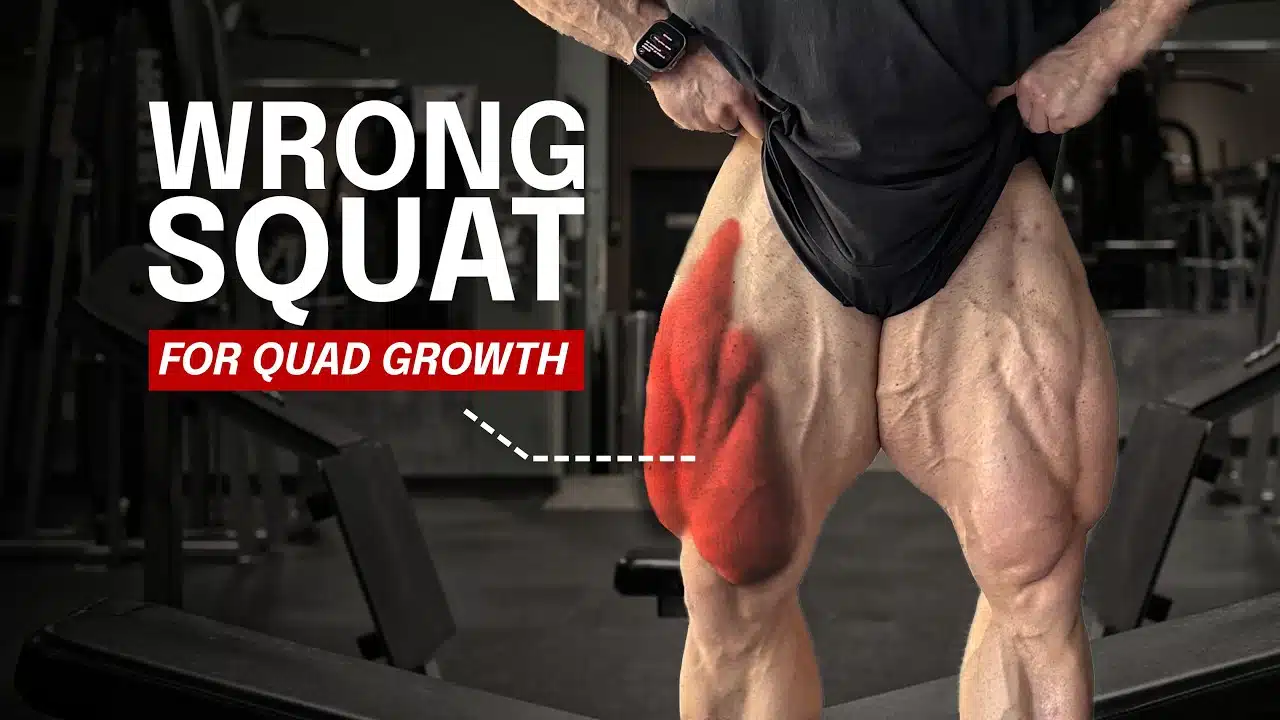
John from J3 University, who has coached multiple top IFBB pros and specializes in bringing up lagging body parts, recently broke down the most common quad-training mistakes and how to fix them.
His approach focuses on exercise selection based on anatomy, proper form adjustments, and strategic programming that actually builds size.
Jump to:
- Understanding Quad Anatomy Changes Everything
- Can You Actually Target Different Quad Heads?
- Exercise #1: Leg Extensions Done Right
- Fixing Your Squat Mechanics
- Exercise #2: Why Barbell Back Squats Aren’t Optimal
- Exercise #2 (His Real Pick): Hack Squats
- Exercise #2 (Actual Top Pick): Pendulum Squats
- Exercise #3: Unilateral Leg Press For Outer Sweep
- Exercise #4: Front-Foot-Elevated Split Squats
- Putting It All Together: Programming Template
Understanding Quad Anatomy Changes Everything
Before diving into exercises, John emphasizes understanding how the quadriceps actually function. The muscle group comprises four main heads: the VMO (vastus medialis oblique), vastus intermedius, vastus lateralis (outer sweep), and rectus femoris.
All four heads extend the knee, which functions as a simple hinge joint. However, the rectus femoris is unique—it’s a biarticular muscle crossing both the hip and knee joints.
The unique thing about it is though is you need to be in more hip extension. So the knee farther back behind you and going through knee extension at the same time to really fully train it.
Recent research has even identified a fifth head called the tensor vastus intermedius, located between the intermedius and lateralis. While interesting anatomically, this doesn’t change training methodology.
Can You Actually Target Different Quad Heads?
John addresses a common question: can stance variations preferentially target specific quad heads, particularly that coveted outer sweep?
The vastus lateralis has attachments to the lower glute max on the hip’s outer aspect. Bringing your knee toward the midline can create slightly more bias toward quad sweep development.
Similarly, the VMO connects closer to the adductors, so bringing feet outward may emphasize that area slightly more.
But here’s the key point: you don’t need endless stance variations. Getting full knee flexion—hamstring to calf contact—will train all quad heads effectively. Strategic exercise selection matters far more than obsessing over foot placement.
Exercise #1: Leg Extensions Done Right
Contrary to popular belief among some strength coaches, John champions leg extensions as the single best movement for complete quad development.
This exercise trains all four heads, including the rectus femoris, when executed properly.
Critical Setup Adjustments
- Lean back as far as possible while maintaining a solid brace—this increases hip extension and maximally engages the rectus femoris
- Align your knee with the machine’s pivot point to prevent joint stress
- Keep feet pointing straight up throughout the movement
That last point addresses a major cause of knee pain during leg extensions.
A lot of people have issues on their extension is as they’re doing their knee extension, their feet rotate out. Like I said earlier, the knees is just a hinge joint. So, it’s not best to load the sides of it.
When feet rotate outward, you load the knee laterally rather than in its natural movement plane. Keeping toes pointed toward the ceiling maintains proper force distribution and can eliminate knee discomfort immediately.
John notes that while research shows slight differences in quad activation with various toe angles, the sustainability issue with those variations outweighs any minor benefits. Maximum knee flexion matters most—if your machine doesn’t allow deep flexion, consider using a pad extension like a Hustler pad.
Fixing Your Squat Mechanics
Before discussing specific squat variations, John introduces a game-changing foot pressure cue that applies to all squatting movements.
The Big Toe Pressure Technique
Most lifters don’t understand proper foot mechanics during squats and leg presses. Creating stability through your feet allows greater tension development in the quads, which translates to more growth.
What I want you to do in your squatting, this isn’t just squats, but also your leg press. Anything where you’re planting your feet down, is I want you to cue big toe down. You should feel equal pressure on your big toe and your heel.
This cue creates internal knee rotation, forming a straight line for optimal quad function. It also dramatically increases glute activation—particularly beneficial for women who struggle feeling glutes during squats.
Rolling to the outside of your feet pushes knees outward, shifting emphasis toward adductors instead. This simple adjustment can also resolve knee pain by keeping force directed properly through the patella.
Exercise #2: Why Barbell Back Squats Aren’t Optimal
John drops a controversial take: barbell back squats aren’t his top choice for quad development.
They’re not inherently bad, and some lifters thrive with them. However, anatomy determines effectiveness.
During back squats, weight travels through your body’s midline. Achieving depth requires significant hip hinging and forward knee travel—creating a movement that’s partially glute, partially quad.
Lifters with long femurs must bend forward considerably, making back squats even more glute-dominant. For maximum quad stimulation, you need an upright torso with substantial forward knee travel.
Workarounds If You Prefer Barbell Squats
- Heel elevation shifts weight forward and promotes upright posture
- Squat shoes with raised heels serve the same function
- Safety squat bars position weight anteriorly, forcing upright positioning
Combining heel elevation with a safety squat bar creates the most quad-focused back squat possible. Still, John prefers other options.
Exercise #2 (His Real Pick): Hack Squats
Hack squats deliver everything needed for quad growth: upright torso positioning, load through the shoulders rather than spine, and forced forward knee travel.
Place feet as low on the platform as possible while keeping heels down throughout the movement. Squat shoes prove particularly valuable here for lifters whose heels rise at depth.
While John mentioned that stance width doesn’t dramatically impact results according to research, finding a stable position matters most. He recommends a moderate stance—toes slightly turned out, knees tracking outside the torso just enough to achieve full hamstring-to-calf flexion.
You don’t want to go super wide frog stance. It’s a lot of adductor in place, but kind of that happy middle ground like have the knees moving out just enough to where you get those hamstrings to calves and that should be your squat position.
Troubleshooting Hack Squats
Shorter individuals or those lacking depth can place yoga blocks between shoulders and the pad, allowing greater range of motion.
Experiencing knee pain? Try positioning a foam roller behind your back. This redistributes load slightly more toward hips, potentially eliminating discomfort. While it reduces quad stimulus marginally, pain-free training always trumps perfect exercise selection for long-term progress.
Exercise #2 (Actual Top Pick): Pendulum Squats
John reveals his true favorite: the pendulum squat. This machine creates an arc around the knee joint as you move, making it extremely quad-biased and surprisingly joint-friendly even for taller lifters.
The catch? Most gyms don’t have one, which is why he led with hack squats.
One critical adjustment: keep toes pointed relatively forward—perhaps 5-10 degrees outward maximum. Because pendulum squats swing through an arc, excessively turned-out feet can load the lateral knee structures improperly, similar to the leg extension issue discussed earlier.
As with hack squats, position feet low on the platform without heels rising. Squat shoes remain beneficial here.
Exercise #3: Unilateral Leg Press For Outer Sweep
John’s third exercise selection is specific: single-leg press rather than bilateral.
Unilateral work allows positioning your foot closer to midline. Remember the vastus lateralis attachment to the glute? This positioning creates additional stretch in that area, providing slightly greater emphasis on quad sweep development.
I know many people say you can’t just grow the quad sweeping and no, you can’t just only target that, but we can create some bias in those areas.
Setup remains consistent: foot as low as possible without heel elevation, maintaining that big toe pressure throughout.
Bilateral Leg Press Still Works
John emphasizes that bilateral leg press remains highly effective. For lifters unable to find a suitable squat variation, leg press alone can build exceptional quad development.
The advantages are significant: reduced axial loading, extremely stable braced position, and pure focus on hip flexion and knee extension. You could replace squats entirely with bilateral leg press one session, then perform unilateral leg press another session for complete development.
Which Leg Press Machine?
John ranks his preferences:
- Cybex leg press – moves toward and down during the descent, mimicking leg extension mechanics for maximum quad bias; works excellently for taller lifters
- 45-degree leg press – linear movement path works great but makes low foot placement harder for some; may require heel wedges or squat shoes
- Hip press machines – movement away and down emphasizes glutes more but remains viable for quad work
Ultimately, choose whichever machine you feel working best.
Exercise #4: Front-Foot-Elevated Split Squats
The final movement is unilateral but addresses two training gaps simultaneously.
Split squats fully lengthen the rear leg, completely training the rectus femoris. They also force hip stabilization in ways heavily braced bilateral movements don’t.
John admits this was his own training mistake early in his bodybuilding career—relying exclusively on stable, braced patterns without challenging lateral hip control. This unilateral work not only builds muscle but raises your performance ceiling on other lifts while serving injury prevention purposes.
Setup for Maximum Quad Focus
Traditional split squat variations with the front foot elevated pitch weight forward, allowing you to sit back—this emphasizes glutes. For quads, do the opposite.
Elevate the front foot on a block instead (squat shoes still beneficial). Hold dumbbells close to your hips rather than near your feet, maintaining a very upright torso.
To initiate the movement, you’re going to have that knee move forward and your whole body is going to shift forward. And then we’re going to push back. This whole movement, it’s nearly like doing a standing leg extension, but it’s very, very quad focused.
You’ll start with slight knee bend—that’s normal. Focus on knee-forward movement with your entire body shifting anteriorly.
This works as an intense finisher at session end or as your primary squat movement at the beginning. If split squats don’t suit you, substitute single-leg press—John does this frequently with clients who struggle with split squat mechanics.
Putting It All Together: Programming Template
John recommends training quads twice weekly with this structure:
Session 1
- Leg extensions: 3 sets
- Best squat variation for you (hack, pendulum, or modified barbell): 3 sets
Session 2
- Leg press (bilateral or unilateral): 3 sets
- Split squats: 3 sets
You can experiment with exercise order in the second session—try split squats before leg press to see which sequence works better for you.
This approach balances compound movements with isolation work, addresses all quad heads including the often-neglected rectus femoris, and incorporates both bilateral and unilateral training for complete development.
Most importantly, the exercise selections and form corrections John provides can eliminate knee pain while maximizing growth—addressing the two biggest obstacles lifters face with quad training.