A 78-year-old German accountant-turned-running-legend is about to do something no one in the history of the Berlin Marathon has ever done.
Wilfried Köhnke is lining up for his 50th Berlin Marathon start — a number so staggering it almost defies belief.
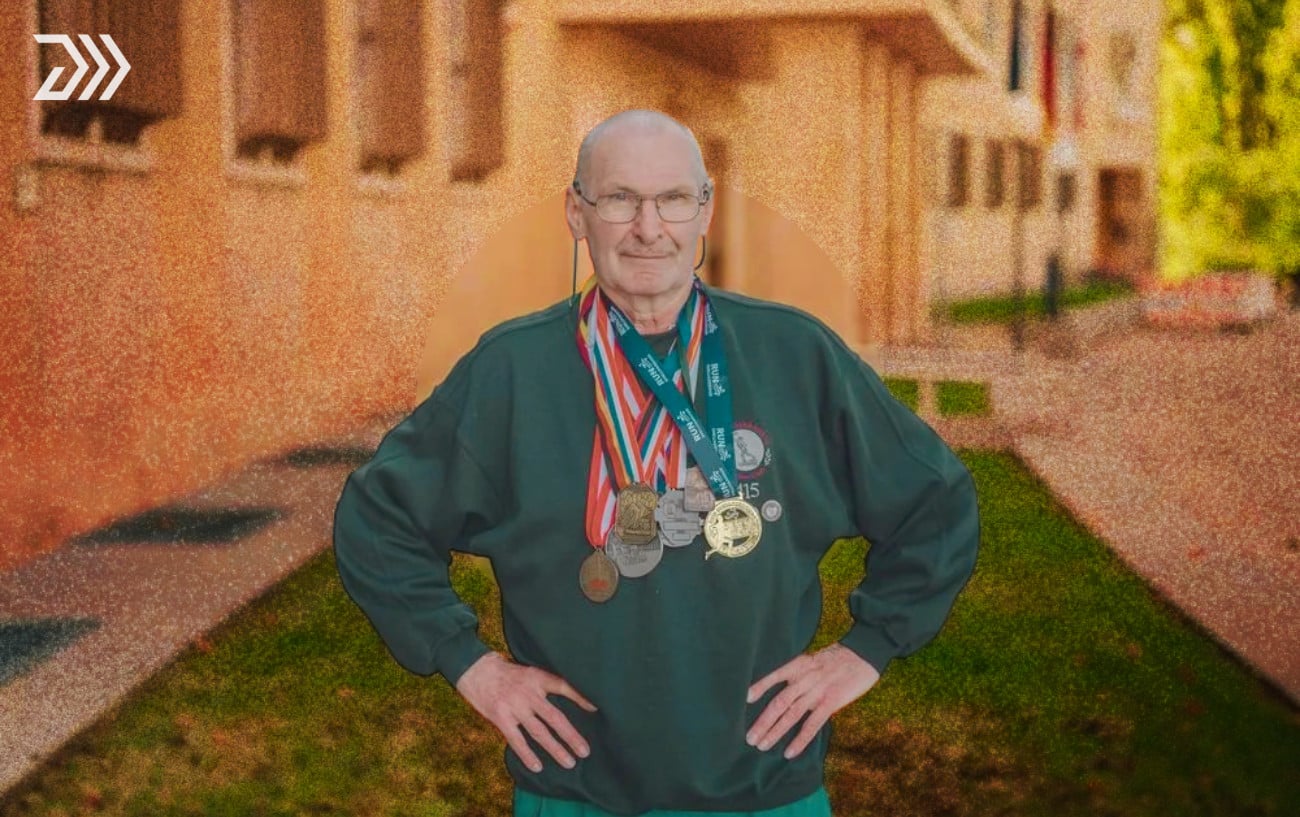
His journey began in 1975, when a group of reporters almost talked him out of entering altogether.
Half a century later, he’s still running — and he’s not finished yet.
Jump to:
From a Reluctant Spectator to a Living Record
When Berlin staged its very first marathon in October 1974, Köhnke was already an experienced runner. He’d been logging miles for eight years by then.
But he didn’t race that day.

If you want something simple that actually works, this is one of the most effective tools I’ve used to build strength, conditioning, and endurance without needing a full gym setup.
- Full-body training with one weight using swings, squats, and presses
- Solid cast iron build that feels stable and lasts for years
- Comfortable grip that makes high-rep workouts easier to handle
Journalists covering the event had convinced him it was a race for specialists only — elite athletes, not everyday runners. So he watched from a distance instead.
The following autumn, he ignored the skeptics and entered anyway. He crossed the finish line in 3:57:05, and something clicked.
What followed was a five-decade commitment that no other runner in Berlin Marathon history has matched. By 2012, Köhnke had surpassed Bernd Hübner’s record of 36 participations, a mark the two Berliners had held jointly through 2011 before illness ended Hübner’s streak.
Even Köhnke admits he never saw it coming.
Of course, I never expected that at the beginning. At some point, the idea did occur to me: Maybe you’ll make it to 50.
A Race That Grew Up Alongside Him
The Berlin Marathon Köhnke first entered in 1975 looks almost nothing like the race it is today.
That debut edition attracted just 286 starters from four countries, with runners setting off from Waldschulallee in Charlottenburg and completing two loops out toward the Wannsee lido through the Grunewald forest. It was a small, intimate affair — 244 people finishing a race that barely registered on the world stage.
If you want something simple that actually works, this is one of the most effective tools I’ve used to build strength, conditioning, and endurance without needing a full gym setup.
- Full-body training with one weight using swings, squats, and presses
- Solid cast iron build that feels stable and lasts for years
- Comfortable grip that makes high-rep workouts easier to handle
By last year, the organizers had 55,146 runners registered. The course moved into the heart of West Berlin in 1981, starting at the Reichstag, and it has only grown from there.
Köhnke has run every version of that course. He’s candid about what that transformation has meant for the competitive experience.
Nevertheless, if I am going to train for a marathon, I would still rather run it as a race.
The massive modern field, in his view, has softened the competitive edge — but his mindset hasn’t changed one bit.
The Numbers Behind a Marathon Life
Köhnke was born in Pritzwalk in 1947, moved to Berlin in 1969, and spent 41 years as an accountant at Germany’s federal pension insurance agency before retiring in 2013. He has raced under the banner of Polizei SV Berlin since 1988.
But it’s the running statistics that truly tell his story.
His personal best — 2:44:48, set in 1985 — is genuinely elite. He has broken the three-hour barrier 11 times in total. During his peak training phases, he was running around 68 kilometers per week, a relatively modest load for someone competing at that level.
If you want something simple that actually works, this is one of the most effective tools I’ve used to build strength, conditioning, and endurance without needing a full gym setup.
- Full-body training with one weight using swings, squats, and presses
- Solid cast iron build that feels stable and lasts for years
- Comfortable grip that makes high-rep workouts easier to handle
These days he averages around 43 kilometers weekly, roughly 27 miles. Not exactly retirement pace.
By spring of this year, Köhnke had completed 106 marathons in total — including races on five continents between 1991 and 1997. Eight of those took place in Australia, a country he has visited 23 times since 1976, where his sister has lived since 1973.
One of those Australian races holds a place no other marathon can touch. His 100th marathon, run in Shellharbour south of Sydney in 2022, fell on May 1 — the birthday of an uncle who died in the war. It’s the race he says he’d most want to run again.
The Club That Keeps Him Coming Back
Berlin’s Jubilee Club rewards runners who complete the race 10 times with a guaranteed annual entry — no lottery, no uncertainty. Members also receive a colored bib number for life.
Free entries are awarded at the 20th, 25th, 30th, 35th, and 40th finishes. Köhnke ran past that last milestone years ago.
The club now counts more than 6,250 members, a testament to how many runners fall under the race’s spell for the long haul.
If you want something simple that actually works, this is one of the most effective tools I’ve used to build strength, conditioning, and endurance without needing a full gym setup.
- Full-body training with one weight using swings, squats, and presses
- Solid cast iron build that feels stable and lasts for years
- Comfortable grip that makes high-rep workouts easier to handle
The American Soldier Who Kept Him Motivated
Köhnke credits one person in particular with helping fuel his decades-long commitment: Martin W. Teague.
Teague, an infantryman with the U.S. Army’s Berlin Brigade, finished the very first Berlin Marathon in 1974, placing 61st in a time of 3:31:25 while wearing bib number 6. That same number was handed back to him for the 50th edition of the race in 2024 — and according to Köhnke, he’s running again this year.
The pair represent something rare in distance running: decades of loyalty to a single event.
They’re not alone in marathon history either. Johnny Kelley started Boston 58 times between 1928 and 1992. Antonio Rao finished his 31st Rome Marathon at the age of 93. These are the people who remind the running world that the sport belongs to everyone — not just the fast, and not just the young.
Still Racing, Still Counting
Sunday’s event is the 52nd edition of the Berlin Marathon, and Köhnke will be somewhere deep in a field of tens of thousands, well behind the elite runners at the front.
He knows that. He doesn’t care.
If you want something simple that actually works, this is one of the most effective tools I’ve used to build strength, conditioning, and endurance without needing a full gym setup.
- Full-body training with one weight using swings, squats, and presses
- Solid cast iron build that feels stable and lasts for years
- Comfortable grip that makes high-rep workouts easier to handle
What matters is that he’s there — for the 50th time — doing the thing he has shown up to do, year after year, through five decades of change, growth, and an entire lifetime of mornings spent running.
At 78, Wilfried Köhnke isn’t a footnote in Berlin Marathon history. He is the history.