World’s Strongest Man Hafþór “Thor” Björnsson recently discovered something humbling: bodyweight exercises can be absolutely brutal.
The Icelandic giant, who famously deadlifted over 1,100 pounds, traded his typical heavy strongman training for high-rep hypertrophy work with Dr. Mike Israetel and Jared Feather from Renaissance Periodization.
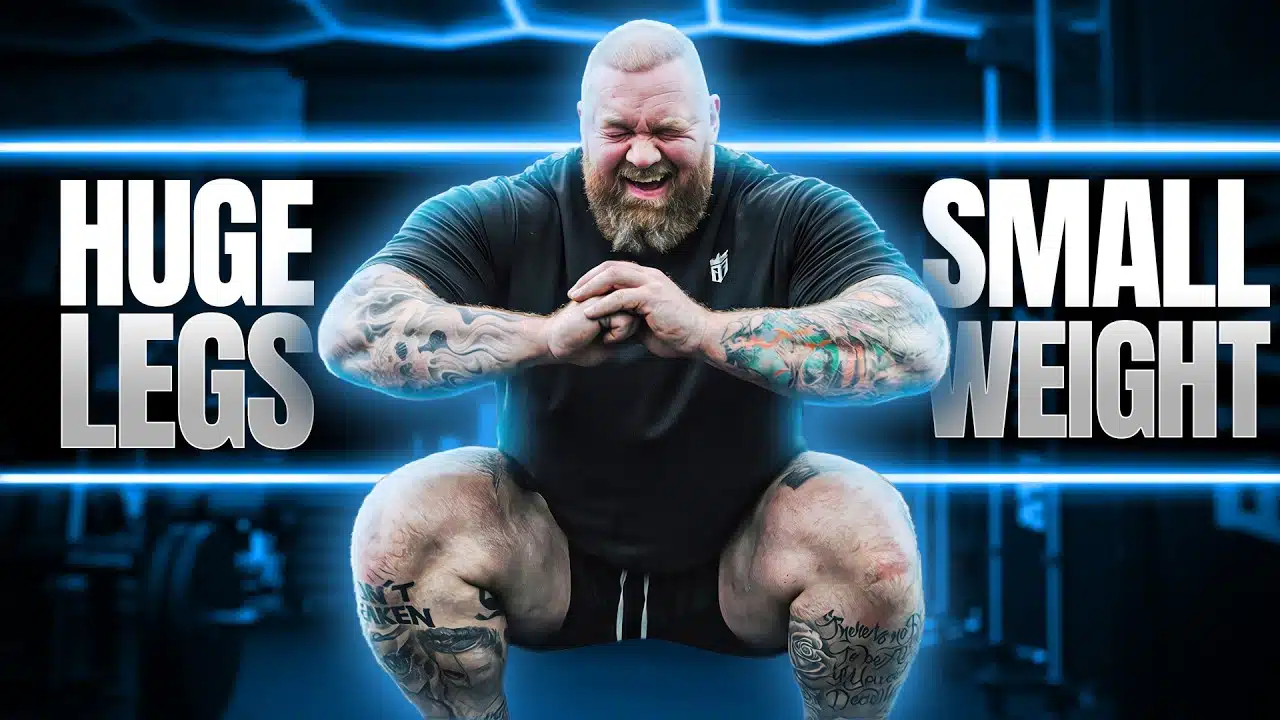
What followed was a leg workout that left the 400-pound athlete questioning his life choices.
And it’s a masterclass in why muscle-building training hits differently than pure strength work.
Jump to:
- When Strength Meets Hypertrophy Training
- Glute-Ham Raises: The Humbling Reality
- Hack Squats: Discovering Quad Isolation
- Heel-Elevated Bodyweight Squats: The Real Test
- Bulgarian Split Squats: The Finishing Move
- Key Principles Behind The Workout
- Why Bodyweight Training Remains Underrated
- The Strength vs. Hypertrophy Distinction
- Practical Applications For Regular Lifters
- The Aftermath
When Strength Meets Hypertrophy Training
Thor arrived ready for what he assumed would be another challenging workout. But hypertrophy training—focused on muscle growth through higher reps and time under tension—proved to be an entirely different beast.
I’m going to do very very heavy. No, I said that wrong. We’re doing light light weight and high reps and it’s going to be miserable and I might die.
Dr. Mike explained the approach clearly: controlled negatives, deep stretches, and relentless volume. This wasn’t about moving maximum weight. It was about maximizing muscular tension and metabolic stress.
For someone accustomed to sets of three to six reps, this was uncharted territory.
Glute-Ham Raises: The Humbling Reality
First up: glute-ham raises. Despite Thor holding the world record deadlift, this posterior chain exercise humbled him immediately.
Dr. Mike noted the irony:
Thor is the holder of the world’s biggest deadlift in strongman, over 1,100 pounds. And you would think, ‘Oh man, he’s got to have this really strong posterior chain.’ You’re completely correct. That just illustrates how insanely difficult the exercise that we’re doing is.
The machine required significant weight assistance just so Thor could complete reps with proper form. The exercise targets the hamstrings and glutes through an extreme range of motion that pure strength training rarely emphasizes.
Two “myo-rep” sets of 20 total reps—broken into mini-sets with brief rest periods—left Thor’s posterior chain screaming.
Hack Squats: Discovering Quad Isolation
Thor admitted he’d never properly done hack squats before. The machine forces knee-dominant squatting patterns that isolate the quadriceps far more than traditional barbell squats.
I actually never do hack squats. This is probably going to be my first ever like real hack squat.
Dr. Mike strategically positioned Thor’s feet lower on the platform with toes pointed outward at 45 degrees. This setup maximized quad engagement while allowing deep hip flexion.
The coaching cues came rapid-fire:
- Control the descent for 3-4 seconds
- Open the hips at the bottom position
- Drive knees outward throughout the movement
- Push through heels on the ascent
Another myo-rep set to 20 total reps had Thor questioning everything. His quads burned in ways heavy barbell squats never produced.
Heel-Elevated Bodyweight Squats: The Real Test
Perhaps nothing illustrated the difference between strength and hypertrophy training more than bodyweight squats. For context, Thor weighs over 400 pounds.
Dr. Mike pointed out:
Obviously the man is 400 and something pounds. So a bodyweight squat for him is equivalent to me putting 200 something pounds on my back and doing it.
Heel elevation shifted even more emphasis to the quads. Thor had to maintain an upright torso, push knees forward maximally, and control every inch of the movement.
The protocol was simple but savage: as many quality reps as possible across three sets.
Slow on the way down. We only count the slow ones.
By the final set, Thor’s legs were shaking. Fifteen controlled reps felt harder than any max-effort squat attempt.
Bulgarian Split Squats: The Finishing Move
If Thor had any gas left, Bulgarian split squats extinguished it completely. This unilateral movement creates intense glute stretching while simultaneously hammering the quad of the working leg.
Dr. Mike explained the biomechanics:
When you’re doing your right leg, your right glute is getting hit because it’s getting stretched like crazy. But your left quad, especially the very middle of your quad, which it doesn’t get hit very well in almost every other exercise, gets hit because your hips are extended and your knee is extended as well.
Thor used ski poles for balance—a practical solution given his 6’9″ frame. Two sets of 20 reps per leg with deep stretches at the bottom completed the workout.
His reaction said everything:
Everything is just fucked right now. My thighs, hamstring, ass is super. Like my glutes. Like it was just burning and almost like feeling like I was about to tear a muscle.
Key Principles Behind The Workout
This session wasn’t random torture. Several evidence-based hypertrophy principles were at play:
Eccentric Overload
Controlled lowering phases create greater muscle damage and mechanical tension than the lifting phase alone. Dr. Mike constantly emphasized 3-5 second negatives.
Deep Stretch Positions
Research increasingly shows that training muscles in lengthened positions produces superior growth. Every exercise prioritized maximum range of motion with deep stretches.
Myo-Rep Sets
This technique extends time under tension by taking brief rests (10-20 seconds) during a single set. It allows accumulation of high volumes near muscular failure without excessive fatigue.
Unilateral Training
Single-leg work addresses asymmetries and creates stability demands that bilateral exercises don’t. Bulgarian split squats forced Thor to stabilize and control in ways his strongman training never required.
Why Bodyweight Training Remains Underrated
If the world’s strongest man can get demolished by bodyweight exercises, what does that mean for regular lifters?
Execution quality matters more than external load. Tempo, range of motion, and muscle engagement separate effective training from simply moving weight.
Dr. Mike’s closing message drove this home:
If Thor, the world’s strongest man, can get a good workout with just his body weight, I think you can, too.
The workout demonstrated several practical takeaways:
- Slow eccentrics dramatically increase difficulty
- Heel elevation shifts squat emphasis to quads
- Deep stretches maximize muscle fiber recruitment
- Unilateral work reveals and addresses weaknesses
- High-rep training builds different adaptations than low-rep strength work
The Strength vs. Hypertrophy Distinction
Thor’s experience highlights a crucial reality: being strong doesn’t automatically mean optimized muscle development. Strongman training builds incredible absolute strength through heavy loads and short rep ranges.
Hypertrophy training uses moderate loads, higher volumes, and techniques specifically designed to maximize time under tension and metabolic stress. The physical sensations differ completely.
Thor noted his hamstrings were “super sore” and glutes “burning” in ways his record-setting deadlifts never produced. That deep ache comes from accumulated metabolites, micro-damage, and sustained tension—all powerful muscle growth stimuli.
Practical Applications For Regular Lifters
You don’t need to be 400 pounds or lift world-record weights to benefit from these principles. Here’s how to apply them:
- Prioritize control over load: Reduce weight if needed to achieve 3-4 second lowering phases
- Emphasize stretch positions: Feel tension at maximum muscle length on every rep
- Try myo-reps: After reaching near-failure, rest 15 seconds and continue for mini-sets
- Include unilateral work: Bulgarian split squats, single-leg RDLs, and pistol squat variations reveal imbalances
- Use heel elevation strategically: Place small plates under heels during squats to increase quad emphasis
These methods require patience and ego management. Weights will be lighter. Reps will be slower. The gym mirror might not be as impressive mid-set.
But muscles respond to tension, not just numbers on a bar.
The Aftermath
Thor’s legs were comprehensively destroyed. Walking, sitting, and basic movement became challenges for days afterward.
Good luck sitting on the toilet for the next week.
That soreness—delayed onset muscle soreness (DOMS)—signals unfamiliar training stimulus. Thor’s body, adapted to heavy loads and explosive movements, encountered sustained tension and stretch it rarely experiences.
Different training creates different adaptations. Powerlifters who try CrossFit get destroyed. Bodybuilders who attempt strongman events struggle. And apparently, world’s strongest men who do bodyweight hypertrophy training discover whole new dimensions of suffering.
The lesson? Respect all training modalities. Each develops unique qualities that don’t automatically transfer.