Pain is the single biggest barrier standing between lifters and their goals.
Not programming. Not exercise selection. Not even training volume.
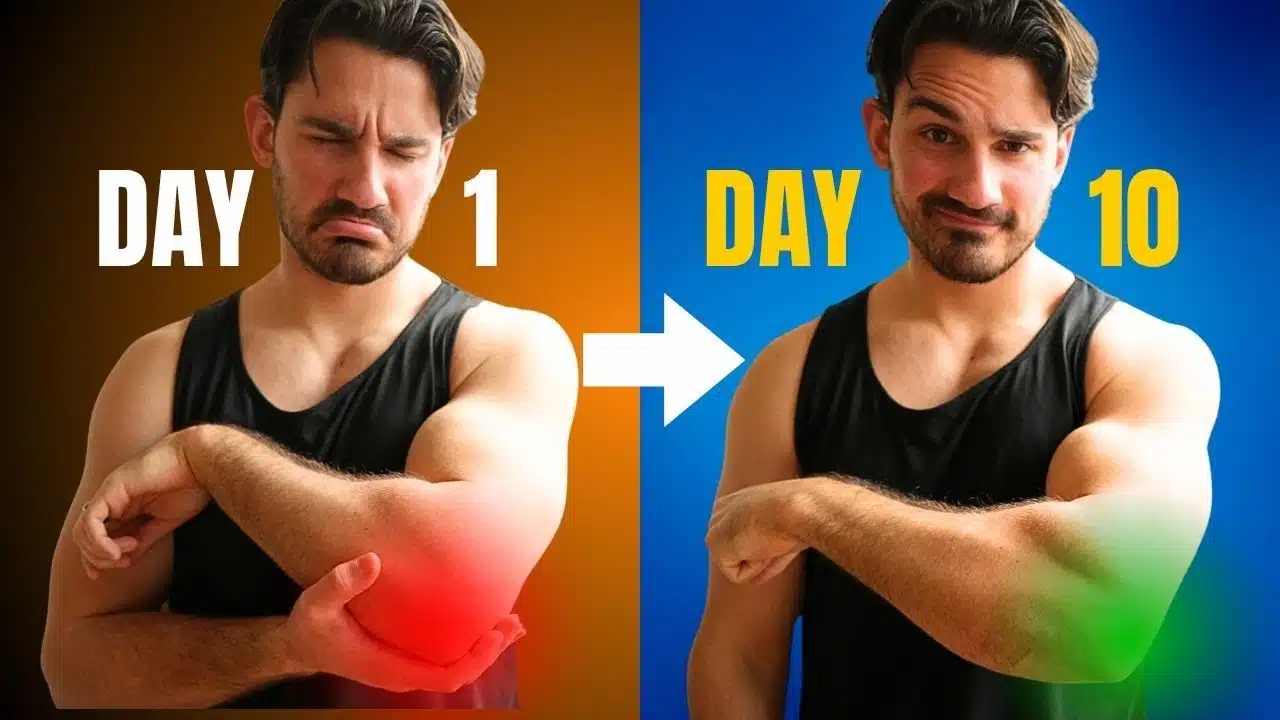
According to biomechanics expert and content creator Ben, understanding and managing training pain is the key to consistent progress in the gym.
In his comprehensive pain-free training guide, he breaks down exactly how lifters can troubleshoot discomfort on their own—without abandoning their favorite exercises or seeking constant professional intervention.
Jump to:
- Understanding Pain: It’s Not What You Think
- The Stress Bucket: Your New Mental Model
- Two Categories of Pain
- Exercise Variable #1: Resistance Direction
- Exercise Variable #2: Joint Position
- Exercise Variable #3: Range of Motion
- Exercise Variable #4: Stability and Anchoring
- Exercise Variable #5: Tempo
- When Everything Hurts: Chronic Pain Strategies
- The Bottom Line
Understanding Pain: It’s Not What You Think
Most people view pain as the boogeyman—something inherently broken that requires fixing. Ben offers a radically different perspective.
Pain is a signal, right? When we have a pain, say, in our elbows, I simply view that as some kind of signal from our bodies that says, “Hey, something is going on here.”
Think of pain like your car’s check engine light. It indicates stress beyond your current capacity to handle—not necessarily that something is fundamentally damaged.
Pain doesn’t mean you’re broken. It means you’ve exceeded your tissue’s tolerance for stress at that moment.
The Stress Bucket: Your New Mental Model
Ben introduces a powerful analogy that reframes how we should think about training stress and pain.
Imagine a bucket representing your capacity to handle stress at a specific joint—let’s say your elbow. Every set of biceps curls or triceps extensions adds water to this bucket.
When you recover properly between sessions, you empty the bucket. The result? Strength gains and muscle growth.
But when the bucket overflows—when stress exceeds capacity—pain emerges as a signal.
If we overflow the stress bucket, that may be elbow ouchy, right? Which many people call lateral epicondilitis, medial epicondilitis, tennis elbow, golfer’s elbow, give it whatever name you want. I don’t care. You are overflowing the stress bucket.
This model shifts focus from diagnosis to load management—a far more practical approach for most gym-goers.
Two Categories of Pain
Ben distinguishes between acute, easily-managed pain and chronic, sensitized pain.
Category One: Acute Pain
This is the straightforward scenario. An exercise hurts, you make an adjustment, pain disappears.
Perhaps switching from a straight bar to a rope attachment on triceps extensions eliminates elbow discomfort. Problem solved immediately.
Category Two: Chronic, Sensitized Pain
This represents a shrinking stress bucket. Nothing seems to help—every variation of an exercise triggers discomfort.
Your tolerance hasn’t actually decreased permanently. Rather, sensitization has increased around that particular area.
Category one responds to exercise modifications. Category two requires a broader, more strategic approach—which Ben addresses with specific principles later in his framework.
Exercise Variable #1: Resistance Direction
Changing how resistance relates to your body is arguably the most powerful modification you can make.
Ben demonstrates this with lat pulldowns. When resistance pulls nearly parallel to your torso, shoulder stress may accumulate. Simply angling forward slightly—making the resistance less parallel—can eliminate pain entirely while maintaining virtually identical lat stimulation.
All I’ve basically done is I’ve taken this exact same scenario and I’ve just changed the resistance angle slightly relative to my body so that the stimulus of the exercise, it’s still a predominantly lower lat exercise.
The same principle applies to curls. Cable curls with resistance pulling backward versus straight down can make massive differences in shoulder and elbow comfort.
Key insight: Even with fixed implements like dumbbells, you can change resistance direction by adjusting your body angle—leaning back on an incline versus standing upright during curls, for example.
Exercise Variable #2: Joint Position
Joint position changes often overlap with resistance modifications, but they deserve separate consideration.
Simple adjustments include:
- Grip width: Narrow versus wide grip bench press dramatically changes shoulder position and stress
- Grip orientation: Pronated (palms down) versus neutral (palms facing each other) versus supinated (palms up)
- Limb angles: Overhead versus lower arm angles on extensions
- Stance width: Narrow versus wide on leg presses targeting different muscle emphasis and joint stress
Ben shares a personal example: forcing his brother’s arm fully overhead during cable extensions caused pain. Lowering the arm angle slightly provided instant relief.
Don’t limit your thinking to obvious joints. Wrist position during pressing, foot position during squatting, even spinal positioning—all can be modified for comfort.
Exercise Variable #3: Range of Motion
Social media has poisoned lifters into believing full range of motion is mandatory. Ben pushes back hard against this notion.
Do you really think that 5% difference in range of motion is going to be the difference between you growing horseshoe triceps and not? Right? Like it should be abundantly clear to you that that is kind of a non-starter as a question.
If the bottom 10% of your barbell skull crushers causes elbow pain, simply don’t go that deep. If the top lockout of dips aggravates your shoulders, stop short of full extension.
Pain-free training beats theoretical optimization every single time.
Interestingly, Ben notes that starting with reduced ranges often allows progressive expansion over time. What hurts today may become comfortable in weeks or months with proper load management.
Exercise Variable #4: Stability and Anchoring
External stabilization—what Ben calls “anchoring”—reduces compensatory stress on surrounding structures.
Standing cable curls require shoulder stabilizers to prevent your arm from being pulled backward. Bracing your upper arm against a cable column or wall eliminates this demand, often resolving shoulder discomfort immediately.
Other anchoring strategies include:
- Using benches to support your torso during rows or curls
- Bracing your non-working arm against your working arm during extensions
- Lying down during exercises typically performed standing
- Using machines instead of free weights to eliminate stabilization demands
The beauty of increased stability? You’re probably already training stabilizers through compound movements. Doubling down on unstable exercise variations when experiencing pain makes little sense.
Exercise Variable #5: Tempo
Tempo might be the most underutilized pain-management tool available.
Ben demonstrates three leg extension tempos: ultra-controlled with pauses, moderate speed, and faster with momentum. All can be valid, but slowing down dramatically often provides the most reliable path to pain-free training.
Slower tempos increase control. Control means continuously opposing resistance throughout the entire range—not just during the lifting phase.
The only foolproof way really that I have reliably helped people to decrease their pain in the gym is to get them to actually learn how to control movement of load.
During the lowering phase of a leg extension, you should still be thinking about pushing the pad away—just with less force than gravity. This maintains tension and control rather than allowing momentum to dominate.
If pain persists despite changing resistance, position, range, and stability, dramatically slowing your tempo should be your next intervention.
When Everything Hurts: Chronic Pain Strategies
For sensitized, long-standing pain that doesn’t respond to exercise modifications, Ben offers nine principle-based strategies.
1. Remove the Trigger
If every triceps variation aggravates your elbow, stop doing triceps work entirely. Temporarily.
This might also mean eliminating pressing and pulling movements. The alternative—continued aggravation—leads to months of persistent problems versus weeks of strategic rest.
Use this time to emphasize other training qualities: core work, cardio, mobility, or simply recovering.
2. Grade Exposure Slowly
After removing triggers, reintroduce stress gradually. Painfully gradually.
If you were doing 10 sets of quad work weekly, restart with one set. Maybe two the following week. Perhaps staying at one set but slightly increasing intensity.
Use lighter loads, slower tempos, higher reps, and ranges well away from failure initially.
3. Pay Attention
Keep detailed logs. Track exercises, sets, reps, loads, and how you feel 24, 48, and 72 hours post-training.
Ben shares that his own low back issues persisted until he started systematically tracking his training and recovery responses. Without data, you’re just guessing.
4. Consider Exercise Overlap
Pain often results from accumulated stress across multiple exercises, not single movements.
Example: Forearm and elbow stress accumulates from gripping dumbbells during presses, holds during rows, direct biceps work, and even just racking and unracking weights.
Solutions include using straps, cuff attachments that eliminate grip, machines instead of free weights, or simply reducing total volume of grip-intensive work.
5. No Exercise Is Perfect Enough to Justify Overdoing It
Ben uses a nutrition analogy: eating only “healthy” foods won’t prevent weight gain if you consume excessive calories.
Similarly, selecting biomechanically optimal exercises won’t prevent pain if your total volume exceeds tissue capacity. Even perfect exercises cause problems when overdone.
6. Stop Being a Diagnosis
Avoid internet diagnoses like “anterior pelvic tilt” or “rounded shoulders” that claim to explain your pain.
These labels create mental constraints, convincing you that specific corrective exercises are mandatory. They rarely are.
Focus instead on load management, appropriate exercise selection, and the concrete variables Ben outlines—not postural “fixes” or special corrective protocols.
7. Remove the Mindset of Need
You don’t need to barbell squat, bench press, deadlift, or perform any specific exercise.
Hundreds of variations exist for targeting the same muscle groups. Attachment to specific movements while experiencing pain only limits your options unnecessarily.
8. Standardize But Don’t Get Stuck
Consistency enables progress tracking. Like following a recipe, you need to measure ingredients (sets, reps, load) to reproduce successful outcomes.
However, don’t maintain standardization when it’s clearly not working. If your carefully tracked program consistently produces pain, change the program.
9. The Dailies Are As Important As the Gym
Your life outside the gym—what Ben calls “the dailies”—profoundly impacts training tolerance.
Consider:
- Daily steps: Aiming for 10,000-15,000 provides low-grade movement stimulus
- Postural variety: Alternating between sitting and standing, changing keyboard height, foot position
- Static positioning: Spending hours in identical positions creates its own stress bucket that overflows
- Movement variability: Humans need varied positions and activities, not sustained postures
Ben uses a standing desk and frequently shifts between standing, sitting, and even pacing. Motion is lotion.
No single posture is inherently “good” or “bad”—but any posture maintained too long becomes uncomfortable and potentially problematic.
The Bottom Line
Pain-free training isn’t about finding perfect exercises or achieving ideal posture. It’s about intelligent load management and systematic experimentation with exercise variables.
Start with resistance direction, joint position, range of motion, stability, and tempo modifications. If acute adjustments don’t resolve persistent pain, implement the nine chronic pain strategies.
Most importantly, remember that experiencing pain doesn’t mean you’re broken—it means you’ve temporarily exceeded tissue capacity. The solution lies in thoughtful programming adjustments, not dramatic interventions or complex corrective protocols.
As Ben emphasizes throughout his comprehensive guide, the power to troubleshoot training pain lies in your hands—not in diagnoses, internet gurus, or mandatory exercise selections.