Workout routines can quickly become monotonous when relying on the same handful of exercises week after week.
While consistency matters more than variety, fitness expert Jeff Nippard believes incorporating lesser-known movements can reinvigorate training programs without sacrificing effectiveness.
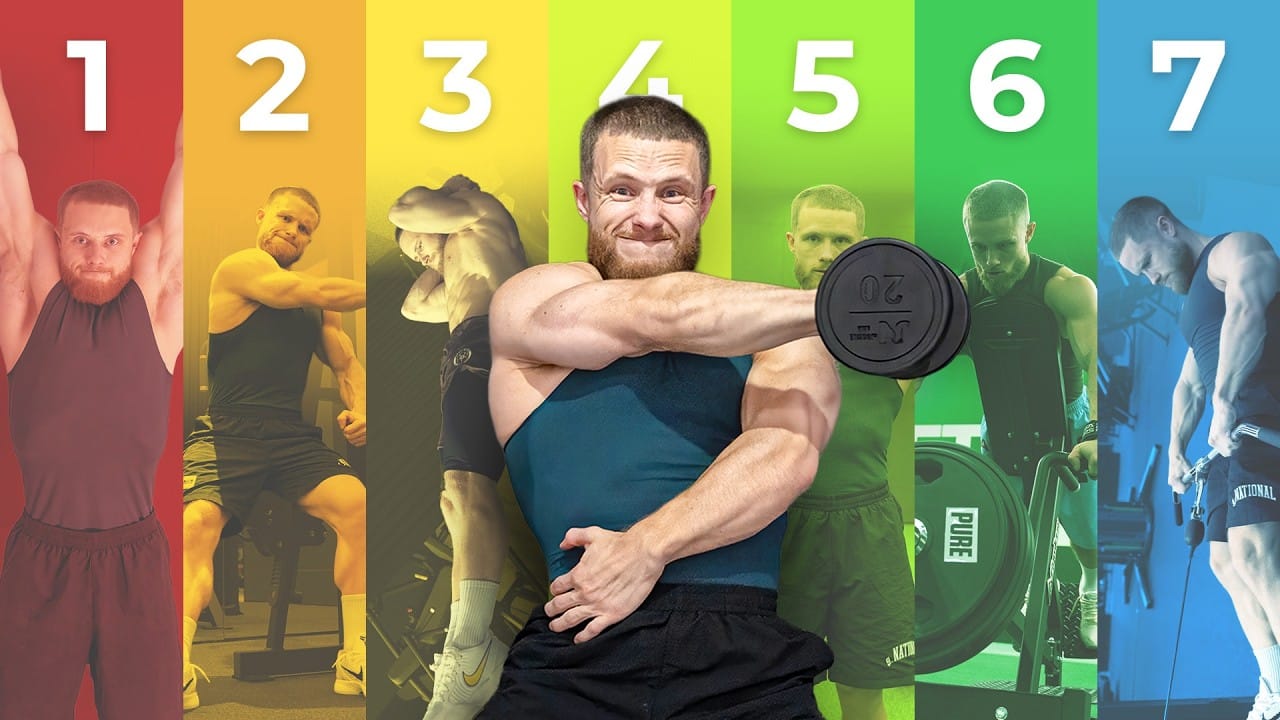
In a recent video, Nippard shared seven underutilized exercises backed by biomechanical science—movements he personally performs weekly that range from moderately familiar to almost completely obscure.
These aren’t gimmicks promising miraculous results, but time-tested techniques that address specific training needs most people overlook.
Jump to:
- Dead Hangs: The Underrated Shoulder and Spine Solution
- Zappman Hammer Curls: Biomechanical Bicep Optimization
- Incline Dumbbell Y-Raises: Superior Side Delt Tension
- Sideways One-Arm Rear Delt Fly: Full Range Activation
- Dragon Flags: Bruce Lee’s Core Destroyer
- Kelso Shrugs: Isolated Mid-Back Thickness
- Seated Cable Deadlifts: Maximum Glute Activation, Minimum Fatigue
- The Foundation Remains Unchanged
Dead Hangs: The Underrated Shoulder and Spine Solution
Dead hangs might seem simple, but this foundational movement delivers surprising benefits for shoulder health, forearm development, core strength, spinal decompression, and muscular endurance.
Nippard recently tested his maximum hang time after coaching his friend Meged through a Mr. Beast challenge. Meged started with just six seconds but reached 60 seconds within 30 days—earning $60,000 in the process.
I just tested it myself and my max time was okay. 2 minutes and 45 seconds. Is that right? Because it really didn’t feel that long.
For context, beginners typically hang 10-20 seconds, intermediates 30-60 seconds, advanced trainees 90-120 seconds, and elite athletes beyond two minutes.
Dead hangs open the shoulder joint, allowing rotator cuff tendons and muscles to move more freely, which may alleviate shoulder discomfort. Spinal decompression benefits remain somewhat debated scientifically, but Nippard finds significant relief after heavy squats or deadlifts.
Technique Tips for Maximum Effectiveness
- Use chalk: Liquid chalk dramatically improves grip duration
- Grip width: Position hands just outside shoulder width
- Start loose: Begin with a lighter grip to preserve forearm endurance, tightening as you begin slipping
- Body position: Keep legs straight, feet together, toes pointed down to minimize swinging
- Breathing: Maintain consistent rhythm rather than holding breath
For those unable to hang with bodyweight alone, resistance bands or assisted pull-up machines provide effective modifications.
Zappman Hammer Curls: Biomechanical Bicep Optimization
This modified curl variation addresses a fundamental training principle: muscles are approximately 40-50% stronger during eccentric (lowering) contractions than concentric (lifting) phases.
Standard dumbbell curls therefore overload the positive phase while under-challenging the negative—despite eccentric training being crucial for muscle growth.
Named after 1800s strongman George Zappman and modified by Nippard, this technique uses grip manipulation to create heavier effective resistance during the negative portion.
How to Execute Zappman Hammer Curls
Curl dumbbells upward using a hammer grip (palms facing each other), which recruits the brachialis and brachioradialis for assistance. At the top, rotate to a supinated grip (palms up) before lowering, forcing biceps to handle the load independently.
Grip dumbbells in the center of the handle rather than letting thumbs rest against the head. Stop just before arms reach vertical, rotate palms upward, then lower in a wide arc before returning to hammer position.
Nippard typically performs 8-10 reps per set. While he doesn’t claim this variation dramatically outperforms standard curls, the biomechanical rationale makes it a worthwhile addition to arm training rotations.
Incline Dumbbell Y-Raises: Superior Side Delt Tension
Standard lateral raises suffer from an unfavorable tension profile—zero tension at the bottom with peak load only at the top of the movement. Recent research confirms lateral raises still build side delts effectively when trained hard, but Nippard prefers more balanced tension distribution.
I find it harder to connect with my side delts when I’m only getting enough tension in such a small aspect of the range of motion.
Setting a bench to 20-30 degrees and bracing against it shifts the resistance curve, providing more consistent tension throughout the range of motion.
Lift dumbbells up and outward in a Y-pattern, targeting fibers between the front and side deltoid heads. This creates superior shoulder definition, particularly when viewed from the front.
Critical technique point: Stop when dumbbells return to your sides rather than letting them swing behind your body, which would eliminate tension at the bottom position.
Sideways One-Arm Rear Delt Fly: Full Range Activation
Traditional pec deck reverse flys effectively perform half-reps in a shortened position—the equivalent of doing bicep curls only in the top half of the movement.
Rear deltoids don’t approach a stretched position until arms cross the body, making the standard setup biomechanically incomplete.
Instead of sitting facing the pad normally, turn sideways and sweep your arm across your body. Dr. Mike Israetel’s cue helps reinforce proper form: imagine there’s money on the ground, and you keep whatever area you can cover.
This visualization encourages sweeping with rear delts rather than yanking with back and biceps.
Alternative Equipment Options
- Cable machine: Reach across body for full rear delt stretch
- Dumbbells: Lie on bench, stretch dumbbell across body, then lift back up
While the deep stretch won’t magically double gains, completely neglecting the stretched portion across all rear delt work likely leaves progress on the table.
Dragon Flags: Bruce Lee’s Core Destroyer
This legendary ab exercise was Bruce Lee’s preferred movement for developing extraordinary core strength. Dragon flags primarily target lower abs through leg elevation while requiring isometric contraction throughout the entire rectus abdominis to maintain spinal extension.
The first time I did these, my upper abs were so sore, I was still sore, I think five or six days after I hit them, so don’t say I didn’t warn you.
Obliques provide stability, serratus muscles anchor shoulders and back, and lats receive activation as well—creating comprehensive core engagement.
Grab the top of a bench, then lift your entire body including glutes off the bench with straight hips and knees until legs reach 60-80 degrees. Lower under control while maintaining hip extension.
Progression Strategy
- Beginners: Start with lying leg raises for 8-10 reps
- Intermediate: Progress to bent-knee dragon flags, which shorten the lever arm
- Advanced: Graduate to full dragon flags for 4-8 reps
Nippard favors dragon flags over hanging leg raises because hanging variations create instability that limits abdominal tension. Dragon flags provide stability while eliminating the need for arms and shoulders to support bodyweight.
Kelso Shrugs: Isolated Mid-Back Thickness
Despite the name, Kelso shrugs function more like rows with one crucial difference—they completely isolate mid-traps and rhomboids without fatiguing the lower back or involving biceps.
Standard rows combine elbow flexion with scapular retraction simultaneously. Research shows rows do build biceps to some extent, but curls produce approximately double the growth. Since biceps are significantly smaller than back muscles, they eventually limit the tension reaching larger back muscles.
After hitting failure on standard rows, most people could perform four or five additional Kelso shrugs—revealing that biceps and rear delts reached failure while the mid-back did not.
Load a chest-supported T-bar row machine, brace against the pad, and take a grip approximately 1.5 times shoulder width. With completely locked arms, squeeze shoulder blades together forcefully, pause one second, then allow shoulder blades to separate during the negative.
The weight should only move four to five inches. This limited range feels insufficient initially because standard rows derive most movement from biceps and lats—but this represents the true mid-back range of motion when properly isolated.
Without a T-bar row machine, an incline bench with dumbbells provides similar isolation benefits.
Seated Cable Deadlifts: Maximum Glute Activation, Minimum Fatigue
Barbell deadlifts excel for building total-body strength, and Nippard performs Romanian deadlifts weekly. However, sometimes training requires glute and hamstring activation without the systemic fatigue accompanying heavy barbell work.
Seated cable deadlifts deliver exactly that. Fixed hip position with glutes planted on the bench creates stability while dramatically reducing demands on the back, core, and quadriceps.
If you do them right, you’ll get a glute pump like you’ve never felt before.
Grip just outside shoulder width with feet on the platform and toes slightly externally rotated for glute engagement. Maintain an upright chest throughout.
Squat the weight up, extend to full lockout, then begin the first rep by unlocking hips and knees. Lower the bar close to your body as far as possible without lower back rounding—typically around ankle level since no plates limit range of motion.
Squeeze glutes forcefully to extend hips while keeping shoulders back and chest elevated. This is not a row—avoid yanking with arms. Emphasizing the glute squeeze at lockout enhances mind-muscle connection.
Variations and Benefits
- Romanian style: Keep knees straighter for increased hamstring emphasis
- Single-leg execution: Eliminates balance concerns while addressing left-right imbalances
Start with the weaker side, perform two reps or near-failure, then match with the stronger side.
Nippard doesn’t consider seated cable deadlifts superior to barbell variations but values their reduced recovery demands and enhanced stability, which improves glute and hamstring connectivity.
The Foundation Remains Unchanged
While these seven exercises offer valuable additions to any training program, Nippard emphasizes that training intensity and consistency matter far more than exercise selection.
These movements provide scientifically sound alternatives that address specific weaknesses in common exercises—better tension profiles, improved isolation, fuller ranges of motion, and reduced fatigue where appropriate.
Whether incorporating all seven or selecting one or two that address personal training gaps, these underutilized exercises deserve consideration from anyone seeking to optimize their workout effectiveness without chasing gimmicks or supposed “optimal tricks.”