Babies born today can reasonably expect to reach 100 years old.
Yet the World Health Organization says the average health span in the United States is just 64.
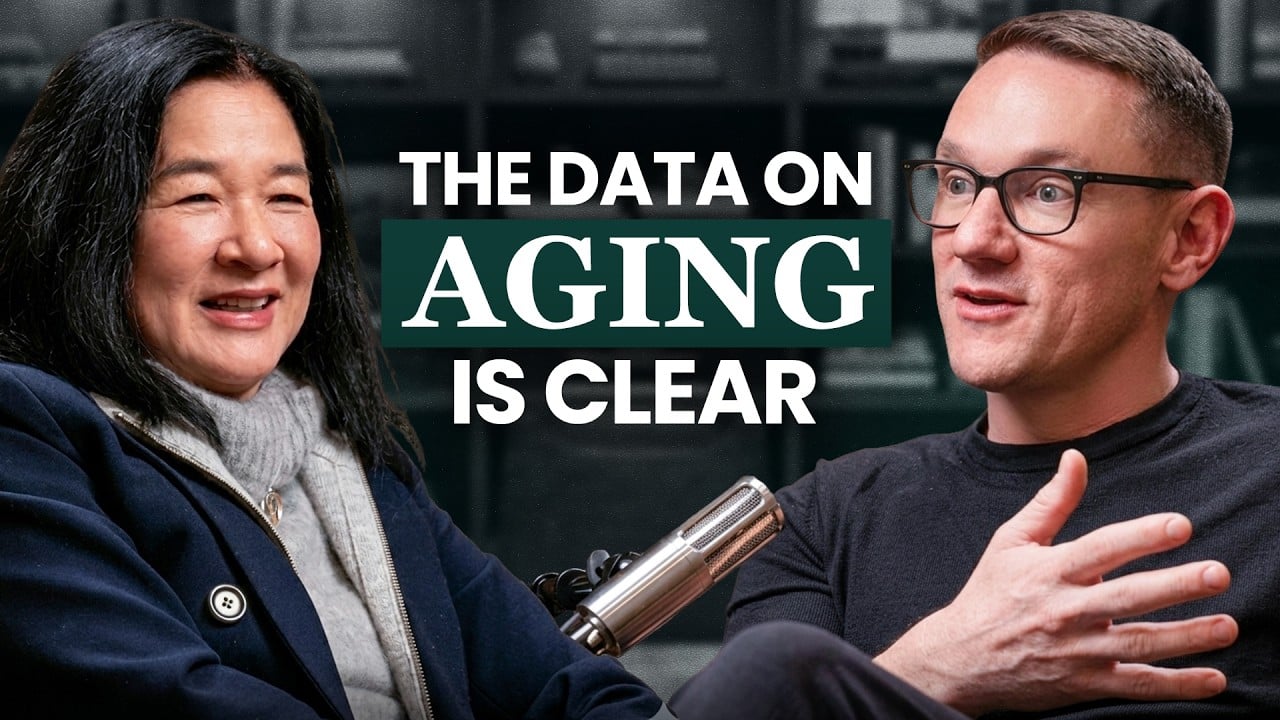
That means most people will spend 15 years living in poor health—a sobering reality that Dr. Deborah Kado, professor of medicine and co-director of the Stanford Longevity Center, believes we have the power to change.
In a recent podcast conversation, Dr. Kado shared decades of research revealing that much of what we accept as “normal aging” may not be inevitable at all.
Jump to:
- The Fall That Changes Everything
- Posture Predicts Lifespan
- It’s Never Too Late to Start
- The Power Metric You’re Ignoring
- Building Bone: What Actually Works
- The Role of Diet and Lifestyle
- Reframing Aging: It’s Not a Disease
- What About Longevity Hacks?
- Exercise: The Universal Intervention
- Three Strategies for Your 20s Through 40s
- Three Strategies for Your 70s and Beyond
- The Future of Aging Research
- The Takeaway: Agency Over Aging
The Fall That Changes Everything
The number one cause of injury-related death in adults over 60 is trips and falls.
Since 2000, the CDC has documented a steady rise in fall-related deaths among older adults. The consequences are devastating: roughly 25% of people who fracture a hip after age 65 die within 12 months.

If you want something simple that actually works, this is one of the most effective tools I’ve used to build strength, conditioning, and endurance without needing a full gym setup.
- Full-body training with one weight using swings, squats, and presses
- Solid cast iron build that feels stable and lasts for years
- Comfortable grip that makes high-rep workouts easier to handle
But here’s what makes this statistic even more alarming.
Dr. Kado’s research revealed that vertebral fractures—fractures in the spine—predict mortality even when people don’t know they have them. Two-thirds of vertebral fractures go undiagnosed, yet they still increase the risk of death.
We found that the more fractures you had, regardless if you knew that you had them or not, the more likely you would die over the next 8 years.
Posture Predicts Lifespan
Dr. Kado’s breakthrough came when she discovered a connection between posture and mortality that had nothing to do with osteoporosis.
Women with severe forward curvature of the spine—what’s called hyperkyphosis or a “hunched” posture—were significantly more likely to die of pulmonary causes like pneumonia and blood clots.
The mechanism? Poor posture compresses the lungs and restricts breathing.
But the findings went deeper. Regardless of bone density, people with worse posture walked slower, experienced faster functional decline, and fell more often.
If you want something simple that actually works, this is one of the most effective tools I’ve used to build strength, conditioning, and endurance without needing a full gym setup.
- Full-body training with one weight using swings, squats, and presses
- Solid cast iron build that feels stable and lasts for years
- Comfortable grip that makes high-rep workouts easier to handle
The more hunched over you were, the more likely it was that you were going to be walking slower, have a decline in physical function, fall, and pass away sooner.
It’s Never Too Late to Start
One of the most hopeful studies Dr. Kado referenced came from the Journal of the American Medical Association around 1990.
Researchers took nursing home residents in their late 80s and early 90s and put them through high-intensity interval training three times a week for 12 weeks.
The results were staggering.
Muscle mass increased by 174%. More importantly, participants walked faster and climbed stairs they couldn’t manage before.
It proved the concept that even if you’re late to the party, you can still have a good time.
This wasn’t about becoming bodybuilders. It was about maintaining independence and agency—cornerstones of quality of life.
The Power Metric You’re Ignoring
Everyone talks about grip strength as a predictor of longevity. But Dr. Kado’s latest research points to something even more critical: power.
If you want something simple that actually works, this is one of the most effective tools I’ve used to build strength, conditioning, and endurance without needing a full gym setup.
- Full-body training with one weight using swings, squats, and presses
- Solid cast iron build that feels stable and lasts for years
- Comfortable grip that makes high-rep workouts easier to handle
In a study of 2,000 older men with a mean age of 84, researchers used force plates to measure jumping ability. After 10 years of follow-up, power was the strongest predictor of who would avoid fractures.
Power declines two to three times faster than strength as we age. That makes it a crucial target for intervention.
We should be thinking about power as we would think about muscle.
A composite metric combining strength, power, and lean tissue may be the most valuable benchmark for healthy aging.
Building Bone: What Actually Works
Reversing bone density loss feels harder than building muscle, but it’s not impossible.
FDA-approved medications like alendronate (Fosamax) and newer drugs like romosozumab can significantly increase bone mineral density. Romosozumab, approved in 2019, showed a 12% increase in spine bone density after one year of treatment.
But medication isn’t the first step.
If you want something simple that actually works, this is one of the most effective tools I’ve used to build strength, conditioning, and endurance without needing a full gym setup.
- Full-body training with one weight using swings, squats, and presses
- Solid cast iron build that feels stable and lasts for years
- Comfortable grip that makes high-rep workouts easier to handle
Dr. Kado emphasized that before prescribing drugs, she assesses activity levels, balance, posture, breathing, and sleep. She also checks for underlying medical conditions that could be causing bone loss.
I talk about a lot of different things before we even get to the drugs.
For younger people, the goal is simple: build as much bone mass as possible before age 30.
Peak bone mass is like VO2 max—it will decline with age, but starting from a higher baseline means you may never cross the fracture threshold.
The Role of Diet and Lifestyle
Bone health isn’t just about calcium supplements.
Dr. Kado advocates for a diet rich in fresh fruits, vegetables, and adequate protein. Vitamin D is essential, and surprisingly, filtered coffee is beneficial—without the U-shaped curve seen in many dietary interventions.
All my 95-plus year-olds pay attention to what they eat. There’s usually something green and fruits. And by the way, coffee is fine.
Physical activity remains non-negotiable. Resistance training and axial loading exercises directly stimulate bone formation through muscle-bone interactions.
If you want something simple that actually works, this is one of the most effective tools I’ve used to build strength, conditioning, and endurance without needing a full gym setup.
- Full-body training with one weight using swings, squats, and presses
- Solid cast iron build that feels stable and lasts for years
- Comfortable grip that makes high-rep workouts easier to handle
Reframing Aging: It’s Not a Disease
Dr. Kado doesn’t see aging as a disease. She sees it as a process that can be influenced, managed, and optimized.
She introduced the concept of “healthy longevity” instead of “health span,” arguing that people can experience setbacks—like cancer—and still return to vibrant health for decades.
I’m not looking at health span. I’m looking at healthy longevity.
This reframe is critical. It acknowledges that health challenges are part of life, but they don’t have to define the rest of it.
What About Longevity Hacks?
When asked about the most overrated longevity advice, Dr. Kado didn’t hesitate: NAD supplementation.
Despite the hype around NAD precursors like NMN and NR, human trials lasting up to three months show that while blood levels increase, there’s no measurable improvement in blood pressure, blood sugar, or muscle function.
Your blood levels go up. So it must work. But everything people care about—blood pressure, blood sugar, muscle function—no difference between the groups.
The most underrated intervention? Purpose.
If you want something simple that actually works, this is one of the most effective tools I’ve used to build strength, conditioning, and endurance without needing a full gym setup.
- Full-body training with one weight using swings, squats, and presses
- Solid cast iron build that feels stable and lasts for years
- Comfortable grip that makes high-rep workouts easier to handle
Finding meaning in life, maintaining curiosity, and exposing yourself to new experiences all contribute to resilience and longevity.
Exercise: The Universal Intervention
Every health challenge associated with aging improves with exercise.
Whether it’s cardiovascular disease, cognitive decline, metabolic dysfunction, or bone loss, physical activity shows up as a protective factor again and again.
Exercise is the thing that comes up time and time again for every single thing we talk about associated with aging. The evidence is absolutely clear.
The type of exercise matters less than consistency. Whether it’s tennis, resistance training, or walking, doing something is what counts.
Three Strategies for Your 20s Through 40s
Dr. Kado’s advice for younger people centers on foundation-building:
- Find your passion and purpose. Stress peaks between ages 18 and 30. Discovering what matters most provides direction and resilience.
- Maximize peak bone mass and muscle. Build as much as possible before your 30s. You’re creating a reserve for the decades ahead.
- Establish sustainable habits. Exercise, nutrition, and sleep patterns formed early become easier to maintain later.
Three Strategies for Your 70s and Beyond
For older adults, Dr. Kado emphasized flexibility and openness:
If you want something simple that actually works, this is one of the most effective tools I’ve used to build strength, conditioning, and endurance without needing a full gym setup.
- Full-body training with one weight using swings, squats, and presses
- Solid cast iron build that feels stable and lasts for years
- Comfortable grip that makes high-rep workouts easier to handle
- Embrace variability. The older we get, the more unique our health profiles become. Personalized approaches matter more than ever.
- Adopt new habits, even late. It’s harder to change entrenched behaviors, but the benefits are profound. Consider diet changes, resistance training, or balance work.
- Seek intergenerational connection. Living in age-segregated communities limits growth. Exposure to diverse people and experiences fuels psychological richness and resilience.
The Future of Aging Research
Dr. Kado’s current research focuses on the mind-gut connection and the microbiome.
She’s interested in multiomics—integrating data on bacteria, metabolites, and proteins to understand how gut health influences aging and resilience.
With AI and quantum computing on the horizon, problems that once seemed mathematically intractable may soon yield answers.
We have the technology to do things we’ve never done before. I just hope we do it in a human way.
The Takeaway: Agency Over Aging
Dr. Kado’s message is clear: we have more control over how we age than we think.
Building strength, power, and bone density isn’t just about living longer—it’s about preserving independence, mobility, and joy.
The science supports optimism. Even at 90, transformation is possible.
If you want something simple that actually works, this is one of the most effective tools I’ve used to build strength, conditioning, and endurance without needing a full gym setup.
- Full-body training with one weight using swings, squats, and presses
- Solid cast iron build that feels stable and lasts for years
- Comfortable grip that makes high-rep workouts easier to handle
The question isn’t whether we can improve. It’s whether we’ll choose to act.