Chronic stress might be the silent brake on your testosterone production, even if everything else about your hormonal system is working perfectly.
That’s the core insight fitness educator Thomas DeLauer recently shared with his audience.
His argument challenges the typical testosterone supplement playbook and suggests that removing suppression might matter more than boosting production.
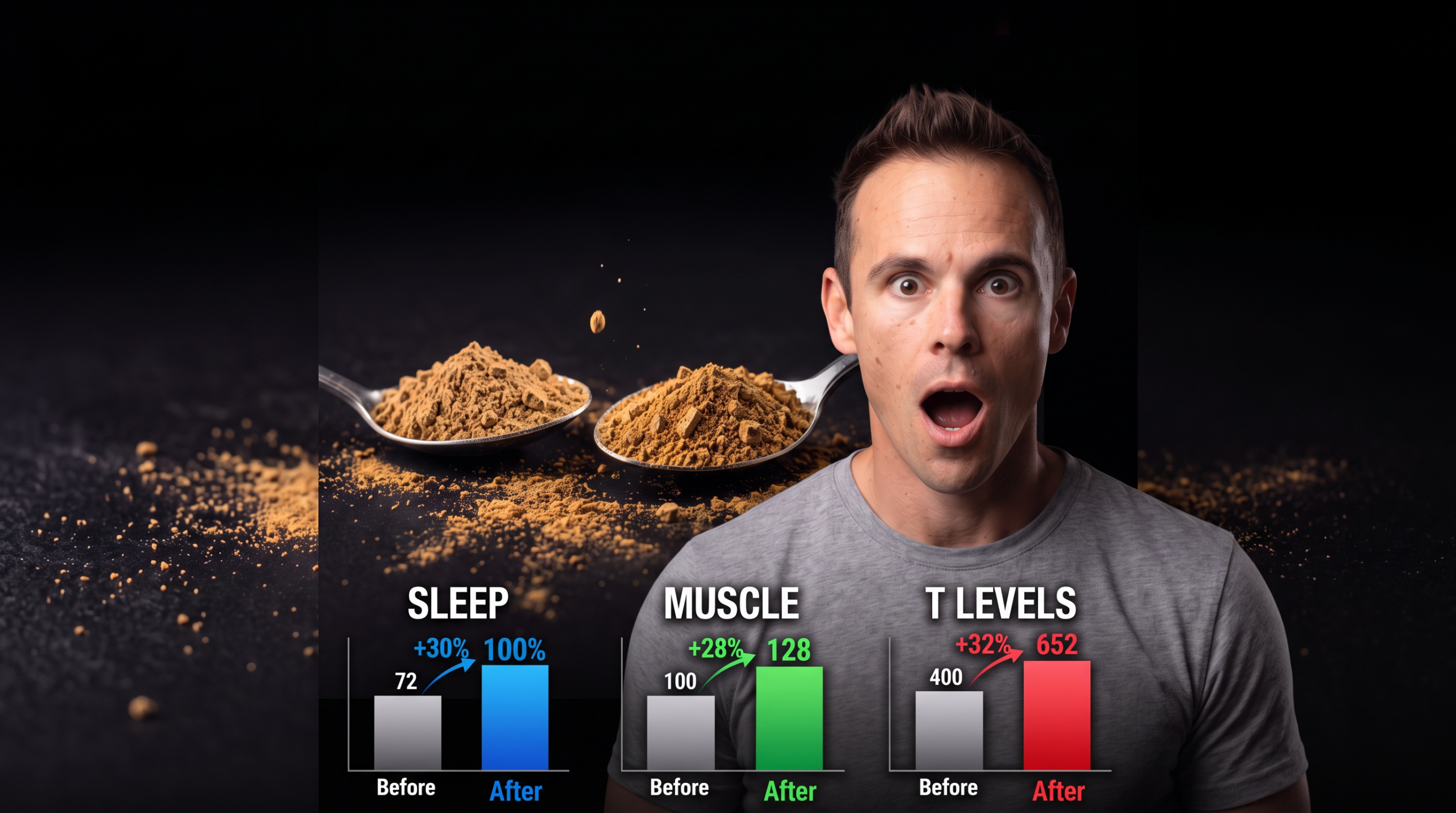
He points to a specific study where overweight men saw testosterone rise 14.7% in 16 weeks—not by ramping up production, but by clearing the hormonal roadblock that was sitting on top of it.
Jump to:
- Why Most Testosterone Supplements Miss the Mark
- The Hormone That Acts as a Testosterone Handbrake
- The Study: 14.7% Testosterone Increase Without “Boosting”
- Ashwagandha: The Cortisol Block Remover
- Tongkat Ali: Driving Production Once the Block Is Cleared
- The Protocol: Sequence Matters
- Managing DHT Conversion: The Hair Loss Angle
- Red Light Therapy: Another Tool in the Arsenal
- The Bigger Picture: Lifting the Brake Before Hitting the Gas
- Sources
Why Most Testosterone Supplements Miss the Mark
According to DeLauer, about 85% of testosterone supplements on the market are “complete trash.”
The problem isn’t that ingredients like zinc, fenugreek, tribulus, or tongkat ali don’t work at all—it’s that they’re designed to push production higher when production might not be your real issue.
What if producing testosterone actually wasn’t your problem? What if your body had the potential to produce more testosterone, but there’s something that’s actively sitting on top of it blocking it?
For many men over 40, DeLauer argues, the machinery works fine. Raw materials are present. But something is suppressing output at the source.
Until that suppression is lifted, no amount of “boosting” will move the needle because there’s a rate-limiting block in place.
The Hormone That Acts as a Testosterone Handbrake
That blocking agent? Cortisol.
Cortisol—the body’s primary stress hormone—suppresses testosterone through three simultaneous mechanisms, DeLauer explains.
1. It Reduces Master Signal Pulsatility
Cortisol decreases gonadotropin-releasing hormone (GnRH) pulsatility at the hypothalamus level. This master signal tells your pituitary gland to instruct the testes to produce testosterone.
Less hypothalamic activity means less luteinizing hormone (LH), which means fewer instructions to produce testosterone.
2. It Blunts Pituitary Sensitivity
Even when signals do get through, cortisol reduces luteinizing hormone sensitivity at the pituitary gland itself. The instruction exists, but it doesn’t hit as hard.
3. It Suppresses Production at the Testicular Level
This is the mechanism DeLauer emphasizes most. Cortisol directly suppresses steroidogenesis at the Leydig cells—the cells in your testes that actually make testosterone.
The machinery gets the instruction to produce. It can’t do it when there’s glucocorticoid pressure, when cortisol is high, because it doesn’t make sense for us to make testosterone when we’re stressed.
Even with perfect signaling from the brain, production at the testes gets squashed.
And it compounds. Cortisol promotes muscle protein breakdown and visceral fat accumulation. That midsection fat upregulates aromatase, the enzyme that converts testosterone into estrogen. You lose testosterone at the production site, lose muscle that would burn fat, and the fat itself converts remaining testosterone into estrogen.
A self-reinforcing loop.
The Study: 14.7% Testosterone Increase Without “Boosting”
DeLauer cites a study published in the American Journal of Men’s Health involving 57 overweight adult men.
Participants received a specific compound for 16 weeks in a double-blind, placebo-controlled, crossover design. Testosterone increased by 14.7% compared to placebo.
Fatigue decreased. Vitality, libido, and aging symptoms improved.
But the second hormone finding is what reveals the mechanism at work.
DHEA Rose 18%—And That’s the Key
DHEA (dehydroepiandrosterone) is a precursor hormone produced by your adrenal glands. When DHEA rises alongside testosterone, it signals that the supplement is supporting adrenal steroidogenesis across the board—not just jacking up testosterone in isolation.
According to DeLauer, this means the supplement is lifting cortisol-mediated suppression on the entire hormonal cascade, not just telling the testes to make more.
If ashwagandha were just a testosterone booster, you’d see testosterone move and nothing else. Instead, the whole steroid pathway lifted.
The authors of the study noted that elevated cortisol is commonly associated with lower testosterone, and that reducing cortisol might be an effective—and perhaps superior—way to optimize steroid hormones in men.
Ashwagandha: The Cortisol Block Remover
The compound used in the study was ashwagandha extract.
Ashwagandha is an adaptogenic herb used in traditional Ayurvedic medicine. In this context, it appears to work by clearing the cortisol-induced suppression that sits on top of testosterone production.
DeLauer recommends looking for an extract standardized to withanolide content—the active compounds in ashwagandha—rather than just raw milligram amounts on a label.
The study used 21 milligrams of standardized extract over four months, producing the 14.7% testosterone increase and 18% DHEA rise.
Tongkat Ali: Driving Production Once the Block Is Cleared
Clearing the cortisol block is only half the equation, DeLauer argues. Once the road is clear, you want to drive production up.
That’s where tongkat ali (Eurycoma longifolia) enters the picture.
Tongkat ali works through four distinct pathways:
- Increases luteinizing hormone (LH) from the anterior pituitary, directly stimulating Leydig cells to produce more testosterone
- Inhibits aromatase, the enzyme that converts testosterone into estrogen, helping preserve testosterone levels
- Lowers sex hormone-binding globulin (SHBG), the carrier protein that locks testosterone up in the bloodstream and prevents it from entering tissues
- Reduces cortisol itself, working on a different angle than ashwagandha
DeLauer points to a study in the Journal of the International Society of Sports Nutrition where 63 moderately stressed subjects took 200 milligrams of tongkat ali daily for four weeks.
Testosterone production went up 37%. Cortisol dropped 16%.
This isn’t a single-study claim, either. Systematic reviews and meta-analyses pooling five different randomized controlled trials found statistically significant increases in total testosterone with tongkat ali as a sole intervention.
Men who started with clinically low testosterone saw the strongest response.
The Protocol: Sequence Matters
DeLauer recommends a two-phase approach:
- Start with ashwagandha to remove cortisol suppression (21 mg standardized extract for at least a few weeks)
- Add tongkat ali to drive production up once the block is cleared (200 mg per day of standardized extract)
“Clear the block as much as you can before amplifying,” DeLauer advises.
Managing DHT Conversion: The Hair Loss Angle
One side effect DeLauer personally experienced with tongkat ali? Hair loss.
Tongkat ali had effects so powerful on me that my hair started to fall out. The DHT conversion was so high.
DHT (dihydrotestosterone) is a more potent androgen derived from testosterone. It’s responsible for many “male” traits but also contributes to male pattern baldness in genetically predisposed individuals.
DeLauer’s simple dietary hack? Pumpkin seeds or pumpkin seed oil.
Compounds in pumpkin seed oil may help inhibit the conversion of testosterone to DHT. It’s a straightforward, food-based strategy to mitigate one unwanted side effect of higher testosterone levels.
Red Light Therapy: Another Tool in the Arsenal
DeLauer also mentions red light therapy as a complementary intervention supported by clinical data.
Red light stimulates cytochrome C oxidase, the final enzyme in the mitochondrial electron transport chain. This enhances mitochondrial energy production—including in Leydig cells located in testicular tissue.
While not the focus of his supplement protocol, DeLauer views it as another science-backed lever for men looking to optimize testosterone naturally.
The Bigger Picture: Lifting the Brake Before Hitting the Gas
DeLauer’s framework reframes testosterone optimization around a simple but powerful metaphor:
You can’t floor the gas pedal with the parking brake on.
For men over 40—especially those carrying midsection fat—chronic cortisol elevation may be suppressing testosterone production at multiple levels simultaneously. Adding a typical “testosterone booster” in that context is like pouring water into a bucket with a hole in the bottom.
The strategy DeLauer advocates is different:
- First, remove the suppressor (ashwagandha to lower cortisol and lift hormonal suppression)
- Then, stimulate production (tongkat ali to increase LH, lower SHBG, inhibit aromatase, and further reduce cortisol)
- Finally, manage side effects (pumpkin seed oil to mitigate DHT-related hair loss)
It’s a layered, mechanism-informed approach grounded in the idea that context matters more than raw supplementation.
And for men dealing with stubborn low testosterone despite eating well, training hard, and sleeping enough, this might be the missing piece: not more production, but less suppression.
Sources
- American Journal of Men’s Health – Ashwagandha and testosterone study
- Journal of Ethnopharmacology – Tongkat ali and aromatase inhibition
- Journal of the International Society of Sports Nutrition – Tongkat ali, testosterone, and cortisol study