The CrossFit Open kicks off tomorrow, and James Sprague—the reigning Fittest Man on Earth—is ready to share his expertise. With nine Opens behind him, he’s learned exactly what works—and what doesn’t—when it comes to movement efficiency.
In his latest video, he shares the top 10 movement hacks that can help competitors gain an edge, move faster, and conserve energy. “I don’t know why I’m putting all my secrets on the internet,” he jokes, “but if you take these seriously, they can help you level up.”
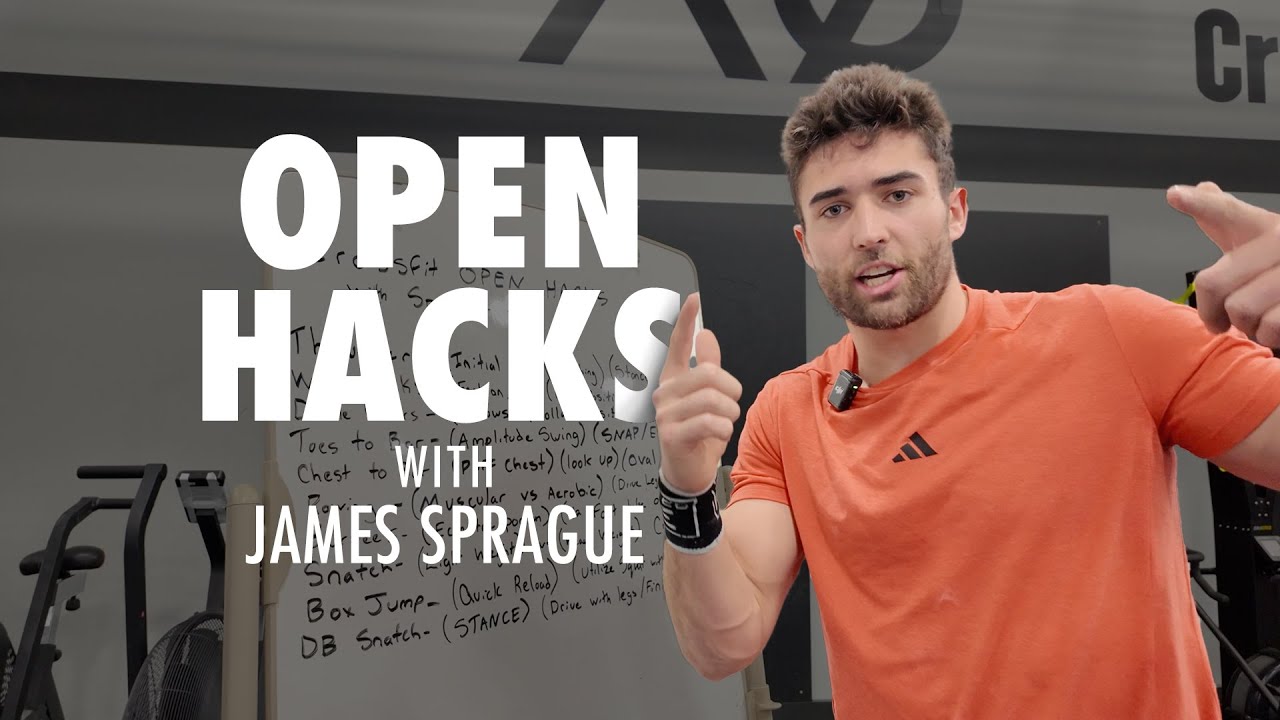
Whether you’re aiming for the top of the leaderboard or just trying to improve your Open performance, these efficiency tips can make a huge difference. Here’s how to move smarter, not harder in the most common Open workouts.
(Full video at the end of the article)
Jump to:
- 1. Thrusters: Optimize the Bar Pickup and Breathing
- 2. Wall Walks: Hand and Foot Positioning for Efficiency
- 3. Double Unders: Arm Position and Hollow Body Mechanics
- 4. Toes-to-Bar: Choosing the Right Swing for the Workout
- 5. Chest-to-Bar Pull-Ups: Head and Chest Positioning for a Stronger Rep
- 6. Rowing: Finding the Right Stroke for the Workout
- 7. Burpees: Using Gravity, Not Muscle Power
- 8. Barbell Snatch: Adjusting Strategy for Light vs. Heavy Loads
- 9. Box Jumps: Faster Cycle Rate with Smart Landing
- 10. Dumbbell Snatch: Foot Positioning for a Smoother Lift
- Final Thoughts: Train Smart, Compete Efficiently
1. Thrusters: Optimize the Bar Pickup and Breathing
The thruster is a staple in the CrossFit Open, showing up every year. Many athletes make the mistake of performing an unnecessary power clean before initiating the movement.
Hack: Instead of cleaning the bar to the shoulders and then squatting, Sprager recommends picking up the bar directly into the squat position. “Notice how much quicker that was,” he points out. “You’re shortchanging the clean, but that’s okay because we’re focusing on movement efficiency.”
Another crucial factor is breathing. Thrusters can quickly elevate heart rate, making breath control essential. Sprager advises inhaling and exhaling when the bar is overhead rather than at the bottom of the squat, where it’s harder to take a deep breath.
2. Wall Walks: Hand and Foot Positioning for Efficiency
Wall walks test shoulder endurance and stability, but small adjustments can make them significantly easier.
Hack: Most athletes keep their palms forward during the ascent, but Sprager suggests turning them slightly outward for better leverage. “You shouldn’t be pressing into your fingers too much,” he explains. “Your palms should take most of the load, with fingers just assisting in balance.”
Additionally, foot placement plays a key role. Instead of taking one step up at a time, Sprager recommends pushing both feet up simultaneously to save milliseconds and reduce energy expenditure. “If you’re confident in your overhead stability, this is a great option,” he adds.
3. Double Unders: Arm Position and Hollow Body Mechanics
Double unders require rhythm, coordination, and efficiency. Many athletes make the mistake of flaring their elbows, leading to unnecessary shoulder fatigue.
Hack: “Think about pinning your elbows to your rib cage and keeping your wrists close to your hips,” Sprager says. This minimizes unnecessary arm movement and conserves energy.
Another key element is body posture. A proper hollow position helps maintain control. “You don’t want to be tucking your knees or flailing your chest,” he explains. “Stay straight up and down, and bound off your feet smoothly.”
4. Toes-to-Bar: Choosing the Right Swing for the Workout
Toes-to-bar can be performed with two different swing styles, depending on the workout’s demands.
Hack: In high-intensity workouts with short time domains, a shorter amplitude swing allows for quicker reps, though it taxes grip and core muscles. In longer endurance-based workouts, a larger amplitude swing provides more control and reduces fatigue.
“For beginners, I recommend a bigger swing,” Sprager notes. “It gives you more time to get your toes up and keeps your core engaged.”
5. Chest-to-Bar Pull-Ups: Head and Chest Positioning for a Stronger Rep
A common mistake in chest-to-bar pull-ups is keeping the head too neutral and failing to engage the chest properly.
Hack: Sprager emphasizes looking up instead of straight ahead. “If you’re staring forward, you’re making it harder for yourself,” he says. “Puff out your chest, look up, and you’ll naturally hit the bar with more control.”
Additionally, maintaining an oval-shaped motion rather than dropping straight down helps sustain the cycle rate. “A lot of people hit their chest and fall straight down,” he explains. “You need to come back in front of the bar and then behind it again to keep a smooth rhythm.”
6. Rowing: Finding the Right Stroke for the Workout
Rowing in the Open isn’t just about pulling hard—it’s about balancing power and aerobic efficiency.
Hack: Sprager recommends determining whether to row with a powerful but slower stroke or a faster but less forceful stroke depending on the workout structure.
“Either you go slow and powerful, or fast and aerobic,” he says. “Both can get you the same calorie output, but one might be better suited to the rest of your workout.”
Another key tip: always grab the handle first when sitting down. “The only way to get the rower counting is to start pulling immediately,” he points out. “Don’t waste time adjusting your feet first.”
7. Burpees: Using Gravity, Not Muscle Power
Burpees are notoriously exhausting, but many athletes make them harder than necessary by actively controlling their descent.
Hack: “Let gravity be your friend,” Sprager says. Instead of doing a push-up to lower yourself, flop to the ground naturally and scoop yourself back up.
The type of burpee variation also matters. Stepping up rather than jumping can conserve energy, while a two-foot takeoff is best for fast-paced workouts.
8. Barbell Snatch: Adjusting Strategy for Light vs. Heavy Loads
In the Open, snatches vary from light, high-rep workouts to heavier, lower-rep lifts.
Hack: For lighter weights, Sprager suggests widening the stance slightly and minimizing hip contact for faster cycle rates. “I don’t even hit my hip pocket,” he says. “I just muscle snatch it straight up.”
For heavier weights, proper technique is key. “Find that power position,” he advises. “Hitting the hip pocket helps control the lift and makes cycling easier.”
9. Box Jumps: Faster Cycle Rate with Smart Landing
Box jumps can slow down drastically if athletes take too much time between reps.
Hack: Instead of pausing at the bottom, step down and jump immediately when the foot makes contact with the ground.
For longer workouts, catching in a deeper squat helps maintain speed when legs start to fatigue. “If you’re tired, don’t force a high jump,” Sprager explains. “Just land lower and keep the rhythm going.”
10. Dumbbell Snatch: Foot Positioning for a Smoother Lift
Dumbbell snatches demand proper positioning to avoid excess strain.
Hack: Keeping the dumbbell centered between the feet ensures better mechanics. “I like to have a line on the ground and punch it every rep,” Sprager says.
Additionally, driving through the legs first instead of relying on arm strength makes a big difference. “Your arm is just a fulcrum,” he reminds athletes. “Let your legs do the work, then finish with the arm.”
Final Thoughts: Train Smart, Compete Efficiently
The CrossFit Open is a test of both skill and strategy. By implementing these movement hacks, athletes can move more efficiently, conserve energy, and ultimately achieve better scores.
Sprager emphasizes the importance of training these techniques ahead of competition. “If you really want to improve, take a screenshot of this, rewind to the movement you struggle with, and drill it over and over again,” he advises.
With the right approach, CrossFit athletes can push their limits and perform at their peak when the Open begins.