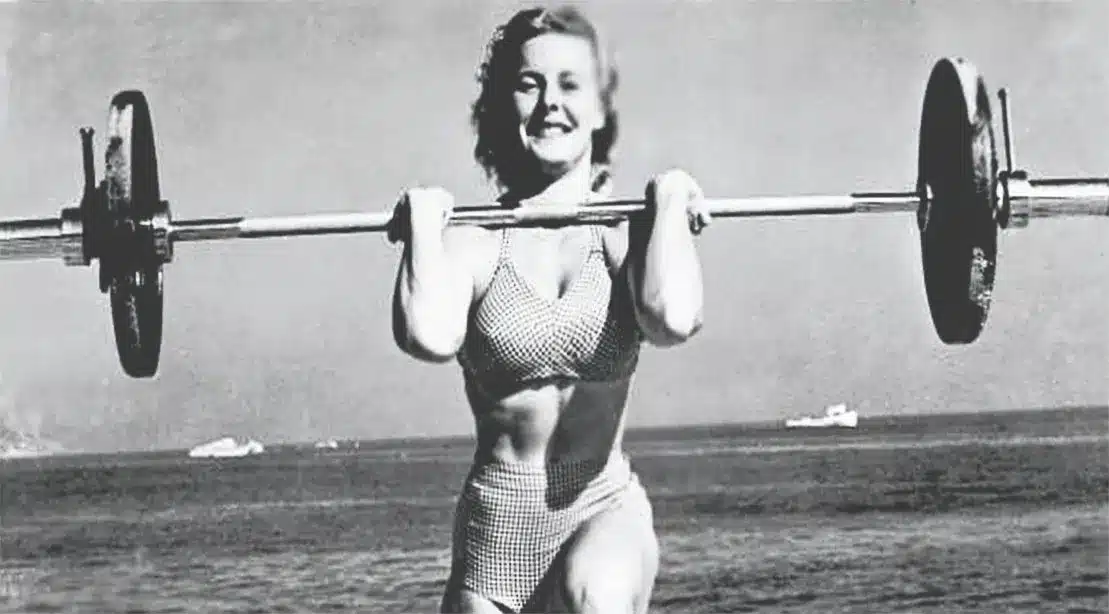
In a time when women were told strength training would make them masculine, Abbye “Pudgy” Stockton lifted her 185-pound husband overhead — and an entire generation of women’s fitness along with him.
Long before Instagram fit-fluencers and wellness brands filled our feeds, Pudgy helped define what it meant to be strong, feminine, and fearless.
Her impact reverberates through every deadlift, every fitness magazine cover, and every woman who’s ever picked up a barbell without apology.
Here’s how the original “Queen of Muscle Beach” changed the face of fitness — and why her legacy still matters today.
Jump to:
From “Pudgy” to Pioneer
Born Abbye Eville in 1917 in Santa Monica, California, she earned the nickname “Pudgy” as a child — ironic, considering she would later redefine the female physique with muscle and grace.
After high school, Abbye took a sedentary job as a telephone operator. But dissatisfaction with her inactive lifestyle led her to start lifting weights — a radical move for a woman in the 1930s.
“In those days, lifting weights was thought to be unfeminine,” Stockton later told Sports Illustrated. “The misinformed think if women strength-trained, they’d become masculine looking. We laughed knowing they were wrong.”
The Rise of Muscle Beach Royalty
In 1941, she married her high school sweetheart Les Stockton, an athlete who shared her passion for physical performance. Together, they became regulars at the now-iconic Muscle Beach, performing acrobatic feats that drew massive crowds.
Despite standing just 5’2″ and weighing 115 pounds, Pudgy regularly pressed her 185-pound husband above her head in a hand-to-hand stand. One of their standout acts included her balancing on Les’s extended arms while he lifted a 100-pound dumbbell overhead — a feat that stunned spectators and photographers alike.
Soon, her strength and beauty caught the attention of media outlets. She appeared in Life, Pic, Laff, and on the covers of over 40 magazines by the end of the 1940s. She also modeled alongside bodybuilding legends like Steve Reeves and John Grimek, proving that muscular women could be both powerful and glamorous.
Shaping Fitness Media for Women
Stockton wasn’t just a performer — she was a voice for women in strength sports. Beginning in 1944, she wrote a monthly column titled Barbelles in Strength & Health magazine — the leading fitness publication of the time.
Her column offered training advice for women, featured strength athletes, and advocated for the benefits of resistance training for women — a revolutionary stance in the postwar era.
“She was the first woman to demonstrate that weight training enhanced athletic activity,” said Dr. Jan Todd, herself a pioneer in women’s powerlifting. “Before Pudgy’s time, women who lifted weights were usually circus performers — not athletes. Pudgy changed that.”
Breaking Barriers in Competitive Weightlifting
In 1947, Abbye made history again by helping organize the first Amateur Athletic Union-sanctioned women’s weightlifting competition in the United States. She didn’t just organize — she competed.
At that meet, she:
- Pressed 100 pounds
- Snatched 105 pounds
- Clean and jerked 135 pounds
Her achievements came at a time when physique contests for women were virtually unheard of. She went on to win the 1948 Miss Physical Culture Venus title — one of the very few honors available to female lifters at the time.
Redefining Women’s Athletic Wear
Stockton’s influence wasn’t limited to training programs and competition. She also challenged cultural norms around women’s attire.
“You couldn’t buy a two-piece,” she recalled. “So my mother ripped apart an old brassiere to use as a pattern.” That custom bikini — designed to offer more freedom for gymnastic stunts — made her one of the first women to wear a two-piece suit at Muscle Beach.
It wasn’t about fashion — it was about performance and freedom. But it symbolized much more: women taking control of their bodies, their movements, and their presence in male-dominated spaces.
Building a Fitness Empire
When Les returned from service as an Air Force pilot in WWII, the Stocktons opened one of the first “women’s only” health clubs in the world. The concept was groundbreaking and wildly successful.
By 1950, they had expanded to co-ed gyms and even partnered with 1950 Mr. America, John Farbotnik. Pudgy continued to work in gyms until her retirement at age 66 — mentoring, managing, and inspiring along the way.
A Lasting Legacy
Throughout her life, Pudgy Stockton received multiple honors, including:
- Steve Reeves International Society Pioneer Award (1998)
- Joe Weider Hall of Fame Induction (2000)
- Association of Oldtime Barbell and Strongmen Honor (1991)
But her greatest accolade came from the generations she inspired.
“Every woman in bodybuilding… owes a debt of gratitude to Pudgy Stockton,” said Jan Todd. “She helped make these modern sports possible.”
Fitness icon Jack LaLanne echoed the sentiment:
“Pudgy was one of the finest athletes I’ve known. She did everything — bodybuilding, gymnastics, acrobatics. She was an exceptional human being.”
The Woman Who Made Strength Look Strong
Abbye “Pudgy” Stockton passed away in 2006 at the age of 88, after a life filled with records, revolutions, and resistance to outdated norms.
Today, her legacy lives on in every squat rack, every competition platform, and every woman who dares to be both feminine and strong.
Pudgy didn’t just lift weights — she lifted barriers, expectations, and the future of women’s fitness.
And for that, she will never be forgotten.