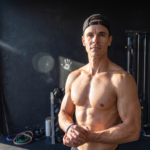
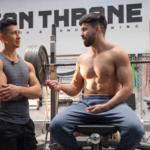
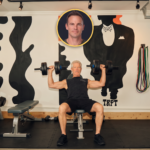
Alan Ritchson, known for his physically demanding role in the hit series Reacher, recently opened up about his training philosophy—and it might surprise those who think he only lifts heavy weights for size.
The 6’3″, 240-pound actor revealed a training approach that prioritizes longevity, functionality, and what he calls “embarrassing the tissue” over chasing powerlifting numbers.

His routine blends high-volume calisthenics, strategic cardio, and moderate-weight resistance training—a combination that keeps him lean, strong, and injury-free.
In a recent interview, Ritchson shared the exact breakdown of his workouts, why he avoids training to absolute failure, and how his approach has evolved after dealing with a broken shoulder during season one of Reacher.
Jump to:
- The Foundation: High-Volume Calisthenics That Build Real Strength
- The Current Split: Full-Body Focus With Strategic Emphasis
- Volume Over Load: The 15-25 Rep Sweet Spot
- Embarrassing the Tissue: The Adaptation Philosophy
- The Injury That Changed Everything
- Muscle Confusion: Instinct Over Science
- Aesthetics Over Strength: Redefining Training Goals
- Key Takeaways From Ritchson’s Approach
- The Bottom Line
The Foundation: High-Volume Calisthenics That Build Real Strength
Ritchson didn’t always have access to fancy gym equipment. For years, he relied exclusively on bodyweight movements performed at parks—no membership required.
I ran and I did push-ups, pull-ups, dips, and sit-ups at parks. I didn’t have a gym membership. That’s what I would do. And, you know, at 205, 6′ 3″ 205, like that’s what you look like.
He returns to this foundation seasonally, especially when he needs definition without excess bulk. The volume is staggering: 100 pull-ups, 100 dips, and 250 push-ups and sit-ups daily.
No products found.
The result? Massive pumps that, over time, become permanent muscle.
You get huge pumps and eventually those pumps become your reality.
His kids have taken notice. They’ve started mimicking his routine—five to ten pull-ups before breakfast, lunch, and dinner—and are already seeing visible changes in muscle definition.
Why Pull-Ups at 240 Pounds Hit Different
When you’re carrying 230 to 240 pounds of bodyweight, every pull-up becomes a serious resistance exercise.
That’s a lot to pull, yeah. Um you know, but it’s it but you see results.
Ritchson emphasizes that high-volume calisthenics aren’t just for beginners or people trying to “tone.” They’re legitimate muscle builders—especially when performed with his level of intensity and consistency.
The Current Split: Full-Body Focus With Strategic Emphasis
Ritchson’s training has evolved significantly since his early days. Now, he trains in his personal gym and incorporates weights regularly—but not in the traditional bodybuilding split most would expect.
His typical session follows this structure:
No products found.
- Warm-up: 250 reps of core work (leg lifts, crunches, weighted movements)
- Cardio: 20-30 minutes of intense training on a Woodway curved treadmill or stair climber
- Resistance training: Full-body emphasis with 2-4 exercises per muscle group
He avoids traditional body-part splits where chest day means six different pressing exercises. Instead, he pairs muscle groups intelligently.
It’s like pecs and back. Um maybe maybe two sets of things, so like four exercises total, chest and back, and then legs.
The next day might emphasize legs with three to four exercises, followed by upper-body work again. This approach keeps strain distributed and prevents overuse injuries.
The Cardio That Actually Works
For most of his training career—from age 17 to 42—cardio was Ritchson’s priority. He’d run first, then do whatever resistance work he had energy for afterward.
Now, weights take precedence, but cardio remains essential. His go-to equipment includes:
- Woodway curved treadmill: Simulates running uphill continuously, delivering results he claims are 30% better than standard running
- Stair climber: Provides intense cardiovascular work without the joint stress of running
Get your heart rate to skyrocket, but I just truck on that Stairmaster for 20 minutes if I can.
Volume Over Load: The 15-25 Rep Sweet Spot
Ritchson’s approach to resistance training centers on one principle: volume, not maximum weight.
His target rep range falls between 15 and 25 reps per set, with most exercises landing around 15-20. He’ll perform four sets to hit 100 total reps—a threshold he believes guarantees muscle adaptation.
No products found.
So, I’ll do four sets of 25. So, I’m trying to get 100. Like, if I can get 100 of some some version of strain that I’ve introduced like undeniably everybody and there’s virtually no human alive that wouldn’t get some kind of pump or growth out of that.
Even with moderate rep ranges, the weight he moves is substantial. On bench press, he performs 25 reps at 225 pounds—far from light work.
It’s about volume to me, but but you know, still like I’ll pump out 25 at 225, you know, so that’s like that’s a lot of weight to do 25 times.
Why Higher Reps Are Actually Harder
Contrary to popular belief, high-rep training isn’t easier—it’s a different kind of brutal.
As one expert noted during the conversation, performing 20 reps to failure requires enduring approximately five reps of intense lactate burn—a mental and physical challenge that 10-rep sets don’t demand.
It is legitimately harder for me to do 20 reps to failure than it is to do 10 reps to failure.
The outdated notion that high reps build “definition” rather than size has been largely debunked. Research now shows minimal difference in muscle growth between 12-rep and 20-rep protocols—possibly a few percentage points favoring moderate reps, but nothing dramatic.
What high-rep training does offer is significantly reduced injury risk, which becomes critical for longevity.
Embarrassing the Tissue: The Adaptation Philosophy
One concept that resonated deeply with Ritchson came from Dr. Steve Magnuss at the University of Houston, who described effective training as simply “embarrassing the mitochondria.”
No products found.
The idea: you don’t need to obliterate muscle tissue. You only need to challenge it enough that adaptation becomes necessary.
You just want to embarrass the tissue, embarrass the cell just enough that it says you know what, I need to get a little stronger.
This philosophy aligns perfectly with Ritchson’s training reality. He’s not a competitive bodybuilder or powerlifter—he’s an actor who needs to maintain peak physical condition while avoiding injuries that could halt production.
Training to absolute failure every session creates excessive recovery demands that interfere with life, family, and work. Strategic stimulation provides consistent progress without destroying quality of life.
There are few moments in life where you know that you just heard something life-changing for yourself. That was definitely one of them.
The Injury That Changed Everything
During season one of Reacher, Ritchson broke his shoulder—an injury caused by accumulated strain from both training and on-set fight choreography.
He had to complete the entire season before getting surgery, performing demanding fight scenes with a broken shoulder.
Man, it was so hard doing fight scenes with a broken shoulder. Like, I couldn’t it was hard. And I don’t want to repeat that.
That experience reinforced his commitment to cycling through full-body workouts rather than hammering individual muscle groups with excessive volume and weight.
No products found.
He observed that powerlifters he knows have all required joint replacements—a fate he’s determined to avoid.
The powerlifters that I know have all had like knee and joint replacements everywhere. That’s not my goal.
Muscle Confusion: Instinct Over Science
Ritchson admits he doesn’t know how much scientific support exists for “muscle confusion,” but he operates largely on instinct—rotating between different training styles based on what his body seems to need.
I think there’s a like, you know, I try to introduce confusion to the body. You know, I don’t know how much science there is behind muscle confusion, you know, but um oh you know, I’ve I’ve always sort of coasted on instincts.
Some periods emphasize high-volume plyometrics and cardiovascular work. Others focus more heavily on resistance training with weights.
While “muscle confusion” as originally marketed lacks strong scientific backing—muscles don’t actually get “confused”—the underlying principle of varied training stimuli does have merit. Periodization prevents plateaus, addresses weaknesses, and reduces overuse injuries.
Ritchson’s intuitive approach to variation has clearly worked for him, keeping his physique stage-ready for years while maintaining functionality for demanding action roles.
Aesthetics Over Strength: Redefining Training Goals
People frequently ask Ritchson how much he can bench press. His response reveals a fundamental difference in training philosophy.
No products found.
Strength is not the goal for me. It’s more aesthetics, you know, so like people ask me all the time how much you bench, and that’s not my goal. I like I’m not a powerlifter.
His work demands a specific look—muscular, defined, mobile, and injury-free. Chasing one-rep maxes doesn’t serve those requirements.
This distinction matters because many recreational lifters adopt powerlifting or bodybuilding protocols without considering whether those methods align with their actual goals.
Ritchson’s approach demonstrates that context determines optimal training. What works for a competitive powerlifter may destroy an actor who needs to perform stunts. What works for a bodybuilder in the off-season may not suit someone who needs year-round conditioning.
Key Takeaways From Ritchson’s Approach
Several principles emerge from Ritchson’s training philosophy that apply broadly:
- High-volume calisthenics build serious muscle when performed with adequate intensity and consistency
- Full-body training with emphasis distributes strain and reduces injury risk compared to traditional splits
- Rep ranges of 15-25 can produce excellent hypertrophy with lower joint stress than heavy, low-rep work
- Total volume matters more than single-set intensity—100 quality reps trump a handful of maximal efforts
- Training should embarrass tissue, not destroy it—strategic stimulation beats constant annihilation
- Varied training prevents plateaus and overuse injuries better than rigid programming
- Goals should determine methods—aesthetics, functionality, and longevity require different approaches than strength or size maximization
The Bottom Line
Alan Ritchson’s training demonstrates that building an impressive physique doesn’t require chasing powerlifting numbers or training to absolute failure every session.
His combination of high-volume calisthenics, strategic cardio, and moderate-weight resistance training produces the muscular, defined look his roles demand while keeping him mobile and injury-free.
No products found.
The approach prioritizes sustainability over short-term gains—a perspective that becomes increasingly valuable as training age increases and life demands compete for recovery resources.
Whether you’re an actor preparing for action roles or someone simply trying to build muscle while preserving joint health and life balance, Ritchson’s methods offer a refreshing alternative to traditional bodybuilding orthodoxy.
Sometimes the most effective training isn’t about doing more or lifting heavier—it’s about finding what challenges your body consistently without breaking it down.