Ever wonder how ancient Roman gladiators built the rotational strength and spine resilience needed for combat?
Renaissance man James Pat—retired ultramarathon runner, author, and historical researcher—has uncovered a forgotten exercise from one of history’s most respected medical minds.
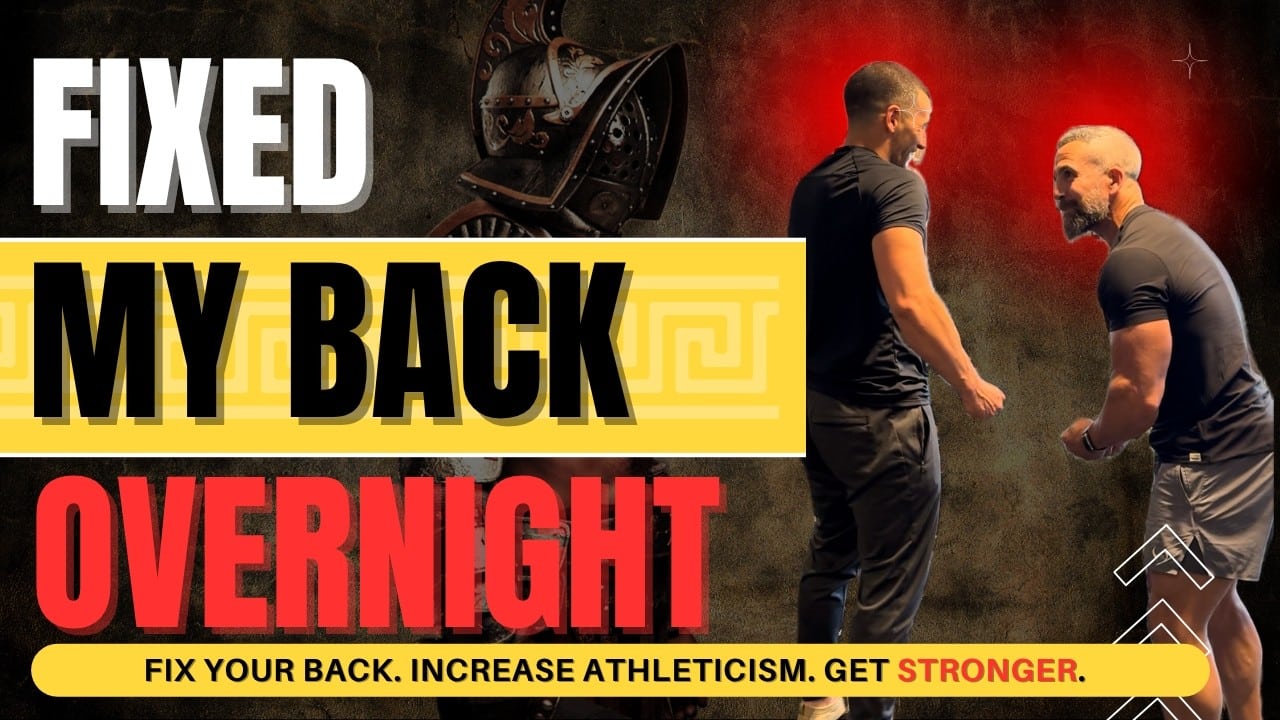
Filmed at Thor’s Power Gym in Reykjavik, Iceland, Pat demonstrates what he calls the “gladiator deadlift,” an ancient movement pattern that addresses back pain, builds rotational strength, and bulletproofs your spine with nothing more than a pair of dumbbells.
And the science behind it might surprise you.
Jump to:
Ancient Wisdom From a Gladiator Physician
Pat discovered this exercise while translating De Sanitate Tuenda, a manual written by Galen—personal physician to Emperor Marcus Aurelius and one of history’s fathers of modern medicine.
Before Galen became renowned for his medical contributions, he specialized in training gladiators, focusing on what he called “living anatomy.” Today, we’d recognize this as exercise physiology.
The gladiator deadlift is something that I uncovered, translated, and named. And I admit I could have probably named it a little bit more creatively, but as I say, a good teacher takes the complex and makes it simple.
What makes this exercise remarkable isn’t just its historical pedigree—it’s how effectively it targets movement patterns modern training often neglects.
How to Perform the Gladiator Deadlift
Setup is deceptively simple. Place two dumbbells on either side of your body.
Step One: The Cross-Body Reach
Stand between your dumbbells. Reach across your body with one hand and grab the opposite dumbbell. Straighten yourself to standing position.
Step Two: The Back Pocket Position
Here’s where the magic happens. Keep that first dumbbell close to the back of your leg—what Pat calls “in your back pocket.”
While maintaining this position, reach down with your other hand and grab the second dumbbell. Return to standing.
Step Three: Controlled Eccentric Lowering
The lowering phase demands attention. Hinge at your hips slowly, keeping hamstrings long and tension throughout the posterior chain. Keep one dumbbell along the back of your leg as you lower both weights to the ground.
We’re going to come really slow on the eccentric. Keep our hips hinging backwards and our hamstrings long.
Complete the movement on the opposite side. Pat counts the entire sequence—both sides, pickup and set down—as one complete repetition.
Why Gladiators Trained This Way
Sword fighting demands exceptional rotational strength. But not just rotation—something more complex.
This exercise not only builds rotational strength and anti-rotational strength, but it also does something we would call an elongating rotation.
Unlike Russian twists or standard rotational exercises, the gladiator deadlift combines rotation with extension. This unique stimulus targets multiple often-neglected areas simultaneously:
- Quadratus lumborum (QL): Critical for spine stabilization
- Rotational core musculature: Essential for athletic movement
- Hip complex: Power transfer between upper and lower body
- Anti-rotational stabilizers: Injury prevention and spine protection
Modern Applications for Back Pain and Performance
Pat’s personal experience with severe scoliosis led him to discover just how effective this ancient movement could be.
For me personally, who has really bad scoliosis, this was probably the single most effective exercise in actually addressing my day-to-day back pain.
Most people spend hours hunched over computers in static positions. Muscles responsible for rotational extension atrophy from disuse, leading to weakness, fragility, and decreased quality of life.
The Performance Connection
Even elite powerlifters sometimes lack what Pat calls “lumbo-pelvic rotational capacity.” Short-term, this limitation hampers performance. Long-term, it creates serious problems.
Pat points to Hafþór Björnsson (Thor) as an example of exceptional mobility supporting exceptional strength. Thor’s athleticism allowed him not only to deadlift over 1,100 pounds but also to defeat Eddie Hall in a boxing match.
He is very mobile, very athletic for someone his size. And that allows him to do lots of things.
Programming Recommendations
Pat suggests a modest approach to integration:
- Frequency: Once or twice weekly
- Volume: Two to three sets of five complete reps
- Timing: Warm-up or cool-down on deadlift or squat days
- Load: Moderate dumbbells—this isn’t about maximal weight
Remember: one rep equals the full movement on both sides, including pickup and set down.
Benefits Beyond Strength
The gladiator deadlift shines for longevity and functional capacity. Pat references his friend Paul, who at 54 years old set a lifetime personal best deadlift—exceeding his previous record by more than 20 pounds.
Key advantages include:
- Back pain reduction: Particularly effective for chronic issues
- Enhanced athleticism: Improved rotational power transfer
- Posterior chain integrity: Comprehensive strengthening
- Minimal equipment: Just dumbbells required
- Injury prevention: Addresses common movement deficiencies
Who Should Add This Movement
Athletes training strength, cardio, or martial arts will find particular value. But anyone seeking to negate the effects of sedentary modern life can benefit.
The movement pattern trains what our bodies rarely experience anymore—dynamic rotation combined with hip hinging and spinal extension under load.
For combat athletes, the carryover is obvious. For desk workers, it’s equally valuable—just less apparent until back pain strikes.
Ancient Technique Meets Modern Science
Galen understood something about human movement that modern exercise science is rediscovering: true functional strength requires training multiple planes of motion simultaneously.
The gladiator deadlift isn’t flashy. It won’t impress gym-goers unfamiliar with its history. But its effectiveness for building resilient, functional strength has survived nearly two millennia.
Pat’s rediscovery and translation of this ancient technique offers modern athletes and fitness enthusiasts a powerful tool—one that addresses common weaknesses while requiring minimal equipment.
Whether you’re managing back pain, seeking athletic improvement, or simply want to move better as you age, this forgotten gladiator exercise deserves consideration in your training program.