Most people assume tight shoulders, stiff hips, and persistent low-level pain are inevitable consequences of aging.
But what if the real culprit isn’t time—it’s training?
One fitness coach recently shared how years of aesthetic-focused gym work left him with locked-up shoulders, nagging lower back pain, and depleted athletic power.
His solution came from an unexpected source: ancient movement patterns used by warriors, wrestlers, and monks for centuries.
Jump to:
- When Modern Training Creates Modern Problems
- The Eight Ancient Movements That Rebuild Broken Bodies
- 1. Hindu Push-Ups: The Wrestler’s Foundation
- 2. Club and Mace Swings: Persian Warrior Power
- 3. Hindu Squats: Building Joint Resilience
- 4. Cossack Squats: Unlocking Lateral Hip Strength
- 5. Horse Stance: Shaolin Monk Endurance
- 6. Dead Hang: Decompression and Grip
- 7. Loaded Carries: The Ancestral Pattern
- 8. Rolling Get-Ups: Ground-to-Stand Mastery
- Why Ancient Movements Work Where Modern Training Fails
- Getting Started: Practical Implementation
- The Bigger Picture: Movement as Medicine
When Modern Training Creates Modern Problems
The coach describes a common trajectory in fitness culture: chasing aesthetics at the expense of function.
Years of isolated movements and mirror muscles left him broken down, not built up.
No products found.
Chasing aesthetics in the gym left me with locked-up shoulders and nagging lower back, stiff hips, and almost no real athletic power left.
He discovered that traditional movement practices—refined over centuries across multiple cultures—addressed mobility, stability, and functional strength in ways modern bodybuilding never could.
The result? Better posture, zero nagging pains, and genuine functional strength that translated to real-world performance.
I don’t feel a decade younger. Oh, definitely don’t feel like I’m almost 40. I’ve actually used them to stay competition ready for marathons, Hyrox, MMA, and boxing while working full-time and raising a family.
The Eight Ancient Movements That Rebuild Broken Bodies
1. Hindu Push-Ups: The Wrestler’s Foundation
Indian kushti wrestlers have used this flowing movement for centuries to build resilient shoulders and spinal strength.
Unlike static push-ups, Hindu push-ups create a wave-like motion that opens tight shoulders and upper back while building scapular strength.
How to perform it:
- Begin in downward dog position
- Lower chest forward and down in a smooth arc as hips drop
- Press back up to starting position
- Keep the movement fluid throughout
Start with three sets of 8-12 reps, performed a couple of times weekly. The coach credits this single movement with eliminating the tightness he felt every morning.
No products found.
2. Club and Mace Swings: Persian Warrior Power
Persian and Indian warriors swung heavy clubs daily to develop powerful, healthy shoulders and rotational core strength.
This movement pattern addresses a critical gap in modern training: rotational power and full-range shoulder mobility.
It restored my full shoulder mobility, fixed my forward posture, and gave me real rotational power I had lost after years of gym training.
How to perform it:
- Use light Indian clubs, a mace, or substitute with a weight plate held at the edges
- Swing in controlled circles or 360-degree patterns
- Keep core braced and movement smooth
- Perform three sets of 8-12 swings in each direction
Bulgarian bags also work well for creating similar circular, swinging patterns.
3. Hindu Squats: Building Joint Resilience
Traditional Indian wrestlers performed high-rep Hindu squats to build endurance and joint resilience—qualities modern strength training often overlooks.
The dynamic nature of Hindu squats develops bounce and spring in the legs while opening stiff hips and ankles.
No products found.
How to perform it:
- Stand tall and rise onto the balls of your feet
- Squat down while swinging arms forward
- Drive back up with control
- Start with three sets of 15-25 reps
The coach notes this movement made his knees feel stronger and more stable—a welcome change from the joint stress of heavy barbell squats.
4. Cossack Squats: Unlocking Lateral Hip Strength
Used across wrestling and martial arts cultures for centuries, Cossack squats develop deep lateral hip strength and mobility that sagittal-plane movements miss entirely.
It unlocked my tight hips and groin in a way regular squats never did. Improved my balance and made every athletic movement feel smoother.
How to perform it:
- Step wide to one side
- Sink deep into that leg while keeping the other leg straight
- Alternate sides with control
- Three sets of 6-10 reps each side
This challenging movement addresses mobility restrictions in multiple planes of motion.
5. Horse Stance: Shaolin Monk Endurance
Shaolin monks and ancient martial artists used horse stance for centuries to forge unbreakable legs and mental toughness.
No products found.
This isometric hold builds tendon strength and joint resilience in knees and hips while stabilizing the lower back.
How to perform it:
- Position feet wide with toes slightly out
- Sink down until thighs are parallel to ground
- Keep chest up, knees pushed out, core braced
- Hold strong and breathe
- Start with 3-4 holds of 30-60 seconds
For athletes competing in multiple sports, this movement prevents leg fatigue and builds remarkable lower body endurance.
6. Dead Hang: Decompression and Grip
Ancient climbers, hunters, and warriors spent significant time hanging from trees, ropes, and branches—a necessity of survival that modern humans have completely abandoned.
The simple act of hanging addresses multiple problems created by desk work and forward-dominant training.
This decompress my spine, open my tight shoulders, and rebuild grip strength I lost from years of pressing. The constant upper back tightness finally disappeared.
How to perform it:
No products found.
- Grab a pull-up bar with both hands
- Hang with arms straight
- Keep shoulders active, not completely relaxed
- Breathe throughout
- Three sets, hanging as long as possible with equal rest periods
Progress to longer holds or active scapula pulls as strength improves.
7. Loaded Carries: The Ancestral Pattern
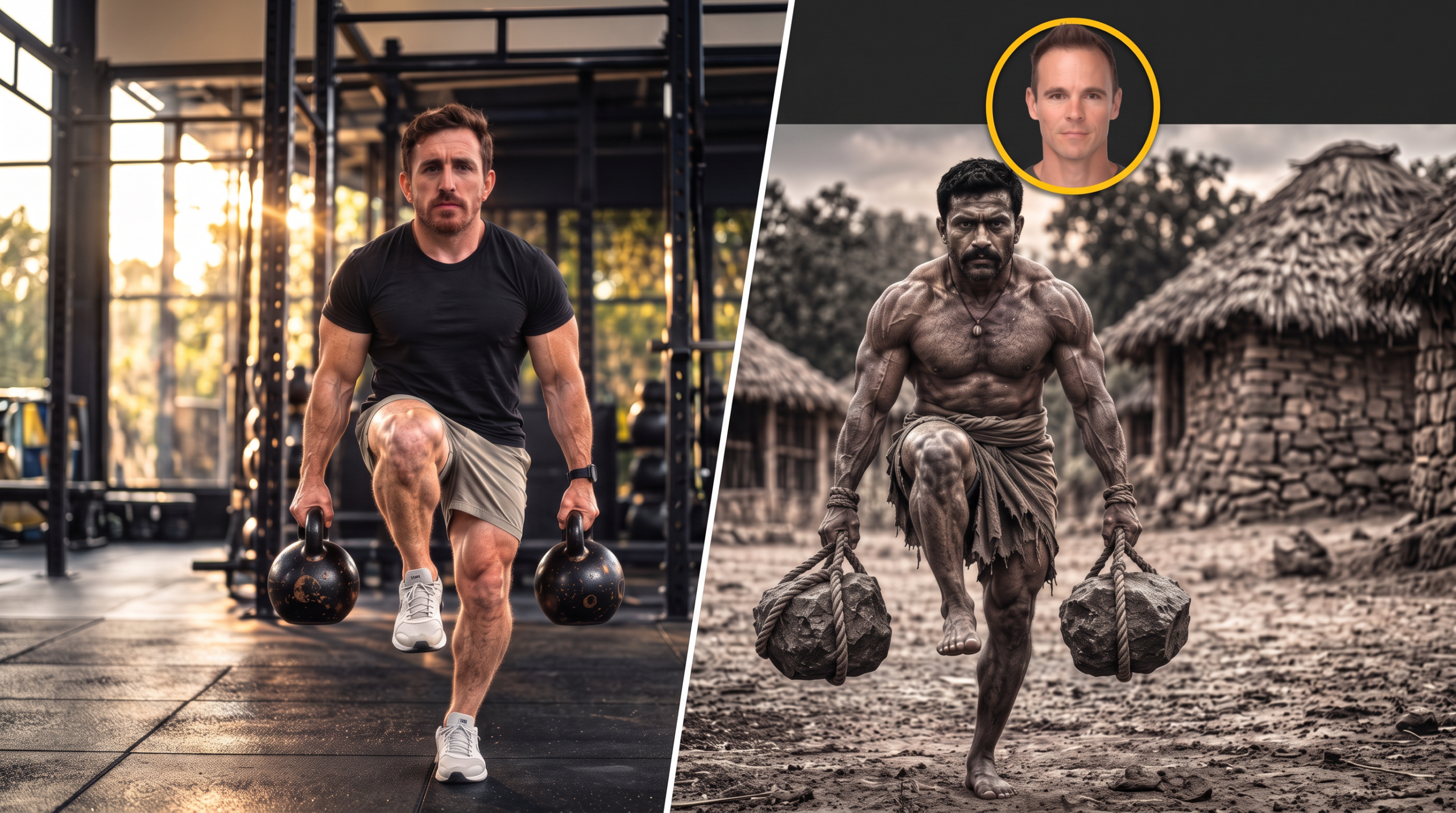
Human ancestors carried heavy stones, logs, and animals daily. This fundamental movement pattern ties everything together.
Loaded carries address postural issues while building genuine grip and core strength that transfers to real-world activities.
It killed my forward head posture, built real grip and core strength, stabilized my hips and spine, and made all the other movements feel more powerful.
How to perform it:
- Use farmers walks, suitcase carries, or bear hug style with sandbag or kettlebells
- Walk tall with braced core
- Start with 3-4 walks of 30-50 meters
- Rest for the same duration as your carry time
This single movement pattern may be the most functional exercise modern fitness rediscovered.
8. Rolling Get-Ups: Ground-to-Stand Mastery
Ancient wrestlers practiced ground-to-stand transitions to build total body strength and the ability to rise powerfully under control.
No products found.
While they may not have understood the biomechanics, the movement was a survival necessity that created remarkable functional strength.
How to perform it:
- Lie on your back
- Roll to side and post on one arm
- Rise smoothly to standing position
- Reverse the movement with control
- Three sets of 4-6 reps each side
This rebuilt my core, improved shoulder stability, and restored the full body coordination that modern training completely ignores.
Why Ancient Movements Work Where Modern Training Fails
These traditional movement patterns share common characteristics that modern gym training often lacks:
- Multi-planar movement rather than isolated, single-plane exercises
- Dynamic flexibility developed through motion, not static stretching
- Joint resilience built through progressive loading and varied ranges
- Functional integration that connects upper body, core, and lower body
- Postural correction through balanced movement patterns
The coach’s experience competing in marathons, Hyrox, MMA, and boxing while maintaining a full-time job and family responsibilities demonstrates the practical application of these movements.
Rather than requiring hours in the gym, these patterns build resilience and capacity efficiently.
Getting Started: Practical Implementation
Incorporating these movements doesn’t require abandoning current training. Instead, they complement and correct imbalances created by modern exercise.
No products found.
Begin with 2-3 movements that address your specific limitations:
- Tight shoulders? Start with Hindu push-ups and dead hangs
- Stiff hips? Focus on Hindu squats and Cossack squats
- Poor posture? Prioritize loaded carries and club swings
- Limited mobility? Incorporate horse stance and rolling get-ups
Perform these movements 2-3 times weekly, either as part of a warm-up or as standalone practice sessions.
The key isn’t intensity—it’s consistency and quality of movement.
The Bigger Picture: Movement as Medicine
What makes these ancient patterns so effective isn’t mystique or tradition—it’s that they address fundamental human movement needs that modern life eliminates.
We no longer climb, carry, squat deeply, or move through varied terrain daily. Our bodies pay the price.
These movements restore capacity that contemporary training often degrades rather than develops.
No products found.
The coach’s transformation—from broken down and nearly 40 to competition-ready across multiple demanding sports—illustrates what becomes possible when training prioritizes function over aesthetics.
Pain, stiffness, and declining performance aren’t inevitable consequences of aging.
Often, they’re simply the result of incomplete movement patterns that leave gaps in strength, mobility, and resilience.
These eight ancient movements fill those gaps—not through complexity or advanced programming, but through time-tested patterns that built functional, resilient bodies for centuries.