Julie Clark walks into a room, and science does a double-take.
She’s 56 years old chronologically, but her biological age clocks in at just 36—a full two decades younger than her birth certificate suggests.
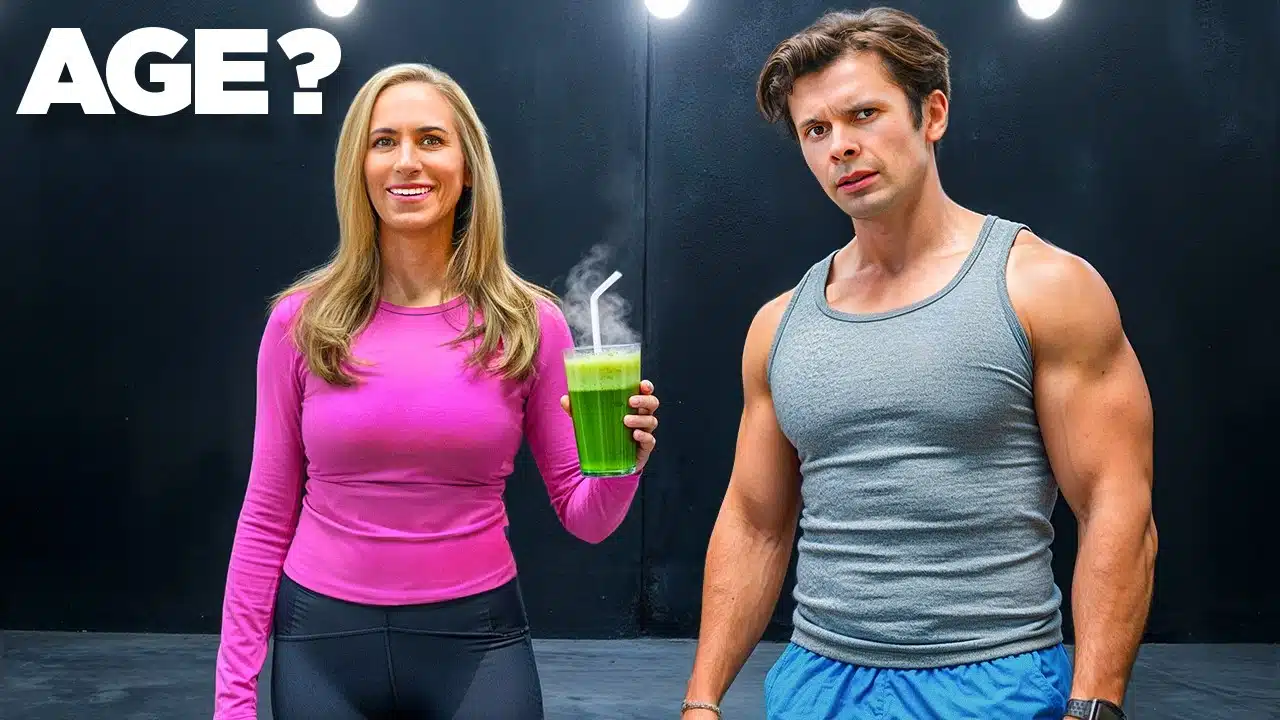
Even more remarkable? She’s achieving results that rival multi-millionaire biohackers while spending just $108 per month.
Her secret isn’t found in expensive supplements or cutting-edge technology, but in surprisingly simple daily habits that anyone can adopt.
Jump to:
- The Woman Aging Backward on a Budget
- The Reluctant Biohacker’s Bedroom
- A Morning Routine That Defies Silicon Valley
- The Green Drink That Started Everything
- The Minimal Supplement Stack
- Training Like an Athlete (Without the Steroids)
- Sauna and Cold Exposure (The Simple Way)
- The Green Latte That Triggered Weight Loss
- The Two Metrics She Actually Tracks
- Eggs, Vegetables, and Honoring Animals
- Dinner and the Nighttime Routine
- The Biggest Ager of All
- The $108 Takeaway
The Woman Aging Backward on a Budget
Clark currently ranks near the top of the Rejuvenation Olympics leaderboard, a competitive platform tracking biological aging metrics. Her “pace of aging” sits at an impressive 0.65, meaning for every 10 years that pass, she only ages 6.5 years.
But her journey wasn’t always smooth sailing.
A lot of horrible fallout from 2020 and some mental health issues in my house, those 6 months were some of the most stressful in my entire life. I was up making sure my son was okay, sleeping maybe every third night for six months. In and Out Burger sometimes, it was just very stressful because it was something I couldn’t control.
During that incredibly difficult period, her pace of aging shot up to 0.68—still impressive, but noticeably worse. Then something shifted.
That second six months I started working out and that’s when I started the pound of vegetables, started the saunas. In that time I slowed my pace of aging down another 3%. So I went from 0.68 to 0.65. I kind of give 8% to NovOS. I really do.
She quickly clarifies that people don’t need to buy expensive products—they can simply look up ingredients and create their own versions.
The Reluctant Biohacker’s Bedroom
Walk into Clark’s bedroom expecting a high-tech sleep cave, and you’ll be disappointed. There are no blackout curtains, no temperature-controlled mattresses, no fancy air filtration systems.
Just a regular room with natural light streaming through the windows.
I call myself the reluctant biohacker because I’m not like the general about the sleep.
She doesn’t even track her sleep scores or wear monitoring devices—at least, she didn’t until recently purchasing an Ultrahuman ring as a Christmas gift to herself.
What does she do? Morning Bible reading in that same bedroom, which she credits with keeping her in “a state of awe and wonder.” She firmly believes this practice contributes significantly to longevity, even if it can’t be measured on a dashboard.
She does employ two simple sleep hacks: mouth taping (to encourage nasal breathing) and wearing a sleep mask. Both cost virtually nothing.
A Morning Routine That Defies Silicon Valley
Clark wakes at 4:10 a.m.—the same time as Dwayne “The Rock” Johnson, though she jokes they probably don’t share the same diet.
Her morning ritual? Refreshingly minimal:
- Make the bed (except Sundays, her signal for complete rest)
- Grab a cup of green tea
- Pack gym bag
- Head to the gym
That’s it. No elaborate meditation sessions, no cold plunges before sunrise, no complicated supplement protocols at dawn.
Her approach serves as a powerful reminder that less is often more when it comes to sustainable healthy habits.
The Green Drink That Started Everything
Before eating solid food, Clark consumes a powdered green drink mixed with lemon and sometimes fermented beet kvass. She adds Meriva curcumin for its sulforaphane content, which helps with detoxification from microplastics.
Collagen powder rounds out the morning beverage.
Despite the intense focus on greens throughout her day, Clark insists she genuinely enjoys her food.
You have to enjoy your food. Food is pleasure. I started cooking when I was maybe like 6 years old, making mud pies, and I just remember feeling this connection to the earth. I can still feel it.
She developed a philosophy: can you make food both healthy and delicious? That question launched her deeper exploration into nutrition.
The Two-Week Freedom Window
Perhaps most surprisingly, Clark gives herself complete dietary freedom during the last two weeks of every year.
I will just do whatever I want and eat whatever I want. Usually about 10 days into that, it’s like okay, I’m so sick of all this gross stuff. It’s really great because you just kind of let go of everything and then it helps you remember, okay, this is why I eat this way.
This psychological release valve prevents feelings of deprivation and reinforces appreciation for her regular eating patterns.
The Minimal Supplement Stack
While many longevity enthusiasts swallow dozens of pills daily, Clark’s supplement routine fits in a few “cute little cups.”
Her daily essentials:
- Fish oil (twice daily)
- Magnesium (she’s deficient, so takes it multiple times)
- Probiotic (currently testing one from Avea)
- B complex or multivitamin
- Vitamin D3 with K2 drops
- Magnesium threonate before bed
When asked which supplements everyone should take, she narrows it down to just three essentials:
- Fish oil – for omega-3 fatty acids
- B complex or multivitamin – because soil depletion affects nutrient density
- Magnesium – essential for every bodily reaction, yet depleted in modern foods
She emphasizes vitamin D3 separately, noting that most people don’t get adequate sun exposure with shoulders uncovered for the necessary 15 minutes.
Training Like an Athlete (Without the Steroids)
Six days per week, Clark engages in physical activity combining resistance training and cardio work. Sunday remains completely off—sometimes without even leaving the house.
Her leg day includes five sets of eight reps of Bulgarian split squats, volume that would impress competitive bodybuilders. Recent DEXA scans confirmed she’d gained a pound of muscle in her legs alone.
I watched my mom who has Parkinson’s, and she never really worked out. There’s a strong link between having good muscle mass and not developing Parkinson’s. Plus it makes you feel good. You feel good and you look good.
She firmly believes everyone, regardless of age, should utilize weight training in some capacity.
The Norwegian 4×4 Protocol
Four times weekly, Clark performs what she calls the “Norwegian 4×4” protocol to boost VO2 max—a critical marker of cardiovascular fitness and longevity.
The protocol involves:
- 3 minutes at low intensity (warmup)
- 4 minutes at maximum sustainable pace
- Repeated four times
Athletes with high VO2 max tend to live longer, and elderly people with better cardiovascular capacity maintain independence longer—climbing stairs without breathlessness, for example.
Sauna and Cold Exposure (The Simple Way)
After Monday workouts, Clark spends 20-30 minutes in the sauna followed by a 4-5 minute cold shower. She does this four times weekly.
The benefits she experiences include immune system support, natural antidepressant effects, and what she describes as “a cocaine high for 2-4 hours” (though she clarifies she’s never actually tried cocaine).
No fancy cold plunge tanks or infrared sauna pods required—just standard gym facilities.
The Green Latte That Triggered Weight Loss
Clark’s signature “green latte” combines bone broth, massive amounts of spinach, peas, and warming spices like ginger, cinnamon, cardamom, and cloves.
She discovered this concoction after hearing Dr. Anna Cabeca discuss the benefits of greens.
Sure enough, within like 10 days I lost 7 pounds and I’m like what the heck.
She carefully measures her spinach (8 ounces) because she tends to overdo it otherwise, which can cause digestive issues. Cooking the greens reduces goitrogens—compounds that can interfere with thyroid iodine absorption.
The drink is described as “Christmas Santa’s bath water” and “a cup of Christmas” that “hugs you on the inside.”
The Two Metrics She Actually Tracks
Unlike obsessive calorie counters, Clark only tracks two nutritional metrics:
- One pound of vegetables daily (half must be greens = 8 ounces)
- 100 grams of protein
At 130 pounds with 98 pounds of lean body mass, her protein target might seem low by bodybuilding standards. But she only counts high-quality protein sources like eggs, meat, and fish—not incidental protein from grains or vegetables.
This simplified approach eliminates the stress and time commitment of detailed macro tracking while ensuring adequate nutrition.
Eggs, Vegetables, and Honoring Animals
Clark’s second meal typically consists of four hard-boiled eggs arranged in a “rainbow” with raw vegetables: radishes, jicama, broccoli stems, celery, peppers, and carrots.
She measures out exactly 8 ounces because she’s “an absolute celery addict” who would otherwise overeat them and experience digestive distress.
This vegetable plate acts as what she calls “a natural GLP-1 agonist”—referencing the mechanism behind Ozempic. Instead of taking weight loss drugs, just eat your vegetables.
She nibbles on this throughout the day, never feeling particularly hungry.
Nose-to-Tail Eating Philosophy
When discussing what everyday people should implement for longevity, Clark emphasized three priorities:
- Walk 10 minutes daily
- Eat vegetables
- Consume animals “tip to tail”
It honors the animal. The animal gave their life to us, and to just throw out these things just seems beyond rude. We really need to honor that animal.
Organ meats, cartilage, and other typically discarded parts contain extraordinary nutritional benefits. She’s tried beef cheeks, brain, and tongue, though she draws the line at consuming fresh monkey brains.
She sources meat from a farmer who sends weekly photos of animals grazing on pasture, creating connection and accountability.
Dinner and the Nighttime Routine
Evening meals vary but follow the same real-food philosophy: scrambled eggs with sautéed mushrooms and greens, sardines with tomatoes, or steak with vegetables.
She prepares satisfying meals without complicated biohacking protocols or exotic ingredients.
Her nighttime routine is deliberately simple because “by then I just can’t even.”
- Stretch
- Wash face
- Brush teeth
- Bed by 8:00 p.m., asleep by 8:30 p.m.
That early bedtime supports her 4:10 a.m. wake time, creating a consistent sleep schedule without requiring elaborate wind-down rituals or expensive technology.
The Biggest Ager of All
When asked what most people do daily that ages them fastest, Clark’s answer wasn’t about diet, exercise, or toxins.
Worry. I think our drive for perfectionism, trying to do everything perfect. I think that can really—it’s the all-day stressors.
Her personal experience during the stressful six months proved this point. Despite having established healthy habits, chronic worry measurably increased her pace of aging.
When she reduced stress through movement, saunas, and better nutrition, her biological aging rate improved dramatically—even during continued difficult circumstances.
The lesson? Consistency over perfection. We’re humans designed to handle occasional mistakes and the occasional french fry. Perfectionism itself may be more harmful than imperfect adherence to healthy habits.
The $108 Takeaway
Julie Clark’s remarkable results demolish the myth that extreme longevity requires extreme wealth. Her monthly spending of $108 covers basic supplements, quality food, and a gym membership.
Everything else costs nothing: walking, mouth taping, making the bed, reading, cooking real food, and maintaining consistent sleep schedules.
Her message resonates clearly: Don’t wait for perfect circumstances or expensive technology. You already know sleep matters. You already know eating well matters. Start there.
The reluctant biohacker proves that biological age reversal doesn’t require becoming a full-time health warrior. It requires sustainable habits, stress management, and the wisdom to know that awe, wonder, and connection matter as much as macros and metrics.
Perhaps that’s the real anti-aging secret hiding in plain sight.