What happens when the world’s fattest city meets the world’s skinniest?
One boasts an obesity rate exceeding 40%, while the other sits at just over 4%—nearly ten times lower.
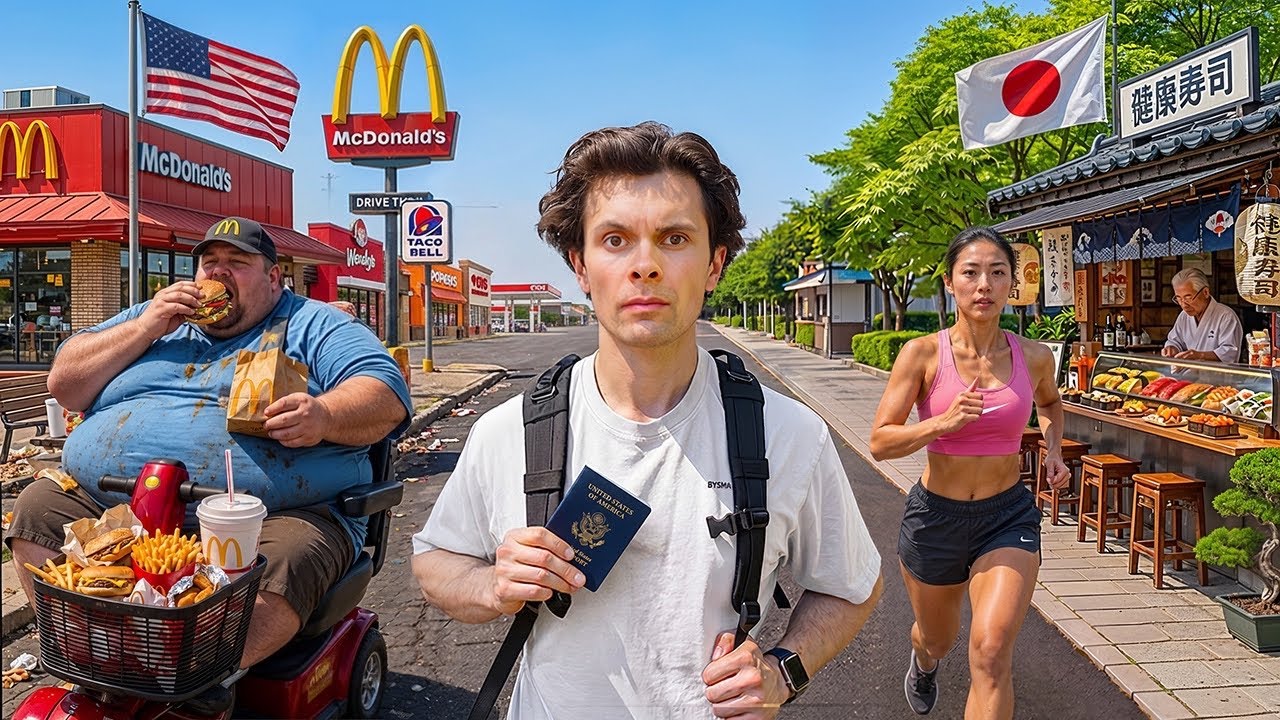
Popular fitness YouTuber Will Tennyson recently embarked on an eye-opening journey to investigate both extremes, starting with Little Rock, Arkansas—America’s most obese city—before traveling to Tokyo, Japan, where obesity is remarkably rare.
What he discovered wasn’t just about food choices, but entire lifestyle systems that either promote health or quietly destroy it.
Jump to:
Welcome to Little Rock: Where Healthy Options Are Hard to Find
Tennyson’s first observation upon arriving in Little Rock was striking: healthy food options were practically nonexistent. Searching for nutritious restaurants yielded only fast food chains, buffets, and convenience stores stocked with processed snacks.
There is literally fast food everywhere. Like there’s a Popeye’s, Pizza Hut, Chinese takeout places, Wendy’s, every single place that you can think of is just all on this one street.
Even more concerning was the complete absence of walkability. Streets lacked sidewalks, forcing residents to drive everywhere.

If you want something simple that actually works, this is one of the most effective tools I’ve used to build strength, conditioning, and endurance without needing a full gym setup.
- Full-body training with one weight using swings, squats, and presses
- Solid cast iron build that feels stable and lasts for years
- Comfortable grip that makes high-rep workouts easier to handle
Physical activity seemed almost discouraged by the city’s design itself.
Breakfast Portions That Double as Food Challenges
At a local donut shop, Tennyson asked what a typical order looked like. The answer? Four glazed donuts for breakfast—a standard routine for many locals who visit two to three times weekly.
These four donuts cost just $5, making the choice economically sensible even if nutritionally disastrous.
Moving on to a popular breakfast restaurant, Tennyson encountered menu items that read like dessert challenges rather than morning meals. Strawberry cheesecake pancakes, cinnamon rolls as appetizers, and the “Eureka” sandwich—featuring fried chicken, bacon jam, actual bacon, mayo, cheese, and a buttered biscuit bun.
This menu is a laminated cry for help. Like, half of the stuff is dessert. The other half is pretty much a food challenge.
One cinnamon roll appetizer likely exceeded 1,000 calories alone—more than many people should consume for an entire meal.
Alarming Gaps in Basic Nutrition Knowledge
Perhaps most troubling was the severe lack of health education among residents. Little Rock has the lowest number of health educators per capita in America, and it shows.
If you want something simple that actually works, this is one of the most effective tools I’ve used to build strength, conditioning, and endurance without needing a full gym setup.
- Full-body training with one weight using swings, squats, and presses
- Solid cast iron build that feels stable and lasts for years
- Comfortable grip that makes high-rep workouts easier to handle
Tennyson conducted informal nutrition trivia with locals, asking basic questions like how many calories are in protein, carbohydrates, or water. Almost nobody could answer correctly.
When asked how many calories an average person should consume daily, responses ranged from 1,000 to 1,200—far below actual requirements. One person estimated an apple contained only 10 calories.
This knowledge gap isn’t the fault of individuals—it reflects systemic failure in public health education.
Fast Food Culture Runs Deep
To understand typical eating habits, Tennyson ordered whatever the person ahead of him ordered at multiple fast food chains. The results were revealing.
At Popeyes, someone ordered a gallon of sweet tea—a beverage choice alone that could contribute to diabetes. At KFC, a standard lunch included six extra crispy wings (1,020 calories), mashed potatoes with gravy (180 calories), and a medium Mountain Dew (290 calories)—totaling nearly 1,500 calories without much nutritional value.
Every single order included full-sugar drinks, adding hundreds of empty calories that could easily be eliminated by switching to diet options or water.
If you want something simple that actually works, this is one of the most effective tools I’ve used to build strength, conditioning, and endurance without needing a full gym setup.
- Full-body training with one weight using swings, squats, and presses
- Solid cast iron build that feels stable and lasts for years
- Comfortable grip that makes high-rep workouts easier to handle
I think the only way you can get your 10k steps here is like literally if your car breaks down or if it gets stolen.
Buffet Culture: Making Your Money’s Worth
Tennyson’s final stop in Little Rock was Golden Corral, an all-you-can-eat buffet where the dessert section was literally larger than the salad bar.
For $16, diners could consume unlimited quantities of pizza, pasta, fried foods, and sugary desserts. The psychology is dangerous: people eat beyond fullness simply to maximize value, consuming thousands of unnecessary calories in one sitting.
Tokyo: A Different World Entirely
Landing in Tokyo felt like entering an alternate reality. With an obesity rate just over 4%, Japan represents the opposite end of the spectrum.
Tennyson’s first morning began with radio taiso—a traditional Japanese exercise routine practiced in parks by elderly residents at 6 a.m.
They’re starting their day with movement, which is key to low obesity rates and longevity.
While not physically demanding, starting each day with community movement sets a positive tone. In Japan, staying active isn’t reserved for gym-goers—it’s woven into daily life for people of all ages.
Convenience Stores That Actually Promote Health
In stark contrast to American gas stations, Japanese 7-Elevens function as legitimate food destinations. Fresh salads, protein bowls, fruit cups, and protein drinks dominated the shelves.
If you want something simple that actually works, this is one of the most effective tools I’ve used to build strength, conditioning, and endurance without needing a full gym setup.
- Full-body training with one weight using swings, squats, and presses
- Solid cast iron build that feels stable and lasts for years
- Comfortable grip that makes high-rep workouts easier to handle
Tennyson tried the wildly popular egg salad sandwich and onigiri (rice ball with meat filling). Despite his usual aversion to egg salad, the Japanese version surprised him with its quality and subtle sweetness. Total calories? Just 224 for the onigiri.
Even desserts were portion-controlled. Ice cream servings were modest, and everything emphasized quality over quantity.
Teishoku: The Standard Japanese Meal
With fellow YouTuber Joseph, who has lived in Japan for 15 years, Tennyson visited a teishoku restaurant—a chain serving traditional Japanese set meals.
The meal followed the “ichiju sansai” principle: one soup, three dishes. This included grilled fish or chicken, two vegetable sides, rice, and miso soup. Total cost? Around seven dollars.
It’s like cheap healthy food too.
Joseph explained the concept of “hara hachi bu”—eating until 80% full. This traditional practice acknowledges that satiety signals take about 20 minutes to register, preventing overeating.
Meals are presented in separate small bowls, slowing consumption and increasing mindfulness. Using chopsticks further reduces eating speed, allowing fullness cues to catch up.
If you want something simple that actually works, this is one of the most effective tools I’ve used to build strength, conditioning, and endurance without needing a full gym setup.
- Full-body training with one weight using swings, squats, and presses
- Solid cast iron build that feels stable and lasts for years
- Comfortable grip that makes high-rep workouts easier to handle
Walking Culture: Built Into Daily Life
Tokyo residents average 6,500 to 7,200 steps daily—and many walk far more. The city’s public transportation system encourages walking, with stations requiring significant foot travel.
When Tennyson asked locals about their step counts, responses ranged from 8,000 to 18,000 steps per day. One person noted that in America, driving everywhere drastically reduced their activity.
Even advertisements reflected health consciousness. Public transportation featured ads for low-calorie snacks rather than junk food.
Vending Machines Stocked With Supplements
Japanese vending machines, ubiquitous throughout Tokyo, offered BCAAs, vitamin C drinks, electrolyte beverages, matcha, and black coffee—not chips and candy.
Tennyson even discovered warm protein shake vending machines dispensing 10.6 grams of protein for just 87 cents.
87 cents for nearly 11 g of protein. And you’re telling me Mr. Olympia is not Japanese?
Fast Food, Japanese Style
Even Japanese fast food differs dramatically. At Mos Burger, Japan’s most famous burger chain, strict advertising laws ensure menu photos accurately represent actual food.
If you want something simple that actually works, this is one of the most effective tools I’ve used to build strength, conditioning, and endurance without needing a full gym setup.
- Full-body training with one weight using swings, squats, and presses
- Solid cast iron build that feels stable and lasts for years
- Comfortable grip that makes high-rep workouts easier to handle
The signature burger contained fewer than 400 calories compared to a Big Mac’s 500-plus. Ingredients tasted fresh and minimally processed, with tomato slices thicker than the meat patty.
Another popular item featured rice patties instead of buns, filled with seafood, edamame, and carrots. Despite being “fast food,” everything felt substantially lighter and less greasy.
Social Pressure and Education
Cultural factors also play significant roles. Japanese society maintains strong communal standards around health and appearance.
Schools employ nutritional experts to design student meals, teaching healthy habits from childhood. Seasonal, fresh ingredients are prioritized over year-round processed options.
Joseph noted that what Americans consider “normal” body weight would be considered overweight in Japan. This isn’t about judgment—it reflects different environmental standards and available choices.
The Real Difference: Environment Over Willpower
Tennyson’s journey revealed that obesity rates have less to do with individual willpower and everything to do with environmental design.
If you want something simple that actually works, this is one of the most effective tools I’ve used to build strength, conditioning, and endurance without needing a full gym setup.
- Full-body training with one weight using swings, squats, and presses
- Solid cast iron build that feels stable and lasts for years
- Comfortable grip that makes high-rep workouts easier to handle
In Little Rock:
- Healthy food is expensive, inconvenient, and scarce
- Fast food is cheap, everywhere, and heavily advertised
- Walking is nearly impossible due to infrastructure
- Health education is virtually nonexistent
- Portion sizes are massive
- Sugar-laden drinks are standard
In Tokyo:
- Healthy options are convenient and affordable
- Even fast food emphasizes quality and smaller portions
- Walking is integrated into daily life through city design
- Nutrition education starts in childhood
- Cultural practices like hara hachi bu prevent overeating
- Water and unsweetened beverages dominate
I think in Japan it’s really hard to cheat on your diet other than just emotionally. Like everything that you want to get is just by default a lot lighter or a lot smaller.
Lessons Worth Learning
Tennyson concluded that the question isn’t why Tokyo is healthy—it’s what other cities can learn from it.
When healthy choices are also easy choices, people naturally make better decisions. When cities are designed for walking, people move more. When nutrition education is prioritized, knowledge gaps close.
Individual responsibility matters, but systemic change creates lasting impact. Little Rock’s obesity crisis isn’t a moral failing—it’s a design failure.
Tokyo proves that health doesn’t require superhuman willpower. It requires environments that support rather than sabotage wellbeing.
If you want something simple that actually works, this is one of the most effective tools I’ve used to build strength, conditioning, and endurance without needing a full gym setup.
- Full-body training with one weight using swings, squats, and presses
- Solid cast iron build that feels stable and lasts for years
- Comfortable grip that makes high-rep workouts easier to handle
The gap between 40% obesity and 4% isn’t genetic—it’s geographic, economic, educational, and cultural. And that means solutions exist beyond telling people to “just eat less and move more.”
Real change happens when communities redesign systems, not just lecture individuals.