In April 2007, NASA astronaut Suni Williams did something no human being had ever done before.
She ran a full 26.2-mile marathon — not on the streets of Boston, but strapped to a treadmill aboard the International Space Station, 210 miles above Earth, moving at 17,500 miles per hour.
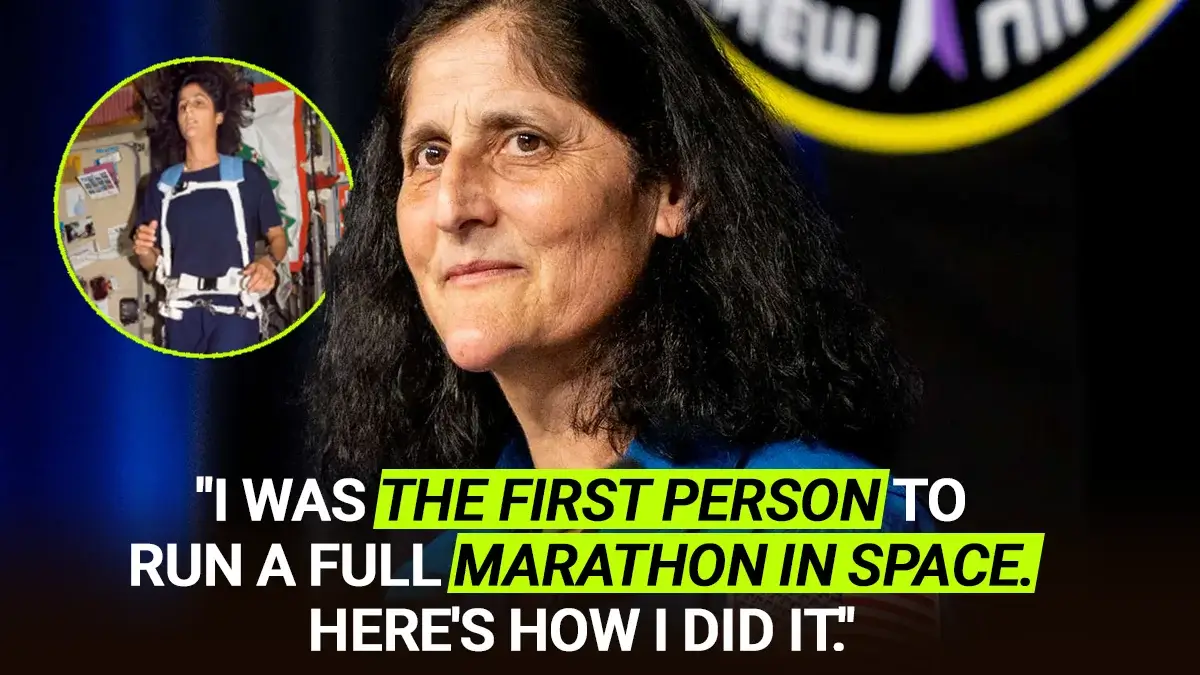
Her finish time was 4 hours and 24 minutes, and she crossed that orbital finish line with a triumphant “Hooyah” that echoed all the way down to Mission Control.
Nearly two decades later, Williams is preparing to run Boston again — this time with her feet planted firmly on the actual course — and the full story of how she pulled off the first space marathon is as extraordinary as ever.
Jump to:
A Boston Bib Beamed Up From 210 Miles Below
Williams has deep roots with the Boston Marathon. She grew up in Needham, Massachusetts, just minutes from the iconic course, and ran it as a teenager.
In 2006, she qualified for the 2007 field by posting a 3:29:57 at the Houston Marathon — a genuinely impressive time by any standard.

If you want something simple that actually works, this is one of the most effective tools I’ve used to build strength, conditioning, and endurance without needing a full gym setup.
- Full-body training with one weight using swings, squats, and presses
- Solid cast iron build that feels stable and lasts for years
- Comfortable grip that makes high-rep workouts easier to handle
The problem? By race day, she was already aboard the ISS serving as a flight engineer, with no immediate ride home on the horizon.
The Boston Athletic Association wasn’t about to let that stop her. They issued Williams bib number 14,000 and transmitted it up to orbit. She printed it out and taped it directly to the front of her treadmill.
Down on Earth, her sister Dina Pandya and NASA colleague Karen Nyberg ran the same race through cold rain and brutal nor’easter conditions. Williams cheered them on from space, asking Mission Control for updates on their splits throughout her run.
The Machine That Made It All Possible
Running in space isn’t as simple as lacing up and stepping onto a belt. In microgravity, there’s no downward force — without a solution, a single stride would send a runner drifting straight toward the ceiling.
Williams ran on a piece of engineering called the Treadmill Vibration Isolation System, or TVIS — a machine specifically designed so that a runner’s footfalls don’t vibrate through the entire station structure.
To stay grounded, she wore a harness around her shoulders and hips, connected to the treadmill deck by bungee cords that pulled her downward with each step. Astronauts can adjust the bungee tension depending on how much impact load they want per stride.
If you want something simple that actually works, this is one of the most effective tools I’ve used to build strength, conditioning, and endurance without needing a full gym setup.
- Full-body training with one weight using swings, squats, and presses
- Solid cast iron build that feels stable and lasts for years
- Comfortable grip that makes high-rep workouts easier to handle
It works. But over four-plus hours? It hurts.
Four Hours in a Harness That Punishes You
Williams was candid before the race about just how physically demanding the setup could be. The shoulder and hip straps become increasingly painful during long efforts, and nothing about running a marathon in a bungee harness is forgiving.
She paused periodically to adjust the straps and stretch her legs. Her crewmates kept her fueled by tossing weightless orange slices and drink pouches across the cabin as she ran — a space-age version of the aid stations she would have passed on Boylston Street.
She wore Boston Red Sox socks for the entire run. Of course she did.
What 26.2 Miles Looks Like When the Station Moves 63,000
While Williams covered her 26.2 miles on the belt, the ISS completed roughly two full orbits of the Earth — traveling approximately 63,000 miles in the same window of time.
Two laptops were mounted on either side of her treadmill. One played footage of past Boston Marathons on DVD. The other displayed the station’s real-time position over the planet.
If you want something simple that actually works, this is one of the most effective tools I’ve used to build strength, conditioning, and endurance without needing a full gym setup.
- Full-body training with one weight using swings, squats, and presses
- Solid cast iron build that feels stable and lasts for years
- Comfortable grip that makes high-rep workouts easier to handle
At the 90-minute mark, she radioed down to report she was approaching 9.5 miles — and that the station had just completed one full lap around Earth.
Hooyah.
That was Williams crossing the finish line, as captured by Space.com at the time. Simple. Earned. Unforgettable.
Why Astronauts Run in Space at All
This wasn’t a publicity stunt. Running in microgravity is, quite literally, a matter of physical survival.
Without the constant resistance of gravity, the human body deteriorates fast. Up to 20 percent of muscle mass can vanish within two weeks in orbit, and bone density drops by 1 to 2 percent every month aboard the ISS.
Without rigorous daily exercise, astronauts returning to Earth would struggle to stand, let alone walk. Every ISS crew member is required to exercise for approximately two hours each day — typically split between the treadmill, a resistance machine, and a stationary bike.
Williams Trained Like She Meant It
For months leading up to the race, Williams ran at least four times per week aboard the station — two longer sessions and two shorter ones — all while fulfilling her flight engineer responsibilities.
If you want something simple that actually works, this is one of the most effective tools I’ve used to build strength, conditioning, and endurance without needing a full gym setup.
- Full-body training with one weight using swings, squats, and presses
- Solid cast iron build that feels stable and lasts for years
- Comfortable grip that makes high-rep workouts easier to handle
Her flight surgeon, Steve Hart, noted that Williams wanted physical fitness to be the defining characteristic of her mission.
She wasn’t just chasing a finish time. She was demonstrating what disciplined training looks like in an environment that actively works to strip strength away.
The Legacy — and the Return to Boston
Williams’ 2007 run opened a door that other astronauts have since walked through. In 2016, British astronaut Tim Peake ran the London Marathon aboard the ISS, finishing in approximately 3 hours and 35 minutes.
But the original story has one more chapter still to be written.
In 2026, at age 60 and following an unplanned nine-month extended stay in space, Williams is set to run the Boston Marathon again — this time on the actual course, on solid ground, with no harness required. The Boston Athletic Association named her the 2026 Patriots’ Award honoree in recognition of her extraordinary connection to the race.
From bib number 14,000 taped to a treadmill in low Earth orbit, to finally running the streets of the city she grew up near — Williams’ running story remains one of the most remarkable in the history of the sport.
If you want something simple that actually works, this is one of the most effective tools I’ve used to build strength, conditioning, and endurance without needing a full gym setup.
- Full-body training with one weight using swings, squats, and presses
- Solid cast iron build that feels stable and lasts for years
- Comfortable grip that makes high-rep workouts easier to handle
Some people run marathons. Suni Williams ran one around the planet.