Baking soda sits in nearly every kitchen cabinet, costing just a few dollars. Yet most people have no idea what it can actually do—or more importantly, what it can’t.
Ben Azadi, a two-time New York Times best-selling author and health expert, recently broke down the truth about sodium bicarbonate in a way that cuts through over a decade of internet misinformation.
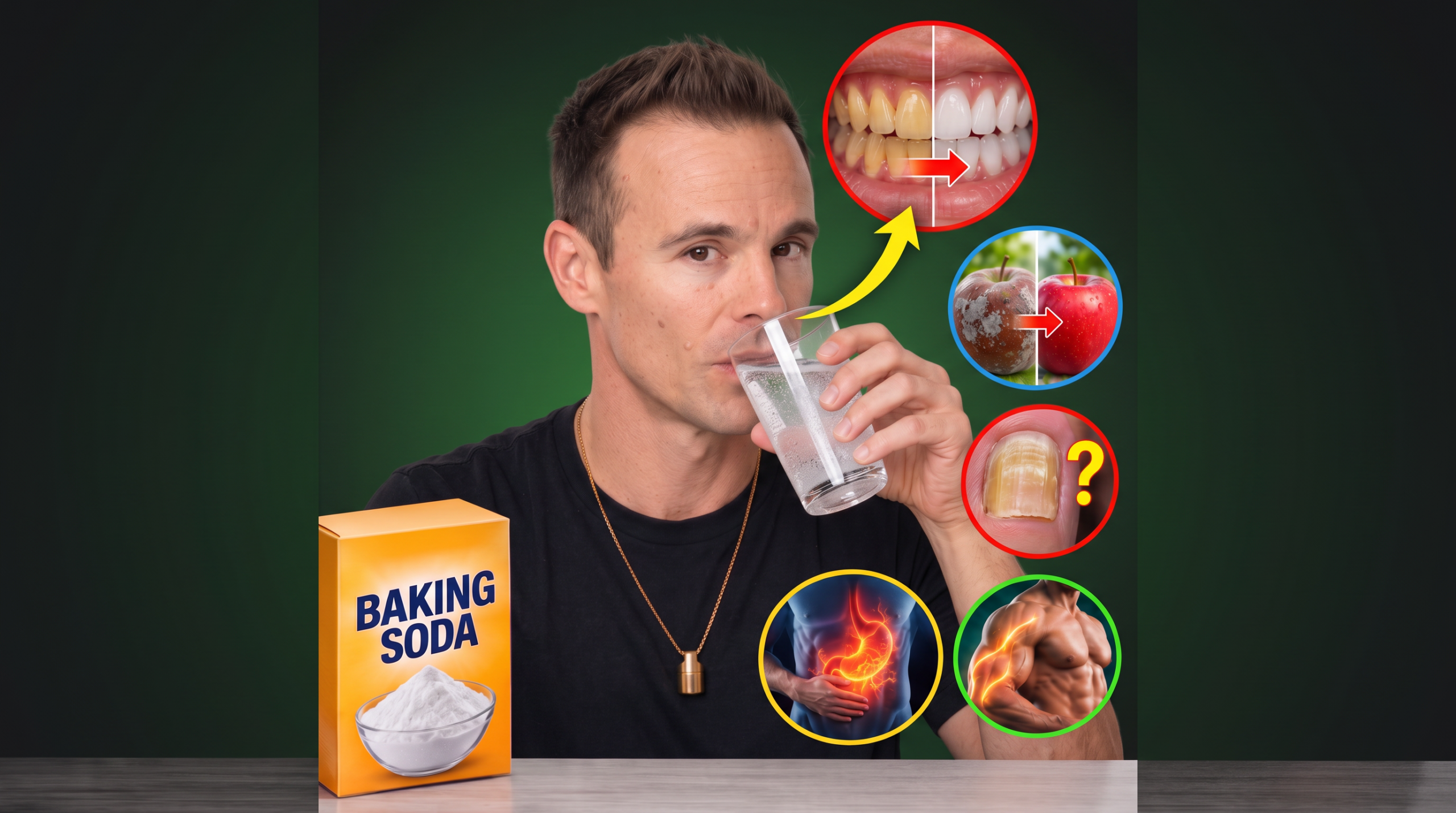
His approach is simple: baking soda works by touching things. Where it lands determines everything.
Understanding three distinct zones—and the evidence behind each—can help anyone separate legitimate uses from complete nonsense in just 15 seconds.
Jump to:
The Alkalizing Myth That Won’t Die
Nearly every baking soda video makes the same claim: it alkalizes your body. Azadi dismantles this idea immediately.
Blood pH sits between 7.35 and 7.45, and the body defends that range aggressively. Moving outside those boundaries doesn’t lead to “feeling energized”—it leads to medical emergency.
If your blood pH moved the way that these videos explained, you wouldn’t feel energized. You would need an ambulance.
Here’s what most people miss: your pancreas already produces 7 to 20 grams of bicarbonate daily as part of normal digestion. A quarter teaspoon of baking soda contains roughly 1.2 grams.
Taking that amount is like adding a shot glass to a swimming pool—your body already manufactured ten times more before breakfast.
Zone One: Where Evidence Is Rock Solid
Zone one covers everything baking soda touches that isn’t you. This is where the science is strongest.
Washing Produce
Pesticide residue clings to waxy produce surfaces. Baking soda does two critical things: the alkaline environment degrades some compounds, and it lifts what remains on the skin.
Plain water can’t degrade those chemicals. Neither can commercial bleach washes. But 12 to 15 minutes in a baking soda solution clears surface residue effectively.
The catch? Nothing you do at the sink removes pesticides that have already soaked into the fruit past the peel. What’s outside comes off. What’s inside stays inside.
How to do it right:
- Mix 1 tablespoon per quart of water
- Soak for 12 to 15 minutes
- Rinse thoroughly
- For berries, 5 minutes is sufficient—they’re more delicate and absorb water quickly
Neutralizing Odors
Sweat is nearly odorless when it leaves your body. The smell develops when bacteria metabolize it, producing volatile acids.
Baking soda neutralizes those acids into salts that don’t evaporate into your nose. It also pulls moisture that bacteria need to thrive.
Azadi stress-tested this approach extensively.
I play basketball every day, and I play outside, and I sweat into those shoes. I’ve also seen The Killers, the greatest rock band in the world, like 45 times. So, I’ve stress test this baking soda, and it works really well for stinky shoes.
Application guide:
- Shoes: 2 tablespoons dry in each shoe overnight
- Garbage bins: Half a cup at the bottom under the bag, swap monthly
- Refrigerator: Open bag left inside absorbs odors over time
Zone Two: The Border Territory
Zone two involves tissue you can touch directly—mouth, stomach lining, skin. Real effects exist here, but dose and frequency determine whether you’re helping or causing damage.
Teeth Whitening
Evidence for this use is stronger than most realize. A 2019 systematic review from the Academic Center for Dentistry in Amsterdam analyzed 121 randomized controlled trials comparing toothpaste with and without baking soda.
Across 43 comparisons, baking soda formulas outperformed controls on plaque removal. Authors noted moderate bias risk, but the signal is solid.
What makes this interesting: normally, scrubbing stains means harsher abrasives that damage enamel. Baking soda breaks that trade-off.
On the RDA scale dentists use, sodium bicarbonate scores low while matching or beating harsher alternatives. But not all baking soda toothpastes are created equal.
Arm & Hammer Dental Care rates RDA 34. Sensodyne with baking soda? RDA 98—nearly triple the abrasion. Same words on the box, vastly different products.
Baking soda works on extrinsic stains—coffee, tea, wine, tobacco—the surface film. It doesn’t change tooth color underneath. But it has a second benefit: buffering decay-causing acid and neutralizing acidic chromogens that cause staining.
Best practice: Dip a wet brush or mix into toothpaste 2-3 times weekly. Don’t use daily or with heavy pressure. A quarter teaspoon in water as a rinse also works—spit, don’t swallow.
Skin Irritation Relief
Bug bites, poison ivy, sunburn—a paste of three parts baking soda to one part water, or a few tablespoons in a cool bath, represents one of the oldest home remedies.
It’s plausible and low-risk, but controlled human data is thin. This use makes the list because it’s cheap and safe, not because robust trials support it.
Zone Three: Swallowing Baking Soda
This zone carries the most confusion and potential danger.
Athletic Performance: What Actually Works
Here’s what’s real: bicarbonate doesn’t change blood pH, but it increases buffer capacity. Blood pH stays locked at 7.4, but the tank holding it there gets bigger.
During intense exercise, muscles flood with hydrogen ions. A bigger buffer helps clear them. The International Society of Sports Nutrition confirms bicarbonate improves high-intensity performance lasting 30 seconds to 12 minutes—cycling, running, swimming, rowing, combat sports.
The effective dose? 0.2 to 0.3 grams per kilogram body weight. For someone weighing 180 pounds, that’s 24 grams—more than 5 teaspoons, carrying roughly 6,700 milligrams of sodium.
This isn’t the “quarter teaspoon with water” protocol circulating online. That dose is one-twentieth of what research actually used.
I play basketball every single day. I just turned 42 years old just a few days ago. Do I load up on bicarbonate before my daily basketball? No. If I did, it will create gut distress, and I wouldn’t be able to play basketball.
Heartburn: Legitimate But Limited
Bicarbonates have been in antacids for a century for good reason. A quarter teaspoon in 4 to 6 ounces of water, sipped occasionally, can relieve heartburn. You’ll burp—that’s the reaction working.
But daily use is dangerous. Poison control centers field calls regularly about people using baking soda as a daily antacid who end up in emergency rooms with scrambled electrolytes and dangerously alkaline blood chemistry.
Who should never drink it:
- Anyone with kidney disease
- Heart failure patients
- People with very high blood pressure
- Anyone on diuretics
- Those on sodium-restricted diets
Frequent heartburn isn’t a baking soda problem—it signals something upstream requiring medical attention.
Toenail Fungus: Misrepresented Research
Every video on this topic cites the same study: Strasburg 2013. Researchers grew 70 fungal strains from human skin and nail infections with sodium bicarbonate. At 10 grams per liter, about 80% of isolates were inhibited.
That’s the number everyone quotes. Here’s what they don’t mention: dermatophytes—organisms causing the overwhelming majority of toenail fungus—needed 20 grams per liter, double the headline number.
More importantly, this was fungus on a plate and detached nail fragments. Nobody in this study was an actual patient. Nobody was cured because nobody was infected.
Real toenail infections live under and inside the nail plate. Your nail is a barrier—that’s its job. A baking soda soak is safe and cheap, potentially helping with odor alongside real treatment, but it’s not a cure.
Buying and Using Baking Soda Correctly
Baking soda is sodium bicarbonate. It should have one ingredient. Check the label—it should say “ingredients: sodium bicarbonate” and nothing else.
Baking powder is different. It contains baking soda plus an acid plus cornstarch. Don’t use it for any applications discussed here.
Look for food grade or USP designation. Grocery store baking soda meets this standard and works fine.
Does baking soda break a fast? No. It contains no meaningful calories and doesn’t raise glucose or insulin.
The three-zone framework makes evaluation simple: Zone one (everything it touches that isn’t you) has rock-solid evidence. Zone two (tissues you can touch directly) shows real effects with proper dosing. Zone three (systematic effects from swallowing) is where most claims fall apart.
Understanding these boundaries transforms how you evaluate any baking soda claim online. The mechanism is always contact—where it lands determines what’s possible, what’s plausible, and what’s pure fiction.