Will Tennyson, a popular fitness YouTuber, recently documented his attempt at 75 Hard, calling it “the toughest mental strength challenge on the planet” and “the equivalent of running an Iron Man for your brain.”
The challenge demands 75 consecutive days of unwavering discipline: two 45-minute workouts daily (one must be outside), drinking a gallon of water, reading 10 pages of non-fiction, following a strict diet with zero cheat meals or alcohol, and taking daily progress photos.
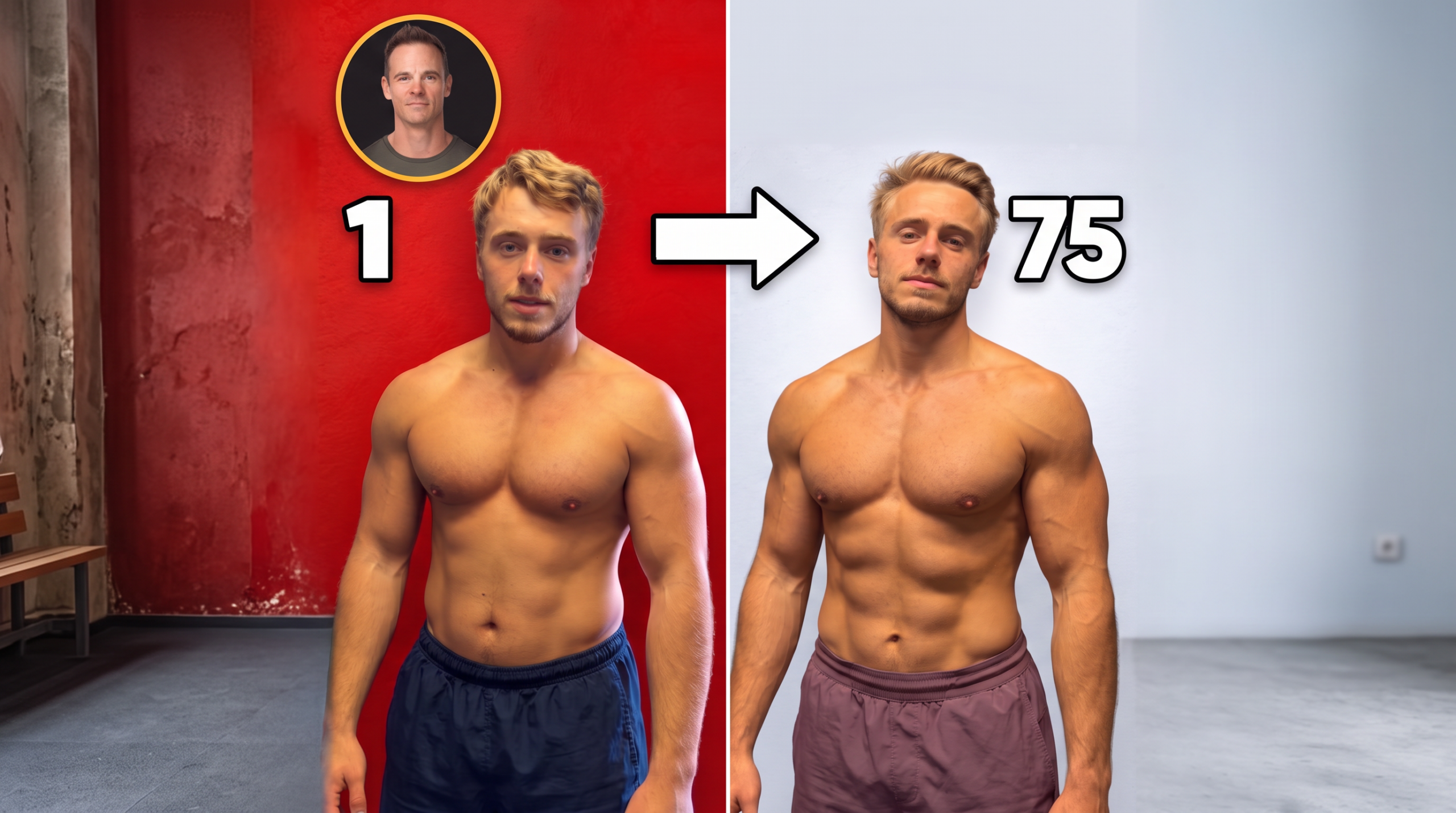
Miss a single task? Start over from day one.
Tennyson’s journey reveals both the transformative power and brutal reality of extreme fitness challenges, along with lessons about sustainability, mental health, and what truly builds lasting change.
Jump to:
- The Challenge Begins: Early Wins and Harsh Realities
- Carb Backloading: Strategy or Speculation?
- Steps Over Gym Time: The Calorie-Burning Truth
- The Water Challenge: Drowning in Discipline
- Ice Baths and Wim Hof: Cold Exposure Claims
- The Canada Collapse: Three Weeks Undone in One
- Mental Health and Personal Struggles
- Energy Drink Dependency: A Hidden Cost
- The Malta Test: Proving Sustainability
- Body Composition Results: The Numbers
- The 16,000 Push-Up Side Quest
- What 75 Hard Actually Teaches
- The Dark Side of Extreme Challenges
- Is 75 Hard Right for You?
- The Bigger Picture: Discipline vs. Sustainability
- Key Takeaways for Your Own Journey
- The Final Verdict
- Sources
The Challenge Begins: Early Wins and Harsh Realities
Tennyson stepped on the scale day one at 89.4 kilograms (197 pounds), heavier than expected. His body fat measured around 11%, though he expressed skepticism about the accuracy.
Hopefully, this time cutting down, I am going to be really ripped.
The first few days brought quick results, dropping to 86.6 kilograms within the opening week. But Tennyson knew this wasn’t pure fat loss.
I think that’s just from not being as bloated. To be honest, I’ve done this quite a few times and I do lose weight quite quickly on those first few days.
Early weight fluctuations during calorie restriction typically reflect water loss and reduced glycogen stores rather than significant fat reduction. The body stores glycogen with water, and depleting these reserves creates rapid scale changes that can be misleading.
Carb Backloading: Strategy or Speculation?
Tennyson’s nutritional approach centered on carb backloading, eating primarily protein throughout the day and saving all carbohydrates for dinner.
All that means is just eating protein for the first few meals of the day. And then when it comes to dinner time, having all my carbs because I’ve got a tendency to kind of just binge eat in the evening.
While this strategy helped him manage cravings, the science behind carb timing for fat loss is less clear-cut than many believe. Research shows total daily calorie intake matters far more than when those calories are consumed. A 2014 review in Nutrition & Metabolism found no significant metabolic advantage to carb timing strategies when total calories and macronutrients were controlled.
That said, if backloading helped Tennyson stick to his deficit by preventing nighttime binges, the psychological benefit was real—even if the metabolic magic wasn’t.
Steps Over Gym Time: The Calorie-Burning Truth
Tennyson made a counterintuitive observation that challenges conventional fitness wisdom.
I’m getting these 12,000 steps in. It’s by far the most important thing for losing weight because I burn more calories doing my steps than I do in my exercise session.
He’s absolutely right. Non-exercise activity thermogenesis (NEAT)—the calories burned through daily movement like walking—often contributes more to total daily energy expenditure than structured workouts. Studies show NEAT can vary by up to 2,000 calories per day between individuals and accounts for a significant portion of fat loss success.
Walking 12,000 steps typically burns 400-600 calories depending on body weight and pace, often exceeding what most people burn during a 45-minute gym session. Plus, walking doesn’t increase appetite the way intense training can, making it easier to maintain a calorie deficit.
The Water Challenge: Drowning in Discipline
Drinking a gallon (3.7 liters) of water daily proved unexpectedly difficult.
While adequate hydration supports metabolic function, exercise performance, and appetite regulation, there’s no universal “one gallon” requirement. The National Academy of Medicine recommends about 3.7 liters for men and 2.7 liters for women from all sources, including food.
Individual needs vary dramatically based on activity level, climate, body size, and diet composition. Forcing down a gallon when your body doesn’t need it offers no additional fat-loss benefit and can even be dangerous in extreme cases, leading to hyponatremia (low blood sodium).
For Tennyson, the challenge wasn’t about optimal hydration—it was about discipline.
Ice Baths and Wim Hof: Cold Exposure Claims
Tennyson added ice baths and Wim Hof breathing exercises to his routine, describing the breathwork as creating “the weirdest feeling” with tingling in hands and feet.
It’s nice because you can’t think about anything else but what you’re doing in that moment.
Cold exposure has gained popularity for claimed fat-loss benefits through brown adipose tissue activation. However, while cold can increase calorie burn slightly, the effect is far smaller than proponents often suggest. A 2014 study in Cell Metabolism found cold exposure increased energy expenditure by roughly 100-200 calories over several hours—meaningful but modest compared to diet and exercise.
The real benefit for Tennyson appeared mental: building resilience, practicing discomfort, and creating a mindfulness ritual. These psychological advantages shouldn’t be dismissed, even if the metabolic boost is overstated.
The Canada Collapse: Three Weeks Undone in One
After dropping to 86.5 kilograms, Tennyson took a week-long trip to Canada. The results were devastating.
So, 3 weeks of work, one week back on holiday, and I’m literally back to 90 kilos where I started, which is not good.
Tim Hortons cinnamon toast, Niagara Falls dinners, and Canadian caramel popcorn erased nearly a month of progress. While some weight was surely water and glycogen (carbs hold water), the rapid reversal highlights how fragile extreme restriction can be.
Tennyson admitted he broke multiple 75 Hard rules during the trip: no progress videos, poor nutrition, inconsistent training. Technically, this meant restarting from day one.
But more importantly, it revealed a critical flaw in ultra-strict approaches: they don’t teach flexible eating skills needed for real life.
Mental Health and Personal Struggles
Beneath the surface, Tennyson was battling significant personal challenges. He hinted at issues affecting his sleep, waking at 4-5 a.m. feeling exhausted, unable to return to sleep.
To be honest, I’ve been going through a really hard time at the moment. Everything in life and what I’ve been doing is just trying to get the positivity into my head.
Later, he revealed he’d gone through a breakup after a three-year relationship, acknowledging that physical transformation hadn’t solved deeper insecurities.
I’ve come to realize it doesn’t matter how much you change your body. You still don’t feel good inside.
This raw honesty cuts through typical fitness content. Research consistently shows body image concerns and self-esteem issues rarely resolve through physical changes alone. A 2016 study in Body Image found body dissatisfaction remained common even among individuals who achieved significant physique improvements.
Tennyson’s transparency about using fitness as both coping mechanism and avoidance strategy offers a more nuanced view than “transformation fixes everything” narratives.
Energy Drink Dependency: A Hidden Cost
Throughout the challenge, Tennyson increasingly relied on energy drinks to suppress hunger and maintain energy during his aggressive deficit.
Had a bit of energy drink addiction the last few days. I’ve had two a day.
At one point, he consumed seven energy drinks in a single day. While caffeine can temporarily suppress appetite and boost workout performance, dependence creates its own problems: disrupted sleep, increased anxiety, tolerance buildup, and potential cardiovascular strain with excessive intake.
This highlights how extreme challenges can inadvertently promote unhealthy coping strategies masked as “discipline.”
The Malta Test: Proving Sustainability
Determined not to repeat his Canada mistake, Tennyson took a solo trip to Malta and set himself a different challenge: enjoy the holiday while maintaining discipline.
He walked extensively, chose lower-calorie alternatives (340-calorie Halo Top instead of gelato), trained consistently, and made smarter food choices—though not perfect ones.
One night, he consumed roughly 2,200 calories in a single meal of meatballs and chicken thighs. Combined with his earlier intake, that brought his daily total near 4,000 calories.
Now, it’s not the most nutritionally smart decision, but I’m hungry and I’m on holiday.
The key difference? His massive activity that day—hiking the entire Gozo Island—kept him in a deficit despite the large meal. He proved something crucial: flexibility beats perfection when activity levels support it.
Returning from Malta, he’d actually lost more weight, validating that balance was possible.
Body Composition Results: The Numbers
Tennyson’s final measurements showed meaningful progress:
- Starting weight: 89.4 kg (197 lbs) at ~16% body fat
- Ending weight: 83.7 kg (184 lbs) at 12% body fat
- Total weight loss: 5.7 kg (12.5 lbs)
- Body fat reduction: 4 percentage points
That represents approximately 8-10 pounds of fat loss while preserving most muscle mass—solid results over several months of work, though achieved through restart and considerable struggle.
The 16,000 Push-Up Side Quest
Beyond 75 Hard’s requirements, Tennyson committed to 16,000 push-ups throughout the challenge period, performing sets daily alongside ice baths.
This “extra” challenge illustrates both his drive and a potential pitfall: more isn’t always better. Adding volume atop an already demanding protocol increases injury risk and recovery demands, particularly in a calorie deficit when the body has reduced capacity to repair tissue.
That said, Tennyson reported no injuries and maintained the habit over a year later, suggesting his body adapted successfully.
What 75 Hard Actually Teaches
Reflecting on the experience, Tennyson identified confidence and capability as the core lessons.
75 Hard’s taught me is I’m capable and I can achieve anything I set my mind to. And that gives me confidence.
A year later, he’d maintained several habits: daily cold showers, twice-daily exercise, continued push-up progression. The challenge did create lasting change.
But it’s worth examining what made those specific habits stick versus others that didn’t (like the gallon of water, which he never mentioned continuing).
The sustainable elements shared common traits:
- He genuinely enjoyed them (morning walks, cold showers as meditation)
- They aligned with existing goals (exercise for fitness content creation)
- They provided immediate psychological reward (sense of accomplishment, stress relief)
The arbitrary rules (exactly one gallon water, exactly 10 pages) served their purpose during the challenge but lacked inherent value afterward.
The Dark Side of Extreme Challenges
While Tennyson’s story has an ultimately positive arc, several concerning patterns emerged:
- All-or-nothing thinking: Small deviations required complete restart, reinforcing perfectionism
- Stimulant dependence: Escalating energy drink use to manage hunger and fatigue
- Social sacrifice: Difficulty enjoying life events (vacations, meals) without guilt
- Body image obsession: Constant disappointment despite visible progress
- Physical exhaustion: Chronic sleep disruption and fatigue from overtraining in a deficit
These aren’t unique to Tennyson—they’re common features of rigid fitness challenges. The question becomes whether the mental toughness gained justifies the potential downsides, particularly for individuals with histories of disordered eating, anxiety, or perfectionism.
Is 75 Hard Right for You?
Tennyson’s experience suggests 75 Hard works best for people who:
- Have a solid fitness foundation and won’t be shocked by daily exercise
- Thrive on structure and clear rules
- Can maintain perspective without spiraling into unhealthy behaviors
- Want to test mental resilience in a controlled context
- Have the life flexibility to prioritize challenge requirements for 75 days
It may not be appropriate for those who:
- Have current or past eating disorders
- Struggle with all-or-nothing thinking patterns
- Face high life stress requiring psychological resources elsewhere
- Need to develop flexible, sustainable habits rather than short-term willpower
- Have physical limitations that make daily intense exercise risky
The Bigger Picture: Discipline vs. Sustainability
Tennyson’s journey illuminates a fundamental tension in fitness culture: the gap between what proves mental toughness and what creates lasting health.
75 Hard undeniably builds discipline. Tennyson demonstrated he could push through discomfort, resist temptation, and maintain consistency despite obstacles.
But discipline alone doesn’t equal health. His energy drink dependence, sleep disruption, relationship with food becoming increasingly restrictive, and admission that physical changes didn’t solve internal struggles all point to complexity the challenge doesn’t address.
Research on habit formation shows that enjoyment and identity alignment predict long-term adherence better than willpower. A 2018 study in Health Psychology Review found intrinsic motivation (doing something because you value it) created more durable behavior change than controlled motivation (doing something to prove you can).
Tennyson’s lasting habits—walking, cold exposure, exercise—succeeded because they became genuinely enjoyable and identity-reinforcing, not just items on a checklist.
Key Takeaways for Your Own Journey
If you’re considering 75 Hard or similar challenges, Tennyson’s experience offers several practical lessons:
- Walking beats intensive cardio for fat loss. High step counts burn more calories with less appetite stimulation and recovery demand.
- Total calories matter more than timing. Carb backloading worked for Tennyson psychologically, but the deficit created results, not the schedule.
- One week can’t undo three. Despite gaining 4 kg in Canada, Tennyson ultimately succeeded. Short-term fluctuations don’t define long-term progress.
- Arbitrary rules serve their purpose. The gallon of water didn’t optimize health, but completing it daily built mental toughness.
- Physical change doesn’t fix internal issues. Tennyson’s honesty about this is perhaps his most valuable contribution.
- Flexibility enables sustainability. His Malta trip proved discipline can coexist with enjoyment when you develop skill, not just willpower.
- Watch for concerning patterns. Stimulant dependence, sleep disruption, and social isolation warrant honest self-assessment.
- Keep what serves you. A year later, Tennyson maintained only the habits he genuinely valued.
The Final Verdict
Is 75 Hard the “toughest mental strength challenge on the planet”? That’s hyperbolic marketing.
Is it demanding, effective at building discipline, and capable of producing physical results? Absolutely.
Tennyson’s journey demonstrates both the power and limitations of extreme fitness challenges. He built habits, lost fat, gained confidence, and proved his capability. But he also struggled with mental health, developed problematic coping mechanisms, and learned that physical transformation doesn’t automatically create internal peace.
The most mature conclusion might be this: challenges like 75 Hard can be valuable tools for specific goals at specific times, but they’re not magic formulas for lifelong health.
They work best when approached with clear eyes about what they can and can’t deliver, integrated into a broader framework of self-understanding, and adapted based on individual needs rather than followed dogmatically.
Tennyson’s lasting success came not from completing 75 days of arbitrary rules, but from discovering which practices genuinely improved his life and deserved permanent space in his routine.
That’s a lesson worth far more than any challenge badge.
Sources
- Nutrition & Metabolism, 2014 – https://nutritionandmetabolism.biomedcentral.com/
- National Academy of Medicine – https://www.nationalacademies.org/hmd
- Cell Metabolism, 2014 – https://www.cell.com/cell-metabolism/home
- Body Image, 2016 – https://www.journals.elsevier.com/body-image
- Health Psychology Review, 2018 – https://www.tandfonline.com/toc/rhpr20/current