For years, rounding your spine under load was considered fitness heresy.
Coaches screamed “neutral spine!” from every corner of the gym, warning that flexion would destroy your back.
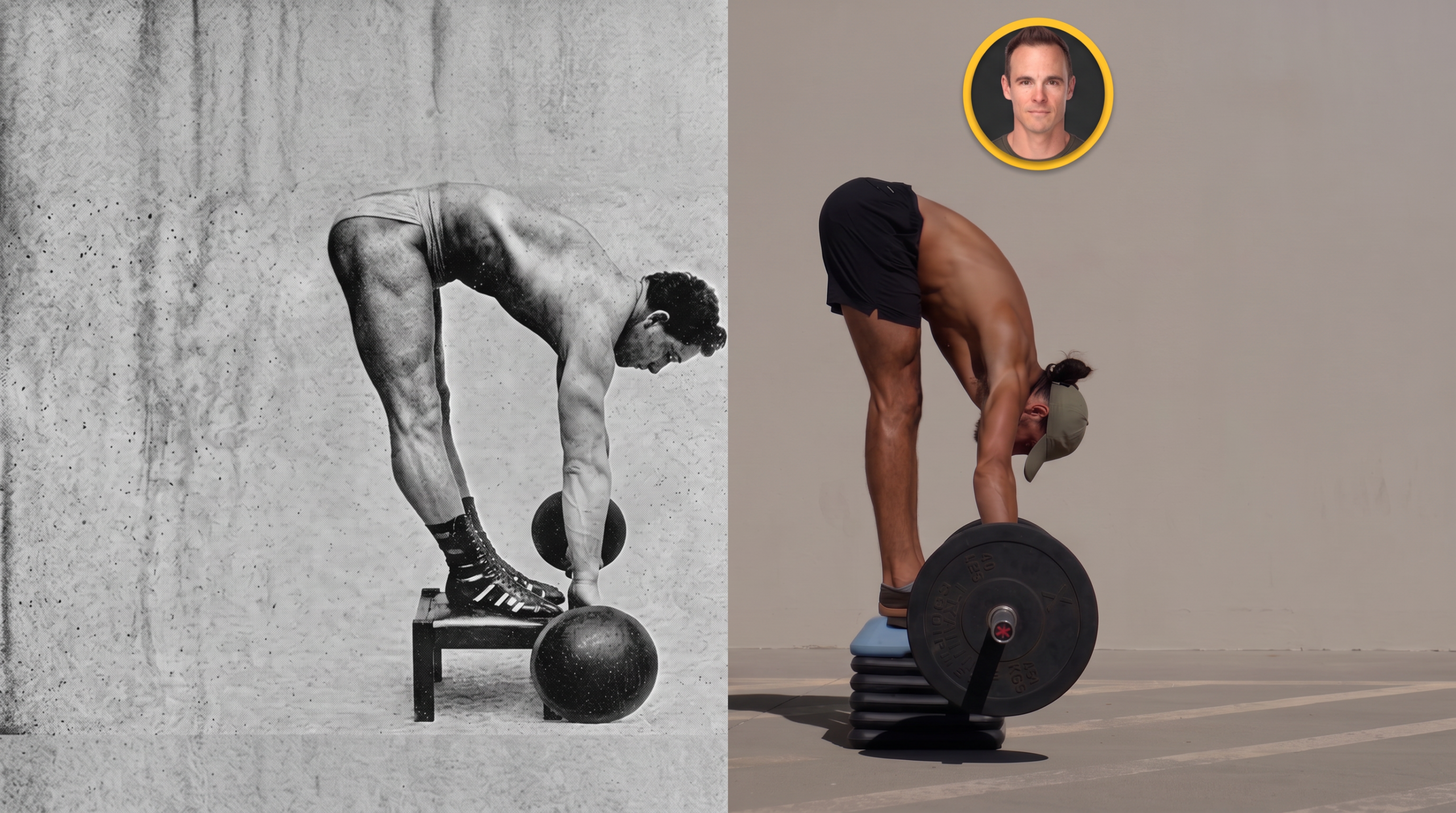
But a growing number of athletes and movement specialists are embracing forward folding—deliberately rounding through the entire spine—as a powerful tool for building resilient, adaptable bodies.
The practice isn’t new; yogis and gymnasts have relied on it for centuries, and modern research suggests they might be onto something.
Jump to:
- What Forward Folding Actually Is
- Why Powerlifters Sometimes Pay the Price
- The Jefferson Curl: Old School Meets New Science
- What Actually Happens When You Fold Forward
- The Three-Level Progression System
- Breathing: The Missing Piece
- How Much Weight Should You Actually Use?
- Who Should (and Shouldn’t) Try This
- Building Your Buffer Zone
What Forward Folding Actually Is
Forward folding differs fundamentally from the hip hinge movement most people learn first in the gym.
While hinging keeps your back straight and bends primarily at the hips, folding distributes the bend throughout your entire spine, rib cage, and hips. It’s a full-body movement that requires—and builds—mobility through every segment.
Think about picking up a toddler who’s squirming in your arms, or reaching down to grab something wedged under a piece of furniture. Life rarely gives you the perfect setup for a textbook hip hinge.
Real movement is messy, unpredictable, and often demands spinal flexion whether you like it or not.
Why Powerlifters Sometimes Pay the Price
Athletes who train exclusively with rigid spinal positioning often develop impressive strength in one narrow movement pattern—but pay for it with vulnerability everywhere else.
I was a powerlifter. I lived and died by a straight spine. I could pick up some pretty big weights. But if life ever asked me to move outside my comfort zone, play a sport, move a couch… even just sitting on the ground, I was always risking a serious back spasm.
This experience isn’t unique. When your body becomes highly adapted to one position, tissues that never experience flexion become stiff and fragile in that range.
The result? You might deadlift 500 pounds safely, but throw your back out picking up a pencil with a slightly rounded spine.
The Jefferson Curl: Old School Meets New Science
The Jefferson curl emerged in the 1800s among strongmen and gymnasts who needed mobile, resilient backs capable of handling heavy, awkward loads.
The exercise is deceptively simple: hold light weights, slowly curl your spine down vertebra by vertebra from neck to hips, then reverse the motion with control.
Olympic weightlifters have quietly used variations of loaded spinal flexion for decades. They understand that even when you intend to lift with a neutral spine, perfection is impossible under maximum loads. Building a buffer zone of strength and mobility in flexion reduces injury risk when form inevitably breaks down.
Modern gymnasts and martial artists continue this tradition, recognizing that athletic performance demands resilience in all positions, not just the “safest” ones.
What Actually Happens When You Fold Forward
The benefits extend far beyond hamstring flexibility.
Forward folding releases chronic tension in areas that plague desk workers and athletes alike: the space between shoulder blades, the lats and pecs that tighten from stress, and the mid and lower back that suffer from endless sitting.
It gives the hamstrings a break from supporting our body weight all day. But what I find more unique is that it lets go of the tension and the space between the shoulder blades or the lats and pecs that get so tight from stress and the mid and lower back from sitting in chairs all day.
The spine and rib cage must open to create space for the fold. This requirement forces movement through segments that have often been locked down for years.
Adding even minimal load begins building tissue resilience—creating structures that are both stretchable and strong, rather than just loose or just tight.
The Three-Level Progression System
Level One: Compression Fold
This bodyweight-only variation teaches the fundamental pattern without any external load.
- Place hands on thighs and create tension by pulling hands into legs
- Round your neck and upper back first, feeling core and hip flexors engage
- Continue the rounding through mid and lower back as you slide hands down legs
- Maintain inward pressure throughout the movement
- Finish in your deepest comfortable forward fold
Most people experience noticeable improvement in their fold depth after just a few reps of this drill.
Level Two: The Floss
Once you understand how to use your front-body muscles to pull yourself deeper into flexion, you’re ready to add resistance using only your own bodyweight.
- Grab the backs of your legs with bent knees (behind knees if less flexible, lower if more mobile)
- Keep spine rounded and chest close to thighs
- Slowly straighten your knees while maintaining that rounded position
- Feel the stretch travel from calves through upper back
- Perform 10 reps per set
Progress to the next level only when your lower back approaches parallel to the ground and you feel genuinely prepared—not just eager.
Level Three: Jefferson Curl
Start ridiculously light. Five-pound dumbbells in each hand is a legitimate starting point, even for strong athletes.
- Hold light weights and slowly curl spine down segment by segment
- Move the roundness intentionally from neck → upper back → mid back → low back → hips
- Actively pull weights toward ground using core and hip flexors
- Reverse the motion with equal control
- Take 10+ seconds per rep, pausing at the bottom for extended stretching
- Perform only 3-5 reps per set
One powerful variation uses a barbell held with an extremely wide grip, creating unique decompression through the upper back that’s difficult to replicate otherwise.
Breathing: The Missing Piece
Breath work transforms forward folding from mere stretching into true tissue adaptation.
Use deep, slow belly breathing throughout each rep. Focus on expanding your ribs backwards as you inhale, which creates internal pressure that supports the spine while simultaneously increasing the stretch.
This breathing pattern activates the diaphragm and deep core muscles that stabilize your spine from the inside out.
How Much Weight Should You Actually Use?
The goal isn’t progressive overload in the traditional strength-training sense.
The goal isn’t necessarily to add more weight. These days, I rarely go above what you’re seeing me do on screen, and I’ve been doing Jefferson curls for over 10 years.
Even practitioners with a decade of experience often stick with relatively light loads—perhaps 10-25 pounds total.
The stimulus comes from controlled movement through range, not from heavy resistance. You’re building neurological comfort and tissue resilience in flexion, not trying to set a one-rep max.
Who Should (and Shouldn’t) Try This
Forward folding makes sense for people seeking movement resilience and real-world durability rather than perfect technique in a controlled environment.
It’s particularly valuable for former athletes stuck in rigid movement patterns, desk workers with chronically tight backs, and anyone who’s experienced back spasms from seemingly innocuous movements.
That said, this isn’t appropriate for everyone. People with acute back injuries, herniated discs, or specific spinal conditions should consult healthcare providers before adding loaded flexion. The practice works best as injury prevention, not rehabilitation for existing damage.
Building Your Buffer Zone
Life doesn’t happen in perfect positions with ideal leverage and plenty of preparation time.
Kids need to be picked up mid-tantrum. Furniture needs moving. Objects roll under couches. Athletic competition demands split-second reactions in awkward positions.
Training only “safe” movement patterns leaves you vulnerable precisely when you need resilience most. Forward folding creates bandwidth—a buffer zone of strength and mobility that protects you when form breaks down and life gets messy.
What I found on the other side is ease of movement, confidence, never worried about injuring myself because my body was prepared.
That confidence—knowing your spine can handle flexion under load—transforms how you move through daily life.
Start conservatively with compression folds, progress slowly through the floss, and only add external load when your body genuinely feels ready. Build the practice over months and years, not days and weeks.
Your spine will thank you when life inevitably demands something other than textbook technique.