Mitochondria aren’t just powerhouses producing energy for cells—they’re also tiny communication centers that manufacture their own signaling molecules.
One of these molecules, a peptide called MOTS-c, has captured the attention of biohackers and researchers alike for its potential to mimic the metabolic effects of exercise.
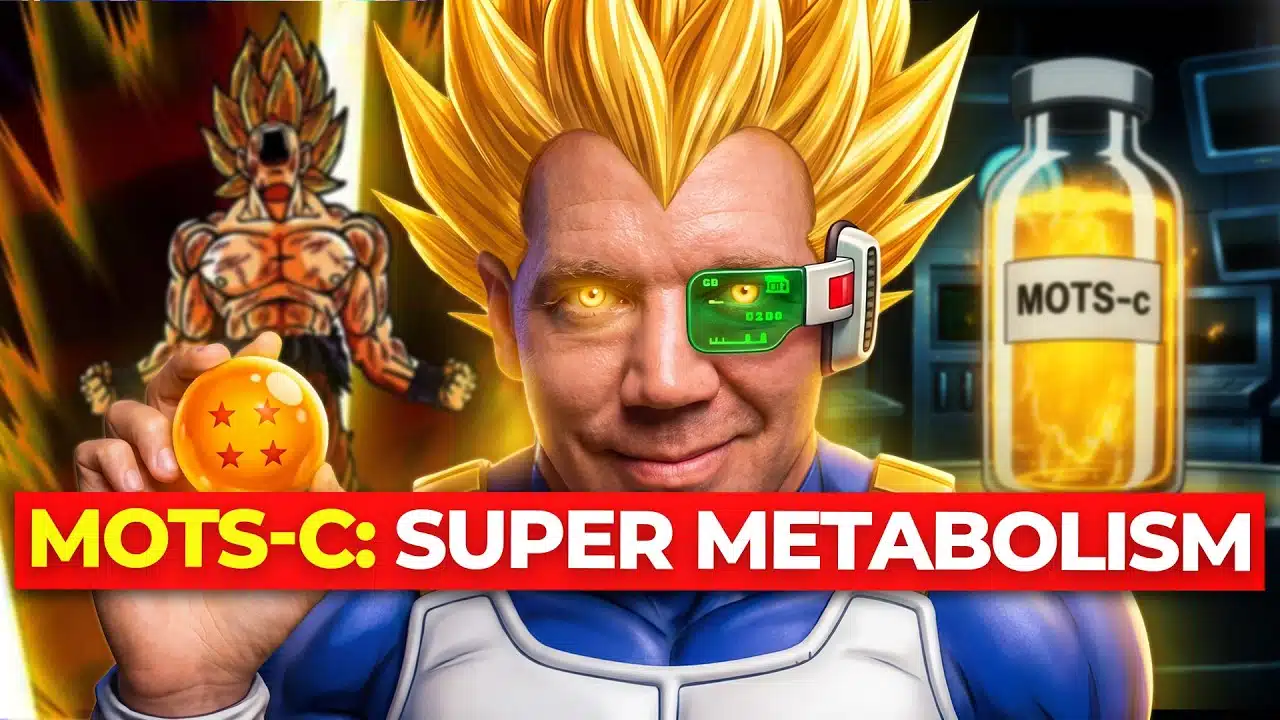
In a recent video, Dr. Alex, a board-certified urologist and men’s health specialist, explored this fascinating compound that’s encoded in mitochondrial DNA—inherited entirely from mothers—and may revolutionize how we think about metabolism and aging.
But while the science is compelling, the clinical evidence remains incomplete, leaving those interested in MOTS-c navigating a complex landscape of promising research and significant unknowns.
Jump to:
- What Makes MOTS-c Different From Other Peptides
- The Evolutionary Story Behind Mitochondria
- How MOTS-c Actually Works in the Body
- What Animal Studies Have Shown
- Human Evidence: Strong Correlations, Limited Interventions
- What Biohackers Are Actually Doing
- Current Legal and Regulatory Status
- The Bottom Line on MOTS-c
What Makes MOTS-c Different From Other Peptides
MOTS-c stands for “mitochondrial open reading frame of the 12S rRNA type c,” though most people stick with the abbreviation. This 16-amino-acid peptide represents something genuinely unusual in human biology.
Unlike most therapeutic peptides that come from nuclear DNA—the genetic material inherited from both parents—MOTS-c originates from mitochondrial DNA. This separate genome lives inside mitochondria and passes down exclusively through maternal lineage.

If you want something simple that actually works, this is one of the most effective tools I’ve used to build strength, conditioning, and endurance without needing a full gym setup.
- Full-body training with one weight using swings, squats, and presses
- Solid cast iron build that feels stable and lasts for years
- Comfortable grip that makes high-rep workouts easier to handle
MOTS-c is coded in your mitochondrial DNA, which is a completely separate genome that lives inside the mitochondria themselves and which you inherited entirely from your mother.
Researchers Dr. Changhan Lee and Dr. Pinchas Cohen at USC discovered MOTS-c in 2015. They published their findings in the journal Cell Metabolism, marking the beginning of an entirely new field: mitochondrial-derived peptides.
When the research team first injected MOTS-c into mice, the results were striking. Obese mice on high-fat diets stopped gaining weight. Insulin-resistant mice regained insulin sensitivity. Old mice began behaving metabolically like young ones.
The Evolutionary Story Behind Mitochondria
Understanding MOTS-c requires understanding where it comes from. Mitochondria themselves have a fascinating origin story.
According to endosymbiotic theory, mitochondria began as free-living bacteria approximately 2 billion years ago. One bacterium engulfed another, failed to digest it, and the two organisms eventually developed a symbiotic relationship that became the foundation of all complex life on Earth.
These organelles retain characteristics of their bacterial ancestors:
- Their own circular DNA resembling bacterial plasmids
- Bacterial-style ribosomes for protein synthesis
- Reproduction through binary fission rather than standard cell division
- Double membrane structure consistent with being engulfed cells
Each cell contains anywhere from a hundred to several thousand mitochondria, depending on energy needs. Heart muscle, liver tissue, and skeletal muscle pack them in densely.
If you want something simple that actually works, this is one of the most effective tools I’ve used to build strength, conditioning, and endurance without needing a full gym setup.
- Full-body training with one weight using swings, squats, and presses
- Solid cast iron build that feels stable and lasts for years
- Comfortable grip that makes high-rep workouts easier to handle
For decades, scientists believed mitochondrial DNA only coded for 37 genes related to energy production machinery. The discovery of MOTS-c shattered that assumption.
How MOTS-c Actually Works in the Body
MOTS-c operates through two primary mechanisms that make it particularly intriguing for metabolic health.
Retrograde Signaling to Cell Nuclei
Under conditions of stress—exercise, fasting, or low oxygen—MOTS-c leaves the mitochondria and enters the cell nucleus. There, it activates a transcription factor called NRF2, which switches on genes controlling antioxidant defense, fat oxidation, and mitochondrial biogenesis.
Mitochondrial biogenesis simply means making more mitochondria. The feedback loop works like this: stressed mitochondria send MOTS-c to command central with a message to build reinforcements and shift fuel preference from sugar to fat.
This is genuinely new biology that is barely a decade old. 20 years ago, back when I was in college as a biochem major, we didn’t think that mitochondria could talk back.
AMPK Activation Through the Folate Cycle
MOTS-c also activates AMPK, often called the master switch for cellular energy. When AMPK turns on, cells burn glucose and fat while shutting down energy-expensive processes like fat storage.
The mechanism is clever. MOTS-c inhibits an enzyme in the folate cycle, causing a metabolite called AICAR to accumulate. This buildup then activates AMPK—essentially using the folate cycle as a pull cord to start the metabolic engine.
If you want something simple that actually works, this is one of the most effective tools I’ve used to build strength, conditioning, and endurance without needing a full gym setup.
- Full-body training with one weight using swings, squats, and presses
- Solid cast iron build that feels stable and lasts for years
- Comfortable grip that makes high-rep workouts easier to handle
Even more fascinating, MOTS-c displays tissue-specific effects. In muscle tissue, it prevents atrophy by activating certain pathways. In fat tissue, it promotes fat burning by inhibiting those same pathways.
The same molecule produces opposite effects in different tissues—a unique strategy for preserving lean mass while reducing fat, independent of testosterone or other hormones.
What Animal Studies Have Shown
The preclinical data on MOTS-c is extensive and consistently impressive across multiple disease models.
In obesity research, mice fed high-fat diets while receiving MOTS-c treatment almost completely avoided diet-induced weight gain. Their food intake remained the same—no appetite suppression occurred. Instead, their basal metabolic rate increased, and more white fat converted to metabolically active brown fat that generates heat.
Additional animal studies demonstrated:
- Restored insulin sensitivity in type 2 diabetes models
- Protected pancreatic beta cells that produce insulin
- Prevented osteoporosis in bone loss models
- Reduced neuroinflammation after traumatic brain injury
- Improved outcomes in cardiomyopathy
The breadth of these effects across different organ systems suggests MOTS-c influences fundamental metabolic processes rather than targeting specific diseases.
If you want something simple that actually works, this is one of the most effective tools I’ve used to build strength, conditioning, and endurance without needing a full gym setup.
- Full-body training with one weight using swings, squats, and presses
- Solid cast iron build that feels stable and lasts for years
- Comfortable grip that makes high-rep workouts easier to handle
Human Evidence: Strong Correlations, Limited Interventions
While animal data looks compelling, human evidence tells a more complicated story.
Correlational studies show that endogenous MOTS-c levels decline with age and drop further in people with metabolic disease. A genetic variant called K14Q, found primarily in Northeast Asian populations, functionally impairs MOTS-c.
Men carrying this variant face significantly higher risk of osteosarcopenia and type 2 diabetes as they age—unless they exercise regularly. With sufficient physical activity, the metabolic disadvantage disappears entirely.
This provides elegant evidence that exercise truly functions as medicine, partially through this molecular pathway.
The One Clinical Trial That Didn’t Quite Work
Only one company has attempted formal human trials with MOTS-c. CohBar developed a stabilized analog called CB4211 and tested it in 23 obese patients with non-alcoholic fatty liver disease.
The drug successfully lowered liver enzymes ALT and AST compared to placebo. However, the primary endpoint—actual liver fat measurement—showed essentially identical results between treatment and placebo groups.
If you want something simple that actually works, this is one of the most effective tools I’ve used to build strength, conditioning, and endurance without needing a full gym setup.
- Full-body training with one weight using swings, squats, and presses
- Solid cast iron build that feels stable and lasts for years
- Comfortable grip that makes high-rep workouts easier to handle
Persistent injection site reactions plagued the trial. CohBar attempted reformulation but ran out of funding and dissolved in 2023, taking the CB4211 program with it.
No successful Phase 2 or Phase 3 trials of MOTS-c or any analog exist. The pharmaceutical development pipeline contains exactly one tombstone.
What Biohackers Are Actually Doing
Without pharmaceutical development, interest has shifted to the biohacking community. Dr. Alex emphasizes he’s reporting on current practices, not making recommendations.
What I’m about to describe is what the biohacking community is doing. This is not my recommendation. I’m not telling you to inject anything.
Common protocols circulating online involve 5-15 mg injected subcutaneously three times weekly for 8-12 weeks, followed by 4-8 weeks off. Some more aggressive approaches use 1-3 mg daily.
The reasoning: MOTS-c has a plasma half-life of only 1-2 hours, but downstream effects on gene expression last much longer. Pulsed dosing allows signaling cascades to complete without constant system stimulation.
Reported benefits include:
If you want something simple that actually works, this is one of the most effective tools I’ve used to build strength, conditioning, and endurance without needing a full gym setup.
- Full-body training with one weight using swings, squats, and presses
- Solid cast iron build that feels stable and lasts for years
- Comfortable grip that makes high-rep workouts easier to handle
- Improved cardiovascular endurance
- Faster recovery from training
- Fat loss without muscle loss during caloric deficits
Common side effects mirror those seen in the CohBar trial:
- Injection site bumps
- Heart palpitations
- Insomnia when dosed late in the day
- Paradoxical fatigue during the first week
- Hypoglycemic-like symptoms in people already fasting or following low-carb diets
No long-term human safety data exists. Zero studies have examined what daily MOTS-c does to humans over a year or longer.
Current Legal and Regulatory Status
MOTS-c occupies the same regulatory gray zone as most research peptides currently under FDA scrutiny.
The FDA’s Pharmacy Compounding Advisory Committee scheduled a hearing for July 23-24, 2026, to re-evaluate MOTS-c for compounding eligibility. The committee will review evidence for two specific indications: obesity and osteoporosis.
MOTS-c appears on day one of the hearing alongside BPC-157, KPV, and TB-500. The committee will hear testimony, review available data, and vote on a recommendation.
While the FDA typically follows committee recommendations, it’s not legally bound to do so. Even with a favorable outcome, rulemaking processes take 60-90 days minimum before licensed compounding pharmacies could legally produce MOTS-c.
If you want something simple that actually works, this is one of the most effective tools I’ve used to build strength, conditioning, and endurance without needing a full gym setup.
- Full-body training with one weight using swings, squats, and presses
- Solid cast iron build that feels stable and lasts for years
- Comfortable grip that makes high-rep workouts easier to handle
July 2026 represents a milestone, not a finish line.
Banned in Competitive Sports
The World Anti-Doping Agency added MOTS-c to its 2026 prohibited list under section S4.4. It’s banned at all times for elite athletes subject to drug testing.
For competitive athletes, MOTS-c isn’t a gray area—it’s explicitly prohibited.
The Bottom Line on MOTS-c
MOTS-c represents genuinely exciting biology. A peptide manufactured by organelles, encoded in a separate genome inherited solely from mothers, capable of entering cell nuclei and altering gene expression to mimic exercise—this isn’t hype, it’s textbook-rewriting science.
The preclinical data is broad, deep, and reproducible. Correlational human data remains consistent. The mechanism is elegant.
But only one human interventional trial exists, and it failed to meet its primary endpoint. No randomized studies demonstrate that injecting MOTS-c into healthy adults safely improves clinical outcomes over meaningful timeframes.
If you want something simple that actually works, this is one of the most effective tools I’ve used to build strength, conditioning, and endurance without needing a full gym setup.
- Full-body training with one weight using swings, squats, and presses
- Solid cast iron build that feels stable and lasts for years
- Comfortable grip that makes high-rep workouts easier to handle
Promise and proof still live in different neighborhoods, but if anecdotal reports are to be believed, this is probably one of the most exciting peptides on the modern biohacking horizon.
Without dose-response curves or safety data beyond 28 days, significant unknowns remain. Questions about potential antibody reactions with endogenous mitochondrial signaling remain unanswered.
For those considering MOTS-c, Dr. Alex recommends consulting with a physician who can provide proper monitoring. The gap between promising research and established medical therapy remains wide—and navigating it requires both curiosity and appropriate caution.