Running performance isn’t just about training miles and tempo runs.
It’s about what runners put in their bodies during those miles.
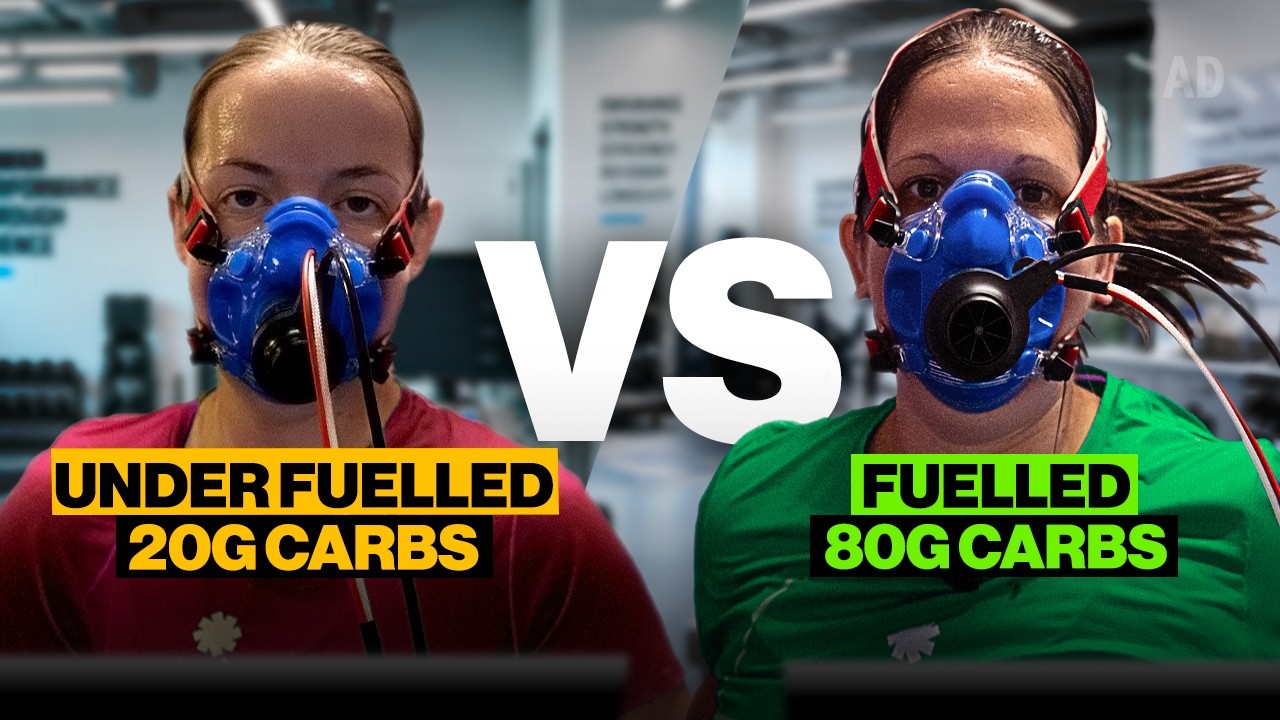
In a recent controlled experiment at Loughborough University, two runners tested dramatically different fueling strategies—20 grams versus 80 grams of carbohydrates per hour—to see exactly how carb intake affects speed, perceived effort, and race-day performance.
The results reveal why so many runners hit the wall, and what science says about fueling smarter.
Jump to:
The Experiment: Low Carbs vs. High Carbs
Two runners, Sarah and Anna, partnered with Science in Sport to conduct blinded tests on separate days. Each runner completed two identical sessions: a 2-hour run at 95% of marathon pace followed by an all-out 1-kilometer time trial.
The twist? Neither knew which fueling strategy they were following during each test.

If you want something simple that actually works, this is one of the most effective tools I’ve used to build strength, conditioning, and endurance without needing a full gym setup.
- Full-body training with one weight using swings, squats, and presses
- Solid cast iron build that feels stable and lasts for years
- Comfortable grip that makes high-rep workouts easier to handle
One test used 20 grams of carbs per hour—deliberately low to simulate under-fueling. The other used 80 grams per hour, aligning with current research recommendations for endurance running at race intensity.
We’re always told to practice our fueling and know exactly how many carbohydrates we’re putting into our bodies. So this is a really interesting test because we’re going purely off of how we physically feel.
Throughout both tests, the runners wore metabolic analyzer masks measuring oxygen consumption, carbon dioxide production, and fuel utilization. Blood samples tracked glucose and lactate levels. Researchers also recorded perceived exertion and gastrointestinal comfort.
What Happened on Low Carbs
The 20-gram strategy represented what many recreational runners accidentally do: under-fuel their long runs.
Both runners reported significantly higher perceived exertion during the steady 2-hour portion when consuming only 20 grams per hour. The same pace felt harder despite identical physical conditions and training preparation.
I’m at the point mentally and physically where the wheels are falling off.
Anna described wanting the session to end early, fantasizing about fire drills that would let her step off the treadmill. Her legs felt increasingly achy as the run progressed.
Performance data confirmed what they felt. Both runners posted slower 1-kilometer time trial results after the low-carb fueling approach.
If you want something simple that actually works, this is one of the most effective tools I’ve used to build strength, conditioning, and endurance without needing a full gym setup.
- Full-body training with one weight using swings, squats, and presses
- Solid cast iron build that feels stable and lasts for years
- Comfortable grip that makes high-rep workouts easier to handle
The High-Carb Difference
Everything changed at 80 grams per hour.
Sarah’s heart rate during the high-carb test dropped by roughly 10 beats per minute compared to her low-carb session—at the exact same pace. That’s a massive physiological difference indicating reduced cardiovascular strain.
Last week at this point, my heart rate was like 168, 169. Right now, I just gave it and it was 158.
Anna felt strong enough to consider continuing beyond the 2-hour mark when properly fueled, a stark contrast to her mental state during the low-carb trial.
Most importantly, both runners ran significantly faster in their final 1-kilometer time trial when consuming 80 grams of carbs per hour. Sarah improved by 22 seconds, Anna by 16 seconds—despite rating their perceived effort identically to the low-carb trials.
What the Data Revealed
Carbohydrate and Fat Oxidation
The metabolic analyzer masks told an important story about fuel utilization.
When fueling with 80 grams per hour, both runners maintained higher rates of carbohydrate oxidation throughout the session. Sarah’s carb burn increased from 108 to 120 grams per hour. Anna’s jumped from 67 to 85 grams per hour.
If you want something simple that actually works, this is one of the most effective tools I’ve used to build strength, conditioning, and endurance without needing a full gym setup.
- Full-body training with one weight using swings, squats, and presses
- Solid cast iron build that feels stable and lasts for years
- Comfortable grip that makes high-rep workouts easier to handle
Simultaneously, fat oxidation decreased. Sarah dropped from burning 43 grams of fat per hour to 34 grams. Anna’s fat burn fell from 43 to 35 grams per hour.
Why does this matter? Carbohydrate is a more efficient fuel source than fat, requiring less oxygen to produce the same amount of energy. During high-intensity efforts like marathon running, carb efficiency becomes critical.
Running Economy Improvements
Higher carbohydrate intake improved running economy—the oxygen cost required to maintain a given pace.
Both runners needed less oxygen to sustain their 95% marathon pace when consuming 80 grams of carbs per hour. This metabolic efficiency translates directly to performance: runners can either maintain pace with less effort, or increase pace for the same effort level.
Perceived Exertion
Carbohydrate availability doesn’t just affect muscles. It influences how hard exercise feels.
Both runners consistently reported lower ratings of perceived exertion across the 2-hour steady run when properly fueled. Maintaining carbohydrate stores helps reduce physiological and perceptual fatigue signals, making marathon pace genuinely feel easier.
If you want something simple that actually works, this is one of the most effective tools I’ve used to build strength, conditioning, and endurance without needing a full gym setup.
- Full-body training with one weight using swings, squats, and presses
- Solid cast iron build that feels stable and lasts for years
- Comfortable grip that makes high-rep workouts easier to handle
Training Your Gut
One crucial finding: neither runner experienced negative gastrointestinal symptoms at 80 grams per hour.
This challenges the common belief that high carb intake inevitably causes stomach distress. The key is practicing fueling strategies during training, not just on race day.
The gut can be trained just like the rest of our body. So by practicing your fueling during training, you can gradually increase the amount you can tolerate.
Showing up to a marathon having never practiced 80-120 grams per hour is a recipe for disaster. But gradually increasing carb intake during training runs allows the digestive system to adapt and efficiently absorb higher quantities.
The Women-Specific Factor
Female runners face unique considerations regarding carbohydrate fueling.
Elite female runners store approximately 500 grams of glycogen on average, compared to 690 grams in elite men. This difference largely reflects body size and muscle mass, not metabolic capability.
However, recent research from Science in Sport reveals that women absorb and utilize ingested carbohydrates at the exact same absolute rate as men. This means consumed carbs do proportionally more work for female runners.
If you want something simple that actually works, this is one of the most effective tools I’ve used to build strength, conditioning, and endurance without needing a full gym setup.
- Full-body training with one weight using swings, squats, and presses
- Solid cast iron build that feels stable and lasts for years
- Comfortable grip that makes high-rep workouts easier to handle
Since women have smaller starting glycogen stores and deplete them faster relative to body size, adequate carbohydrate intake during races becomes even more critical. Smaller body mass doesn’t mean scaling down fuel intake—proper fueling is essential for optimal performance.
Beyond Performance: Recovery Matters
The fueling differences extended beyond the treadmill.
The worst I felt the rest of the day. And actually, I think that’s the biggest thing that I’ve learned in marathon training is if you fuel your long runs really well, not only do you help yourself in the run, but you don’t get that like I can only exist on the sofa for the rest of the day.
Proper fueling during long runs doesn’t just prevent mid-run bonking. It dramatically improves post-run recovery, reducing that couch-bound exhaustion many runners experience after depleting glycogen stores.
Practical Fueling Recommendations
Current research supports 60-90 grams of carbohydrates per hour for endurance sessions, with some athletes tolerating up to 120 grams per hour.
Individual tolerance varies. What works depends on:
- Training adaptation: How much practice consuming carbs during running
- Exercise intensity: Higher intensities require more carbohydrate
- Duration: Longer sessions benefit more from higher intake
- Personal physiology: Carb oxidation rates differ between individuals
Using products combining glucose and fructose can help maximize absorption. These carbohydrate types use different intestinal transport pathways, allowing greater total carb uptake compared to glucose alone.
If you want something simple that actually works, this is one of the most effective tools I’ve used to build strength, conditioning, and endurance without needing a full gym setup.
- Full-body training with one weight using swings, squats, and presses
- Solid cast iron build that feels stable and lasts for years
- Comfortable grip that makes high-rep workouts easier to handle
It’s trying to keep them as full as possible without making yourself sick, basically.
Start Testing Now
The experiment demonstrates that carbohydrate intake profoundly affects running performance, effort perception, and recovery.
Runners should begin experimenting with fueling strategies during training—not waiting until race week. Gradually increase carb intake during long runs to build gut tolerance. Track how different amounts affect perceived effort, performance, and recovery.
The difference between hitting the wall and finishing strong often comes down to those 60-80 extra grams of carbohydrates consumed each hour. Train the gut, fuel appropriately, and watch race-day performance transform.