Will Tennyson was supposed to compete in ATH-X, a new functional fitness competition attracting global brand sponsorships.
Instead, he ended up coaching from the sidelines after a hamstring injury derailed his plans just days before the event.
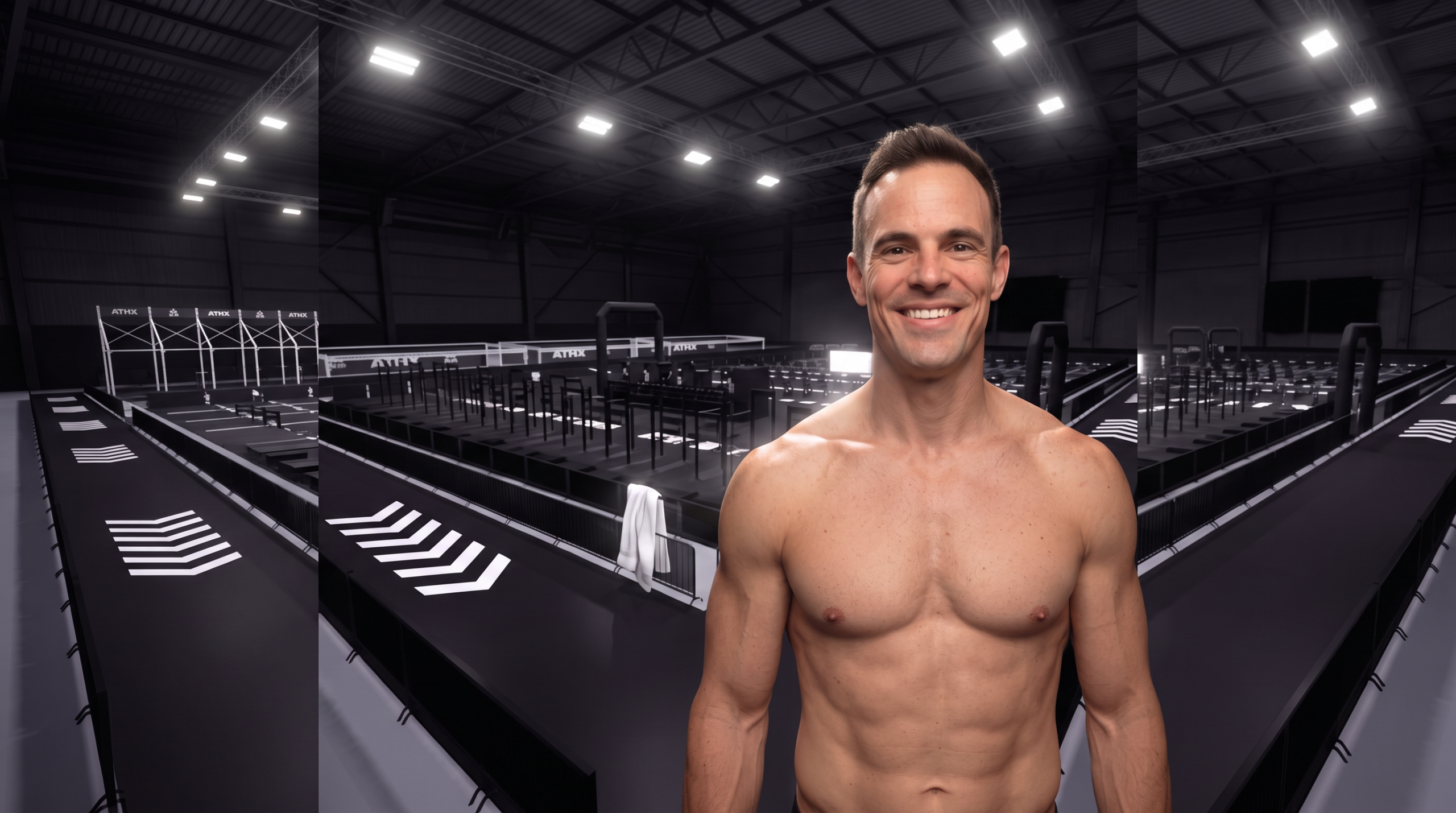
But his misfortune created an unexpected experiment: watching his training partner Ollie, a commercial gym bodybuilder with zero competitive experience, tackle the 2.5-hour format for the first time.
The result? A revealing look at whether this new middle-ground competition actually delivers on its promise to bridge CrossFit and Hyrox.
Jump to:
- When Sprinting Goes Wrong
- Enter The Rookie
- Event One: The Strength Gauntlet
- The Ten-Minute Refuel Window
- Event Two: The Aerobic Sting
- The Recovery Zone Psychology
- Event Three: The Metcon Grinder
- The Final Results
- Is ATH-X Worth The Hype?
- What Makes Someone Competition-Ready?
- The Competition Experience Factor
- The Coaching Perspective
- Would They Do It Again?
When Sprinting Goes Wrong
Tennyson’s week had started strong with running intervals that left him optimistic about his Hyrox training.
That was wicked. One step closer to Hyrox. Like the best running session I’ve ever had.
Then came the photo shoot for new hybrid shorts at a track, where despite warnings from Ollie, Tennyson decided to sprint all-out on tired hamstrings.
I’m 33, and I shouldn’t sprint full out after 40 minutes on tired hamstrings.
The result was a mild strain severe enough that attempting heavy deadlifts or double dumbbell snatches would risk worsening the injury. At this stage in his training career, Tennyson made the smart call to step back rather than push through.
Enter The Rookie
Ollie became the unlikely test subject for evaluating ATH-X. His fitness profile made him particularly interesting: capable of running 15K in under an hour (sub-20-minute 5Ks back to back), but with zero CrossFit or functional fitness competition experience.
His training consisted entirely of commercial gym bodybuilding-style work, providing a pure baseline for how someone with general strength and conditioning would fare.
Tennyson believed ATH-X occupied a sweet spot between Hyrox and CrossFit—less technical skill required than CrossFit, less running than Hyrox, more emphasis on functional fitness and raw strength.
Event One: The Strength Gauntlet
ATH-X structures its competition around three distinct stations spread over roughly 2.5 hours. Station one tests pure strength across three lifts.
Competitors get 6 minutes to establish a one-rep max strict press, followed immediately by 6 minutes for a three-rep max back squat, then 8 minutes for a five-rep max deadlift.
Total combined weight lifted determines your score. Lifting straps aren’t allowed, making grip strength a limiting factor for many athletes.
Ollie was nervous about his overhead pressing, but competition adrenaline worked its magic.
Oh, no, I won’t do any more than 60. I didn’t even press 60 in training.
He hit 65 kg on the strict press, crushing his own expectations. Then came 155 kg on the squat, again surpassing his projected numbers.
The deadlift brought perhaps the most dramatic breakthrough: Ollie had never pulled 190 kg before, let alone for five reps. Competition day delivered both.
Never pulled 190 before, just did it for five.
Tennyson observed that competing creates an energy impossible to replicate in training, pushing athletes beyond what they believe possible.
The Ten-Minute Refuel Window
Between stations, competitors get designated rest periods. After the strength event, athletes have 10 minutes in a refuel station before moving to zone two for the endurance test.
This structured timing keeps the competition moving efficiently while preventing complete recovery, testing how well athletes can perform under accumulated fatigue.
Event Two: The Aerobic Sting
The endurance station features a 22-minute AMRAP alternating between 750-meter runs and 750-meter rows. The format creates a specific metabolic challenge that sits uncomfortably between pure aerobic work and anaerobic efforts.
22 minutes is one of those not quite long enough to be really aerobic, but not quite short enough that you’re fully sending it distances. It’s right there in the middle, and it stings.
Tennyson advised Ollie to leverage his running strength by pushing harder on runs and moderating intensity on the rower, aiming for a 1:50 split (150 seconds per 500 meters).
Ollie ignored this guidance initially, coming off his first row at a 1:39 split, well above the prescribed pace.
The aggressive rowing compromised his leg freshness for subsequent running intervals, forcing him to dial back. By the second row, he’d corrected to the target pace, but the damage was done.
Despite the pacing error, Ollie’s strong aerobic base allowed him to finish well. The experience taught him the crucial competition lesson about sustainable intensity over short-term heroics.
The Recovery Zone Psychology
After the endurance event, competitors get a 30-minute recovery period before the final Metcon station. This extended break presents a mental challenge as adrenaline levels drop and fatigue sets in.
Tennyson noted the venue’s extremely loud music, comparing it unfavorably to previous Hyrox experiences where the bass was intense enough to cause palpitations.
Managing energy and mental readiness during this window becomes critical for performance on the final test.
Event Three: The Metcon Grinder
The final station tests functional capacity across varied movements within a 25-minute time cap:
- 45-calorie erg
- 30 alternating dumbbell snatches
- 30-meter sandbag carry
- 30 box jump overs
- 30-meter dual dumbbell walking lunge
- 30-meter burpee broad jumps
- 45-calorie ski
This chipper-style workout rewards athletes who can maintain steady output across diverse movement patterns without significant technical skill requirements.
ATH-X offers different weight categories—pro for advanced athletes and light for those building capacity—making the competition accessible across fitness levels.
Ollie sent the opening erg hard, embracing Tennyson’s advice to attack the final event with full commitment.
The Final Results
When the scores posted, Ollie had finished joint sixth in the ATX category at Birmingham with 48 points.
His strength dominance was evident—44 of his 48 points came from the lifting station. He actually won the endurance event outright and placed fourth in the Metcon.
For someone with zero competitive experience entering his first event, the performance validated both his training approach and ATH-X’s accessibility for traditionally trained athletes.
Is ATH-X Worth The Hype?
Tennyson’s assessment after observing the full competition day was overwhelmingly positive, particularly regarding the time structure.
I really like that it’s in a timed format. So, 2 and 1/2 hours from warm-up to finish, you’re done.
This sits between CrossFit competitions that can consume an entire day with multiple events and rest periods, and Hyrox races finished within 60-90 minutes.
The format provides enough substance to feel worthwhile without the marathon commitment required by traditional functional fitness competitions.
Who ATH-X Favors
Tennyson identified ATH-X as particularly suited to powerful, strong, fast athletes rather than pure endurance specialists.
If you’re really fit at long endurance pieces, you’re probably going to be good at the 22-minute piece anyway.
The competition lacks the extended aerobic tests that define Hyrox while avoiding the technical gymnastics and Olympic lifting skills required in CrossFit.
It occupies genuine middle ground—accessible to general gym-goers with solid strength foundations and decent conditioning, without demanding specialized skills.
The Training Block Advantage
One unexpected benefit Tennyson highlighted: ATH-X could provide a strategic deload opportunity for athletes feeling beaten up from high-skill, high-impact training.
If you took a block to just train for ATHX, removed all the kipping out, removed all the Olympic weightlifting out, removed all the long distance running out, you could have a good solid block of training and hit ATHX pretty well, and pretty healthy.
Training cycles focused on strict strength, moderate conditioning, and functional patterns without repetitive joint stress from kipping movements or heavy technical lifts could offer sustainable preparation.
This makes ATH-X appealing for athletes managing injuries or seeking variation from more demanding competition formats.
What Makes Someone Competition-Ready?
Ollie’s successful debut offers lessons about baseline requirements for ATH-X performance.
Key attributes that translated well:
- Solid compound lift numbers (150+ kg squat, 180+ kg deadlift, 60+ kg strict press)
- Ability to run 5K in under 20 minutes with repeatable efforts
- General gym conditioning from consistent training
- Mental toughness to push through discomfort
Athletes don’t need specialized functional fitness backgrounds, CrossFit experience, or ultra-endurance capacity. Traditional strength training combined with moderate cardiovascular fitness provides adequate preparation.
The Competition Experience Factor
Both Tennyson and Ollie emphasized how competition unlocks performance beyond what training produces.
Ollie exceeded his training maxes across every lift in the strength event, ran harder than typical training paces, and discovered reserves he didn’t know existed.
That’s what I planned. Well, it’s always good when the plan happens early, isn’t it?
The structured environment, other competitors, spectators, and time pressure create physiological and psychological conditions impossible to replicate in regular training sessions.
This validates using competitions as testing grounds and breakthrough opportunities rather than only entering when perfectly prepared.
The Coaching Perspective
Tennyson found unexpected satisfaction in coaching rather than competing, despite initial disappointment about his hamstring injury.
I ACTUALLY QUITE LIKE BEING A COACH.
Watching Ollie navigate first-competition nerves, make pacing errors, learn real-time lessons, and ultimately succeed provided satisfaction distinct from personal performance.
The experience also highlighted coaching challenges—particularly when athletes ignore advice during competition intensity, as Ollie did with his rowing pace.
Would They Do It Again?
Both answered definitively yes. Ollie caught what Tennyson called “the bug”—that post-competition reflection on what could be improved, the desire to return and perform better.
It’s that bug, isn’t it? It’s like, “Oh, I could have done that a bit better.”
Tennyson committed to competing in the pro pairs category in Liverpool just one month later, the day after returning from America—questionable timing he acknowledged, but evidence of genuine enthusiasm for the format.
His final verdict: thumbs up, with the caveat that preference for competition formats remains highly individual based on what aspects of fitness athletes value and enjoy testing.